Shenzhen Airlines to Link Nanning and Hong Kong from 31 July
The Star Alliance carrier will fly three weekly Boeing 737-800 rotations between Nanning Wuxu and Hong Kong International from 31 July 2026, giving the Guangxi capital a direct link to Hong Kong's intercontinental hub.
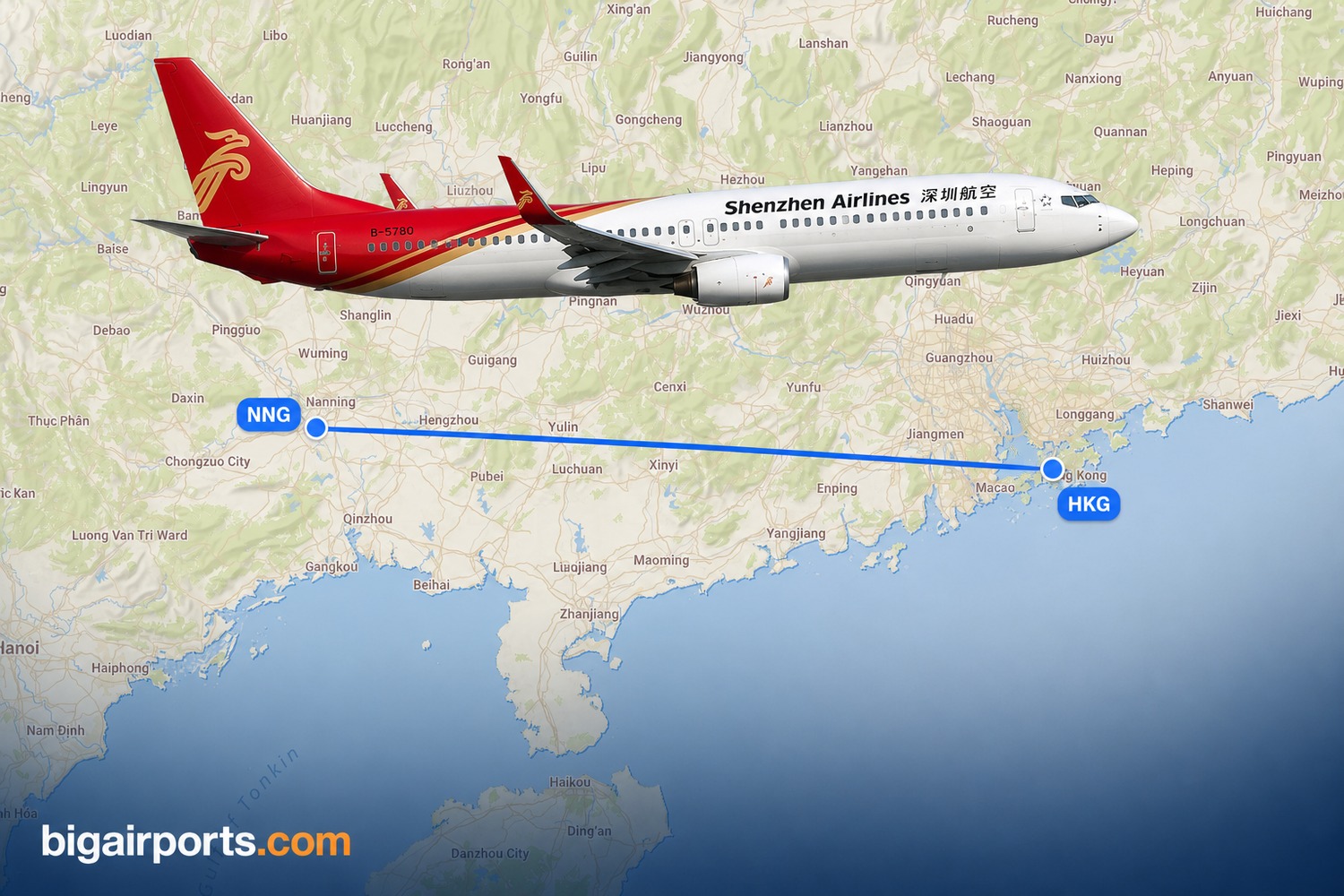
Shenzhen Airlines will open a nonstop service between Nanning and Hong Kong on 31 July 2026, operating three weekly rotations with the Boeing 737-800. The Star Alliance carrier has scheduled the flights for Wednesdays, Fridays and Saturdays, according to listings first reported by AeroRoutes, giving the capital of Guangxi a direct connection to one of Asia’s principal intercontinental gateways.
- Airline
- Shenzhen Airlines (ZH)
- Route
- Nanning (NNG) to Hong Kong (HKG)
- Aircraft
- Boeing 737-800
- Frequency
- 3x weekly (Wed/Fri/Sat)
- First flight
- 31 July 2026
Route overview
The sector between Nanning Wuxu International Airport and Hong Kong International Airport covers around 585 kilometres, a block of little more than an hour in the air. Despite the short distance, this is a cross-border operation between the Chinese mainland and the Hong Kong Special Administrative Region, handled through international facilities and subject to full immigration and customs formalities at both ends. In network-planning terms it behaves more like a regional international route than a domestic hop.
The service appears in the carrier’s northern summer 2026 schedule filing, and the Wednesday, Friday and Saturday pattern suggests a mixed brief: mid-week departures aimed at corporate and government traffic moving between Guangxi and Hong Kong, and weekend rotations serving leisure and family travel. With a two-class Boeing 737-800, the schedule will place roughly 500 seats per direction each week on the pair, a cautious opening allocation that leaves room to add frequencies if demand firms up.
Shenzhen Airlines’ network position
Shenzhen Airlines, majority-owned by Air China and a Star Alliance member since 2012, operates one of the largest narrowbody fleets in China from its base at Shenzhen Bao’an International Airport. The carrier flies an extensive domestic trunk and regional network, supplemented by short-haul international services around East and Southeast Asia, and maintains branch operations in Nanning that station aircraft and crews in the Guangxi capital. That local presence makes it the natural operator to develop capacity from the city, and it gives the airline established ground handling, crewing and maintenance support at the origin from day one.
The new service extends the airline’s reach within the Greater Bay Area beyond its home catchment across the border in Shenzhen. Chinese travel trade outlets TTG China and TTG BTmice reported the 31 July start date earlier this month.
About the aircraft
The Boeing 737-800 assigned to the route is the backbone of the Shenzhen Airlines fleet. A member of Boeing’s Next-Generation 737 family powered by CFM56-7B engines, the type is typically configured by Chinese carriers with around 160 to 170 seats in a two-class layout, pairing a small business cabin with a dense economy section. Its range of more than 5,000 kilometres far exceeds the demands of a sector under 600 kilometres, and that is precisely the point: the aircraft can rotate through Nanning-Hong Kong and onwards into the carrier’s domestic network without penalty, keeping utilisation high. Short sectors of this kind reward the type’s quick turnaround times, and its ubiquity across the fleet gives schedulers the flexibility to swap airframes without affecting capacity.
The airports at each end
Nanning Wuxu International Airport serves the capital of the Guangxi Zhuang Autonomous Region and offers 83 nonstop routes, according to bigairports.com tracking. Its network is overwhelmingly domestic. The busiest links by tracked flights are Beijing Capital with 71, followed by Nanjing, Shanghai Pudong and Xi’an on 64 each, with Beijing Daxing, Hangzhou, Chengdu Tianfu and Zhengzhou close behind. Bangkok is the only international destination among its fifteen busiest links, which underlines how thin the airport’s cross-border offering remains and how much headroom a Hong Kong service enjoys. The city itself is positioned as China’s commercial gateway to Southeast Asia and hosts the annual China-ASEAN Expo, generating steady official and trade traffic.
Hong Kong International operates at a different scale, with 185 nonstop routes in the same dataset. Taipei Taoyuan leads on 498 tracked flights, ahead of Anchorage on 366 and Bangkok on 355; the Anchorage figure reflects Hong Kong’s standing as one of the world’s largest air cargo hubs rather than passenger demand. Seoul Incheon is served by fifteen separate operators and Tokyo Narita by ten, a measure of the competitive depth on offer. For passengers originating in Nanning, the new link opens that long-haul schedule to Europe, North America and Australasia with a single connection.
Market context and competition
The route’s strongest competitor is not another airline but high-speed rail. Direct trains link Nanning East with Hong Kong West Kowloon in around four hours, terminal to terminal, and rail holds a structural advantage for point-to-point travellers heading downtown. The aircraft’s case rests on connecting traffic: passengers bound for Hong Kong’s intercontinental departures can check baggage through and clear formalities once, an option rail cannot match.
Current tracking shows no significant existing air capacity between the two airports; neither features among the other’s fifteen busiest links. That hands Shenzhen Airlines a clean start on the origin-and-destination market, with the usual caveat attached to thin cross-border routes: three weekly frequencies limit the product’s appeal to time-sensitive business travellers who need same-day flexibility, and the service’s staying power will depend on how effectively it feeds, and is fed by, connections at Hong Kong. The city’s home carriers have concentrated their mainland flying on trunk markets such as Shanghai Pudong, with 300 tracked flights, and Beijing Capital on 197, leaving secondary mainland points to be contested by mainland operators or conceded to rail. From 31 July, Nanning moves from the second category into the first. Whether the route builds towards a daily operation will be the measure to watch through the winter season.
Sources & references (3)
Generated with editorial oversight from AI research.