Flynas Links Riyadh and Alexandria with Three-Weekly A320 Service
Saudi low-cost carrier Flynas began direct flights between King Khalid International and Alexandria on 6 July 2026, becoming the sole nonstop operator on the city pair with three weekly Airbus A320 rotations.
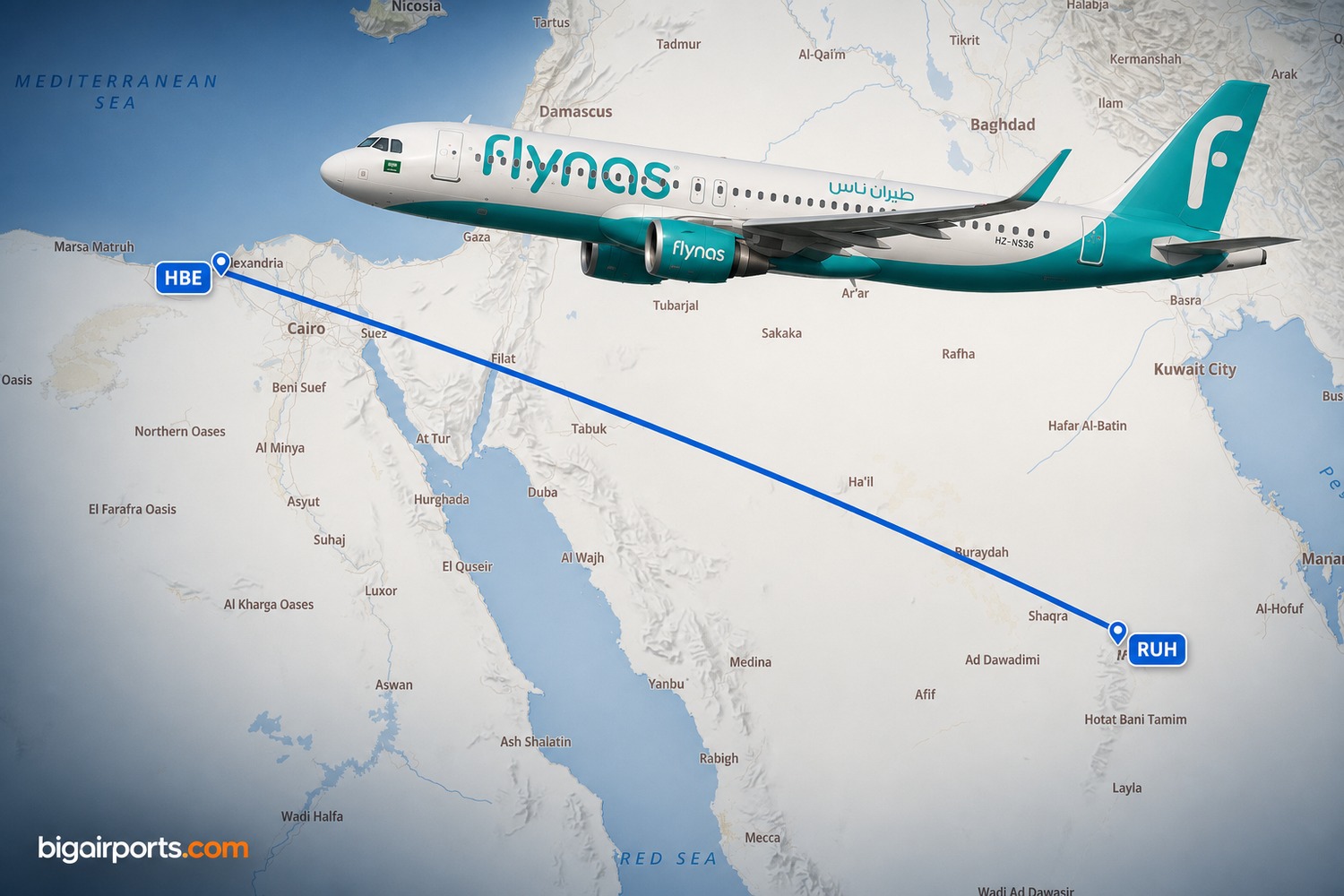
Flynas launched scheduled services between Riyadh and Alexandria on 6 July 2026, giving the Saudi capital its first nonstop link to Egypt’s second city. The Saudi low-cost carrier operates the sector three times weekly with Airbus A320 narrowbody equipment and is currently the only airline flying the city pair direct.
- Airline
- Flynas (XY)
- Route
- Riyadh (RUH) to Alexandria (HBE)
- Aircraft
- Airbus A320
- Frequency
- 3x weekly
- First flight
- 6 July 2026
Route overview
The new service connects King Khalid International Airport in Riyadh with Alexandria International Airport on Egypt’s Mediterranean coast, a great-circle sector of roughly 1,800 kilometres with block times of around three hours. That places the route firmly in standard narrowbody territory for a Gulf low-cost operator, alongside the dense web of services between Saudi Arabia and Egypt already flown by carriers on both sides of the Red Sea.
Flynas announced the route through its media centre ahead of launch, and the inaugural flight operated as planned on 6 July. At three rotations per week on A320 equipment, the schedule adds roughly 500 seats per direction each week to a city pair that previously had no scheduled nonstop service, based on the single-class layouts typical of the carrier’s narrowbody fleet. Tickets are sold through the airline’s usual direct and agency channels, and the route joins the summer 2026 programme rather than being flagged as a seasonal operation.
Flynas network context
Founded in 2007 and headquartered in Riyadh, Flynas is Saudi Arabia’s leading low-cost carrier, operating an all-Airbus fleet from bases in Riyadh, Jeddah and Dammam to more than 70 domestic and international destinations. Egypt is long-established territory for the airline, which already connects its Saudi bases with Cairo and other Egyptian points, so Alexandria extends an existing country market rather than opening a new one.
In its launch communication the carrier framed the route as part of its wider international expansion and its contribution to Saudi Arabia’s National Civil Aviation Strategy, which targets links to 250 destinations and 330 million passengers a year by 2030. Riyadh is central to that push. The capital is the focus of state-led efforts to grow inbound tourism, business traffic and event-driven demand, and Flynas has steadily added both domestic frequencies and international spokes from its home hub in support of those goals. The airline also completed an initial public offering on the Saudi Exchange in 2025, strengthening its balance sheet ahead of a period of planned fleet and network growth.
About the aircraft
The Airbus A320 assigned to the route is the workhorse of the Flynas operation. In the single-class configurations favoured by low-cost operators the type seats around 170 passengers, and current-generation examples offer a range comfortably beyond 5,500 kilometres, so the three-hour sector to Alexandria sits well inside the aircraft’s capability with a full payload.
Flynas operates a mix of A320ceo and A320neo variants and has committed to substantial fleet growth, including a 2024 order covering additional A320neo-family narrowbodies alongside the carrier’s first widebody type, the A330-900. For a three-weekly regional service of this length, the A320 lets the airline match capacity to demand while keeping trip costs low, the standard approach for opening thinner international city pairs.
Riyadh and Alexandria: the two airports
King Khalid International is one of the region’s major hubs. Current bigairports.com schedule data shows 137 nonstop destinations served from Riyadh, led by the domestic trunk to Jeddah, which records around 910 flights across four operators in the current period. Cairo is Riyadh’s busiest Egyptian link, with eight operators and 271 flights, followed by high-frequency regional connections to Dubai, Dammam, Abha and Medina. The airport’s long-haul portfolio includes London Heathrow, served by five operators, and its schedule mixes dense domestic trunk routes with a widening spread of international spokes across the Gulf, South Asia and Europe.
Alexandria International presents a very different profile. The airport shows just 10 nonstop routes in current data, oriented almost entirely towards the Gulf and North Africa. Jeddah stands out with four operators on the sector, while Dubai, Sharjah, Abu Dhabi, Kuwait City and Istanbul are each served by a single carrier. A cluster of Libyan links to Tripoli, Misrata and Benghazi reflects Alexandria’s role as a gateway for traffic into Libya. The Flynas service makes Riyadh the airport’s second Saudi destination after Jeddah, and its first direct connection to the Saudi capital.
Market context and competition
Flynas enters the market as the sole nonstop operator on the Riyadh to Alexandria pair. Until now, passengers travelling between the two cities have relied on one-stop itineraries, most obviously over Cairo, where eight operators compete on the Riyadh sector, or over Jeddah, which carries the bulk of Alexandria’s existing Saudi traffic across its four competing carriers.
Saudi Arabia and Egypt form one of the largest bilateral air travel markets in the Middle East, underpinned by a substantial Egyptian expatriate workforce in the kingdom, steady visiting-friends-and-relatives demand and year-round religious travel to Mecca and Medina. Alexandria, a metropolitan area of several million people, has historically been underserved relative to that demand base, with most of its regional connectivity routed through Cairo, some 180 kilometres to the south-east. The city’s Mediterranean location also gives the route a leisure dimension in summer, when Egypt’s north coast draws holiday traffic from across the Gulf.
For now, the launch gives Alexandria its first nonstop link to Riyadh and removes a connection from journeys that previously required a stop in Cairo or Jeddah. Flynas has announced no capacity beyond the three-weekly schedule that began on 6 July, and no other carrier has published plans to serve the pair.
Sources & references (5)
Generated with editorial oversight from AI research.