Flynas to Launch Riyadh–Kochi A320neo Service in September 2026
The Saudi low-cost carrier will link King Khalid International and Cochin International three times weekly with the Airbus A320neo from 1 September 2026, opening a city pair currently served only via Gulf hubs.
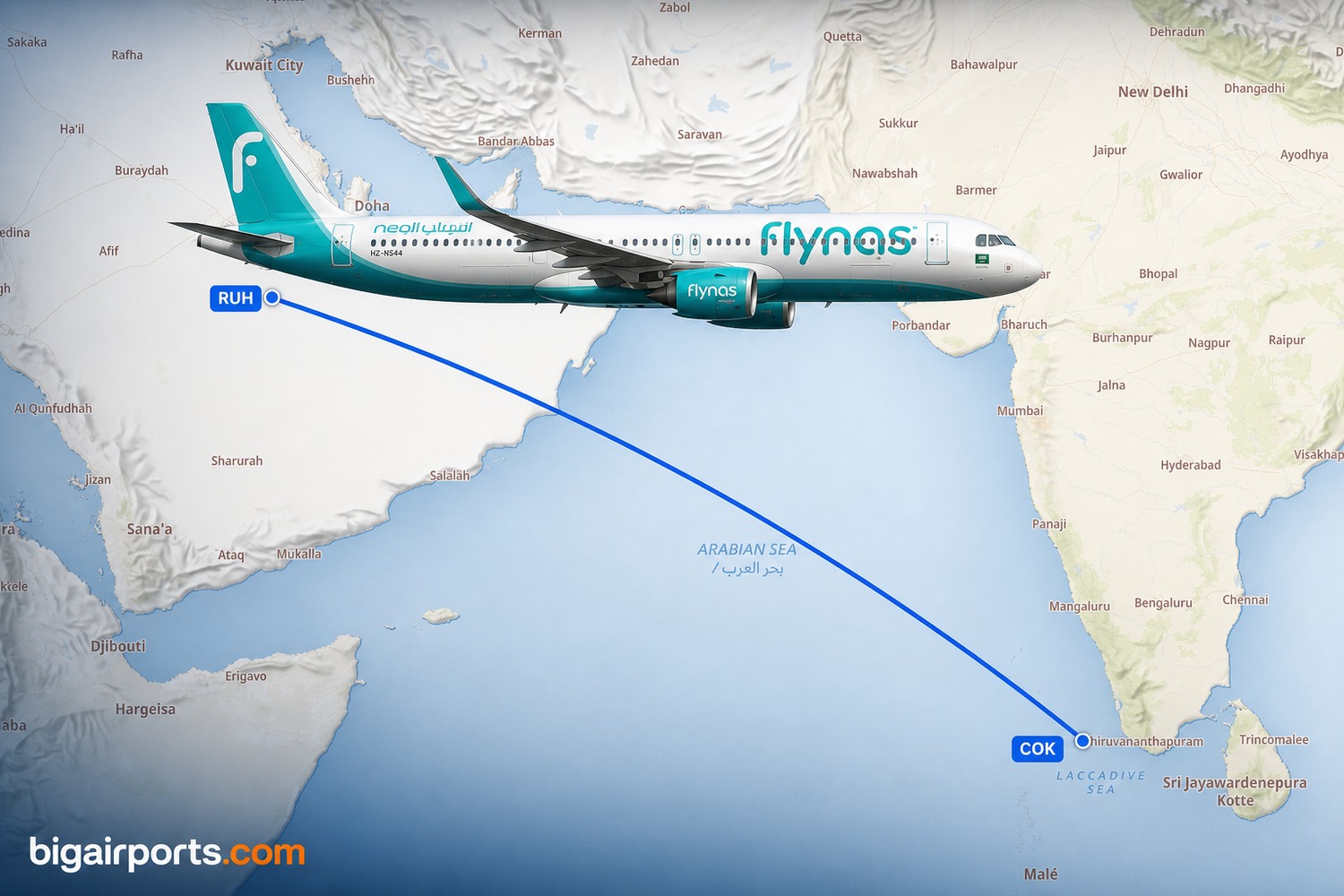
Flynas will open a nonstop link between Riyadh and Kochi on 1 September 2026, deploying an Airbus A320neo on a three-times-weekly rotation. The Saudi low-cost carrier announced the route through its media centre, and the schedule was subsequently filed for sale, as first reported by AeroRoutes.
- Airline
- Flynas (XY/KNE)
- Route
- Riyadh (RUH) to Kochi (COK)
- Aircraft
- Airbus A320neo
- Frequency
- 3x weekly
- First flight
- 1 Sep 2026
Route overview
The new service connects King Khalid International Airport, the carrier’s home base in the Saudi capital, with Cochin International Airport in the southern Indian state of Kerala. The sector covers roughly 3,500 kilometres, a routine assignment for a current-generation narrowbody, and will be flown three times weekly in each direction, implying a scheduled block time in the region of four and a half hours. Flights are on sale through the airline’s website, mobile application and sales offices, with the first departure scheduled for 1 September 2026.
Neither airport currently appears in the other’s schedule, according to bigairports.com data, which lists no nonstop operator on the city pair. The launch therefore establishes direct connectivity on an origin-and-destination market that presently depends on one-stop routings over Gulf hubs.
Airline network context
Flynas, which holds the IATA code XY and ICAO code KNE, is Saudi Arabia’s low-cost carrier and operates an all-Airbus narrowbody fleet from bases led by Riyadh and Jeddah. International growth sits at the centre of its strategy, in step with Saudi Arabia’s national aviation programme, which aims to expand the kingdom’s air connectivity substantially by the end of the decade.
India is a core component of that push. The country supplies one of the largest expatriate workforces in Saudi Arabia, and traffic between the two markets is dominated by labour and visiting-friends-and-relatives demand, segments that are structurally price-sensitive and therefore well matched to the low-cost model. Kochi gives the airline a scheduled presence in Kerala, the Indian state most closely tied to Gulf employment flows. The carrier framed the launch as part of its wider international expansion in the announcement published through its media centre, and the route slots into a Riyadh operation that already links the capital with points across the Gulf, the Levant, Egypt and South Asia.
About the aircraft
The route will be flown by the Airbus A320neo, the re-engined variant of Airbus’s narrowbody family. Powered by either CFM LEAP-1A or Pratt & Whitney PW1100G engines, the type delivers 15 to 20 per cent lower fuel burn per seat than the previous-generation A320ceo, together with a reduced noise footprint. Its range of around 6,300 kilometres leaves a comfortable margin on the 3,500-kilometre Riyadh-Kochi sector.
Typical A320neo configurations seat 160 to 186 passengers depending on layout and class mix, which at three weekly rotations places the route’s capacity at up to roughly 550 seats per week in each direction. Those economics have made the type the standard tool for medium-density international sectors in the four-to-five-hour band, which is precisely the profile of this route: long enough to defeat regional equipment, thin enough at launch frequency that widebody capacity would be difficult to sustain.
The airports
King Khalid International serves 134 nonstop routes, according to bigairports.com schedule data. Its busiest links are regional trunks: Dubai leads with 924 flights across six operators, narrowly ahead of Jeddah on 908 flights, while the domestic network takes in Dammam, Medina, Abha, Tabuk, Ta’if, Gizan and Najran. Cairo stands out for carrier depth, with nine operators active on the sector, and London Heathrow anchors the long-haul schedule with five operators and 146 flights. Kochi does not currently feature anywhere on the airport’s route map.
Cochin International, India’s first greenfield airport delivered under a public-private partnership, serves 34 nonstop routes, with a network weighted heavily towards the Gulf. Dubai is its largest international link, with 285 flights across six operators, followed by Abu Dhabi, Doha, Kuwait City, Muscat and Sharjah. Domestically, Bangalore, Mumbai and New Delhi lead the schedule, with Hyderabad, Chennai and Pune also served. Saudi Arabia is currently represented only by Jeddah, served by two operators with 20 flights, which makes Riyadh the airport’s second Saudi destination when the Flynas service begins.
Market context and competition
No airline currently operates nonstop between Riyadh and Kochi, so traffic on the pair moves over intermediate hubs. The two airports share several connecting points, among them Dubai, Abu Dhabi, Doha and Sharjah, and the Gulf network carriers and their low-cost affiliates are the incumbents on this flow. Dubai illustrates the scale of that intermediated market: it is simultaneously Riyadh’s busiest link, at 924 flights, and Kochi’s largest international connection, at 285 flights, in the bigairports.com data. At launch, Flynas will hold a nonstop monopoly on the city pair, competing against those one-stop itineraries on total journey time rather than against another direct operator.
The underlying demand base is well established. Kerala maintains one of India’s largest expatriate communities in the Gulf region, including Saudi Arabia, generating consistent year-round labour and VFR traffic alongside steady remittance-driven travel. On the Saudi side, Riyadh’s role as the kingdom’s administrative and commercial centre concentrates employment demand that has until now been served indirectly.
A three-times-weekly frequency represents a measured entry rather than a saturation play, and it broadens choice in a Kochi-Saudi market where nonstop capacity has so far been confined to the Jeddah sector. For King Khalid International, the service adds a new South Indian spoke to a network of 134 routes that already spans domestic trunks, dense Gulf shuttles and long-haul operations; for Cochin International, it deepens a Gulf-facing route map that accounts for the bulk of its international flying. The first rotation is scheduled for 1 September 2026.
Sources & references (3)
Generated with editorial oversight from AI research.