Flynas to Launch Twice-Weekly Medina–Brussels Service in October
The Saudi low-cost carrier will connect Prince Mohammad Bin Abdulaziz Airport with Brussels Airport from 5 October 2026, operating two weekly rotations on a city pair with no existing nonstop service.
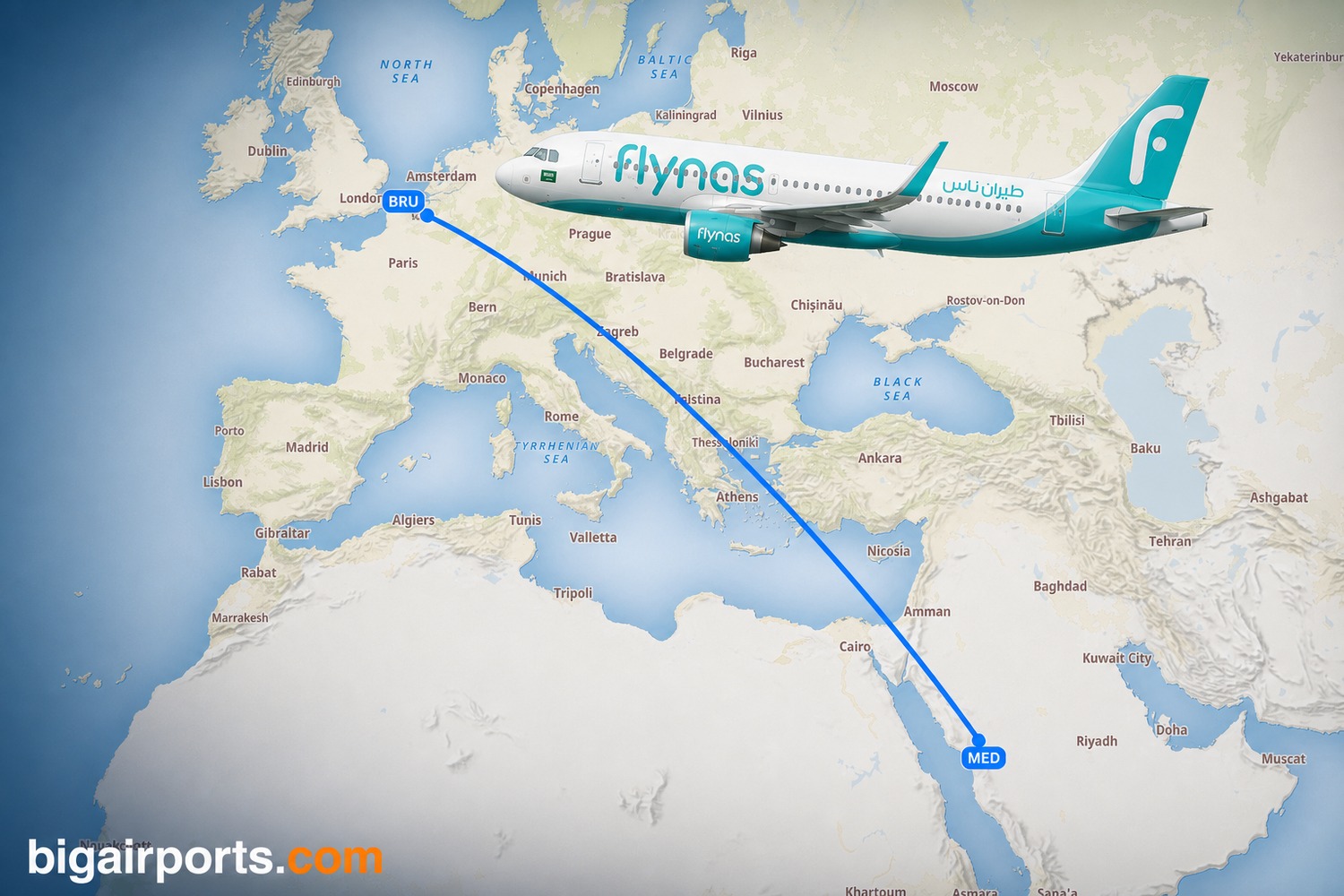
Saudi low-cost carrier Flynas will open a twice-weekly service between Medina and Brussels on 5 October 2026, its first scheduled route to Belgium. The carrier will fly the sector on Mondays and Wednesdays, linking Prince Mohammad Bin Abdulaziz Airport with Brussels Airport from the start of the northern winter 2026/27 schedule. The launch gives the airline its first scheduled presence in the Benelux region and adds a new Middle East spoke to the Belgian hub’s network.
- Airline
- Flynas (XY/KNE)
- Route
- Medina (MED) – Brussels (BRU)
- Frequency
- Twice weekly (Mon/Wed)
- First flight
- 5 October 2026
- Aircraft
- Not yet announced
Route overview
The service spans a great-circle distance of approximately 4,200 kilometres (2,270 nautical miles), a firmly medium-haul sector at the longer end of typical narrowbody scheduling; block times on comparable sectors run to around six hours. Flynas has not yet published departure and arrival timings, and weekly seat capacity will depend on the aircraft assigned. The route was first listed by AeroRoutes on 11 August 2026 and has since been picked up by trade outlets in the Gulf and Europe.
The Monday and Wednesday pattern gives the city pair two rotations per week from launch. The start date aligns with the beginning of the northern winter 2026/27 season, a common entry point for new medium-haul leisure and religious-travel routes. The practical effect for passengers is straightforward: a market that today offers no nonstop option in either direction gains a direct air link.
Flynas builds out its international network
Flynas, headquartered in Riyadh and operating under the codes XY and KNE, is Saudi Arabia’s largest low-cost carrier. Over recent years it has converted a largely domestic operation into an international network spanning the Middle East, Africa, Asia and Europe, and it listed on the Saudi Exchange in 2025 with international growth central to its investment case.
That growth is aligned with the Saudi Aviation Strategy, which targets 330 million air passengers a year by 2030 and encourages direct capacity into the kingdom’s religious gateways. Medina has become one of the carrier’s principal international bases alongside Riyadh, Jeddah and Dammam, with inbound demand dominated by Umrah traffic that runs year-round rather than peaking only around the Hajj.
Brussels extends the airline’s reach into north-west Europe, a catchment it has so far served only over intermediate connecting points. For pilgrims originating in Belgium, a nonstop service into Medina removes both a hub transfer and, on many itineraries, an overland leg from Jeddah.
Fleet and aircraft assignment
Flynas has not yet announced the aircraft type for Brussels. The carrier operates an all-Airbus fleet built around the A320 family, including current-generation A320neo and A321neo variants, and the roughly 4,200-kilometre sector sits within the capability of those types with a full load.
The airline also holds a 2024 order for Airbus A330neo widebodies to support longer-haul flying, although narrowbodies remain the workhorse of its international network, and it has previously supplemented its own fleet with leased capacity during Hajj peaks. Until an aircraft type is loaded into distribution systems, weekly seat counts on the route cannot be calculated; on A320-family equipment, two weekly rotations would represent a measured, capacity-light entry into the market.
Medina and Brussels: the two airports
Prince Mohammad Bin Abdulaziz Airport serves 130 nonstop routes in current network data, weighted heavily towards short-haul flying within the Gulf and the wider Middle East. Riyadh is the busiest corridor with 504 tracked flights across three operators, followed by Cairo with 354 flights across five operators, then Jeddah (246), Dammam (193), Istanbul (165) and Kuwait City (133). The data also records thin or restarting services to Damascus, Kabul and Kandahar, evidence of a catchment that stretches across religious-travel markets well beyond the Gulf. European destinations are absent from the airport’s busiest routes, which makes Brussels a notable addition to its long-range map.
Brussels Airport operates at a different scale, with 207 nonstop routes concentrated on intra-European flying. Amsterdam is its highest-frequency link with 1,867 tracked flights, ahead of Madrid with 1,357 flights across ten operators and Barcelona with 1,258. Spanish and Mediterranean leisure destinations, including Malaga, Alicante, Palma de Mallorca and Tenerife, account for much of the remaining volume, while London Heathrow shows 85 tracked flights across two operators. Among the airport’s busiest routes, long-haul service towards the Gulf region currently appears only via Doha, served by a single operator with 68 tracked flights, so the Flynas service adds a rare additional long-haul spoke towards the Middle East.
Market context and competition
There is no existing nonstop service between Belgium and Medina, and no direct competitor is expected on the city pair at launch. Passengers travelling between the two cities today rely on one-stop itineraries, most commonly over Istanbul, the Gulf hubs or Cairo. The Medina network data underlines that pattern: Istanbul is served by four operators from the Saudi city and Cairo by five, reflecting the connecting traffic that feeds the holy cities from Europe and North Africa.
On the Belgian side, demand rests on a sizeable Umrah and Hajj travel market for which Medina is typically the first or final stop of a pilgrimage itinerary. A nonstop flight removes several hours of connecting time in each direction compared with hub routings and gives travel organisers a scheduled direct option for group bookings. Brussels Airport’s catchment also extends into northern France, the Netherlands and western Germany, widening the pool of potential traffic beyond Belgium itself.
At two weekly frequencies, the operation is modest next to the multiple daily connecting departures available over Istanbul and the Gulf, and the schedule points to leisure and pilgrimage traffic rather than time-sensitive business travel. Flynas has not detailed wider European plans beyond the routes already announced, and Brussels will operate as its sole Belgian point from 5 October 2026.
Sources & references (4)
Generated with editorial oversight from AI research.