Oman Air Resumes Muscat-Singapore Service with Boeing 737 MAX 8
The Omani flag carrier returned to Changi on 2 July 2026 after a nine-year absence, flying four weekly Boeing 737 MAX 8 rotations on its longest narrowbody sector.
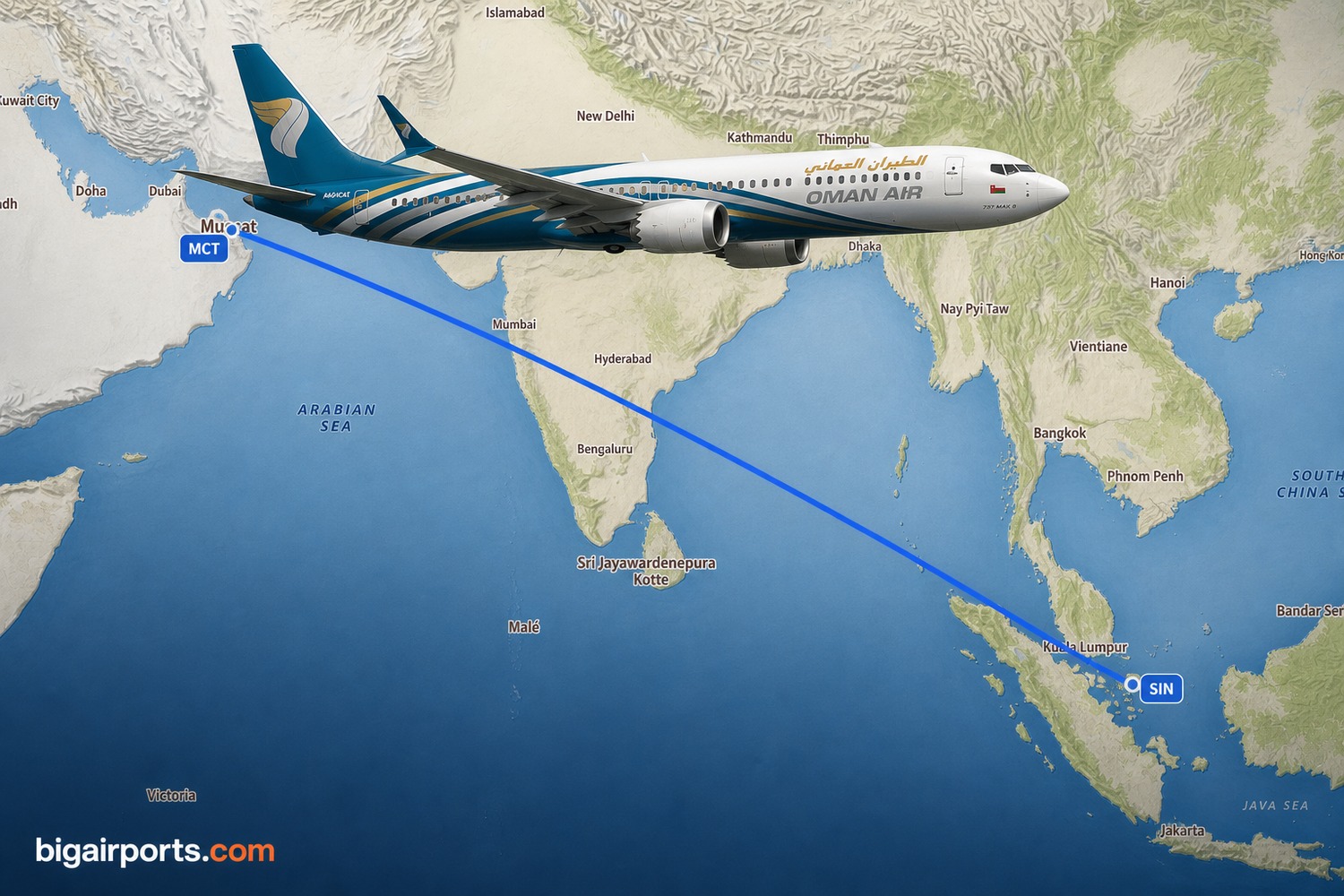
Oman Air returned to Singapore on 2 July 2026, restoring nonstop service between Muscat and Changi after an absence of nine years. The Omani flag carrier operates the route four times weekly with the Boeing 737 MAX 8, and the sector now ranks as the longest flown by a narrowbody aircraft anywhere in its network.
- Airline
- Oman Air (WY)
- Route
- Muscat (MCT) to Singapore (SIN)
- Aircraft
- Boeing 737 MAX 8
- Frequency
- Four weekly
- First flight
- 2 July 2026
Route overview
The service links Muscat International Airport with Singapore Changi Airport across a great-circle distance of roughly 5,500 kilometres, or close to 3,000 nautical miles, giving block times in the region of seven hours. FlightGlobal reports that this makes it the longest narrowbody flight Oman Air has ever operated, and one of the longer scheduled 737 MAX 8 sectors flown by any carrier in the region.
The airline withdrew from Singapore in 2017, and the city pair has been without nonstop service since, a gap Aviation Week puts at nine years. Aviation Week also frames the return as part of a wider recalibration of the carrier’s eastern network rather than a one-off addition. With 162 seats on each departure, the four weekly rotations restore 648 weekly seats per direction to a market that has otherwise depended on one-stop connections. None of the launch reporting points to additional frequencies or a widebody upgrade at this stage, and Oman Air has published no schedule changes beyond the four-weekly pattern.
Oman Air’s network position
Singapore is a rare long-haul addition in a period during which Oman Air has mostly been cutting. The carrier has spent recent years trimming unprofitable flying and scaling back widebody commitments as part of a broader turnaround, and it joined the oneworld alliance in June 2025, a move that raised the value of serving alliance-heavy hubs. Speaking to Reuters around the launch, the airline said the route is aimed primarily at inbound tourism to Oman and confirmed that North Asia is being assessed for future expansion.
The addition also rebalances a network that had become heavily weighted towards the Gulf and South Asia. Among Muscat’s fifteen busiest corridors in bigairports.com route data, Bangkok was previously the only Southeast Asian market, served by two operators with around 130 tracked flights. Singapore gives Oman Air a second gateway into the region, and one attached to substantially deeper onward connectivity than any point it currently serves east of the subcontinent.
The Boeing 737 MAX 8
Oman Air deploys the 737 MAX 8 on the route in a 162-seat configuration, split between 12 business class seats and 150 in economy, according to Mainly Miles. That yields the 648 weekly one-way seats noted above, a deliberately conservative capacity commitment for a re-entry into a market the carrier abandoned nine years ago.
The type’s nominal range of around 3,500 nautical miles places the Singapore sector inside its capability envelope, though towards the longer end of typical MAX scheduling. The economics are the point: a narrowbody of this size carries far lower trip costs than the 787s that anchor Oman Air’s long-haul fleet, allowing the carrier to test demand on a thin O&D without committing widebody capacity it no longer has to spare. If the market matures, gauge and frequency decisions can follow the traffic rather than anticipate it.
The airports at each end
Muscat International serves 98 destinations, according to bigairports.com data. Its densest corridors are regional: Salalah leads with 399 tracked flights, followed closely by Dubai with 398 across four operators, then Doha with 283 and Jeddah with 276. South Asia forms the airport’s other pillar, with Mumbai (160 flights, four operators), Kochi (146), Dhaka (139) and Cairo (141) all among the top fifteen. Before this launch, Bangkok was the airport’s only long-haul link into Southeast Asia.
At the other end, Changi counts 185 destinations in the same dataset, making it one of the most connected hubs in Asia. Kuala Lumpur leads on volume with 400 tracked flights across eight operators, ahead of Jakarta with 379 flights and ten operators, Hong Kong with 251 and Guangzhou with 226. The hub’s long-haul depth matters for this route too: Sydney (123 flights), Melbourne (112), Tokyo Haneda (102) and Seoul Incheon (77) all sit within Changi’s fifteen busiest corridors, underlining the reach of the network Oman Air has now rejoined. For passengers originating in Muscat, that breadth is a meaningful part of the product even before any formal partnerships are layered on.
Market context and competition
Oman Air is the only carrier flying Muscat to Singapore nonstop, so the service launches without direct competition on the O&D. Indirect competition is nonetheless substantial. Dubai and Doha are Muscat’s two busiest international corridors, and both funnel Singapore-bound traffic over the hubs of Emirates and Qatar Airways, which have carried most of the market since the nonstop link disappeared in 2017. Against those one-stop options, Oman Air is selling roughly seven hours nonstop versus routings that typically add several hours of connecting time.
The demand case, as described to Reuters, leans on Singapore-originating tourism into Oman rather than on transfer traffic over Muscat. That is consistent with the modest four-weekly frequency and the narrowbody gauge. The open questions are the ones the carrier has flagged itself: whether the route can sustain a frequency increase, and whether Singapore proves to be the first step in a broader push towards North Asia. For now, the return itself is the story, a nine-year gap on the city pair closed with the smallest aircraft capable of doing the job.
Sources & references (4)
Generated with editorial oversight from AI research.