Wizz Air Launches Berlin Brandenburg to Vilnius with A321neo
Wizz Air has opened a three-weekly Berlin Brandenburg to Vilnius service with the Airbus A321neo, adding the Lithuanian capital to its winter 2026/27 programme at Germany's largest city.
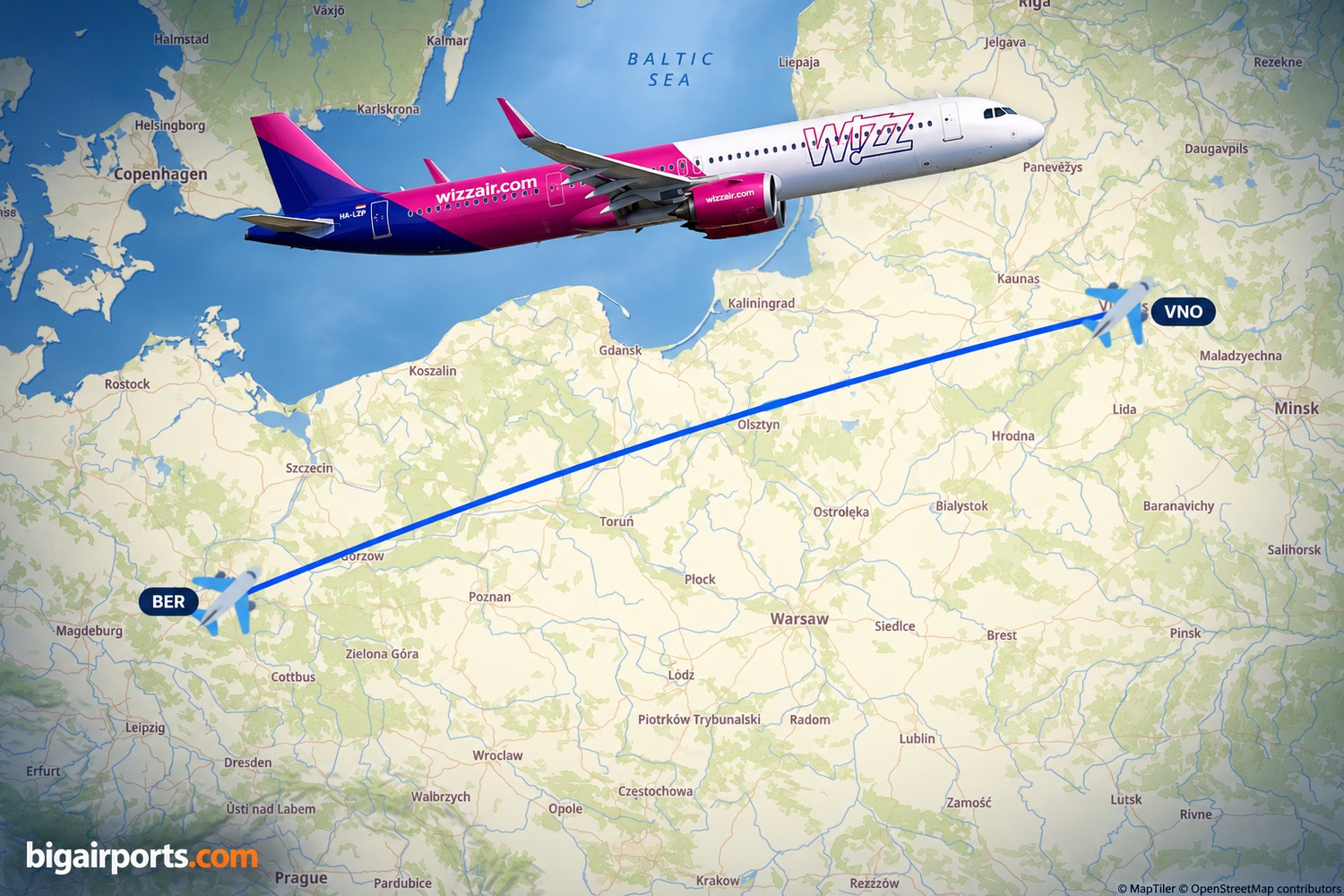
Wizz Air began operating a new service between Berlin Brandenburg and Vilnius on 26 October 2026, adding the Lithuanian capital to its winter 2026/27 schedule from the German capital. The Budapest-based ultra-low-cost carrier flies the route three times weekly, on Mondays, Wednesdays and Fridays, with the Airbus A321neo. Schedule filings tracked by Aeroroutes and Aviation Week list the pairing among the carrier’s new northern winter additions, and both airports have confirmed the launch through their own announcements.
- Airline
- Wizz Air
- Route
- Berlin Brandenburg (BER) to Vilnius (VNO)
- Aircraft
- Airbus A321neo
- Frequency
- 3x weekly (Mon, Wed, Fri)
- First flight
- 26 Oct 2026
Route overview
The sector between Berlin Brandenburg Airport and Vilnius International Airport measures roughly 820 kilometres, or about 440 nautical miles, placing it firmly in short-haul territory with a block time of around one hour and 40 minutes. In Wizz Air’s standard 239-seat single-class layout, the three weekly rotations add approximately 717 seats per week in each direction.
The Monday, Wednesday and Friday pattern follows a familiar Wizz Air template for new short-haul markets: a low opening frequency that can be stepped up if load factors justify it. The carrier has not published a schedule beyond the current season, and both airport announcements refer only to the winter 2026/27 timetable. The first flight fell on the first Monday of the IATA northern winter season, which began on 25 October.
Berlin Brandenburg framed the route as part of a wider winter expansion at the airport driven by Eurowings and Wizz Air, while Lithuanian Airports presented it as a new link from Lithuania to Germany’s largest city.
Wizz Air network context
Wizz Air has been present at Vilnius for more than a decade and maintains a base at the airport, making Lithuania its largest operation in the Baltic states. The Vilnius base serves a spread of western and northern European points, with the United Kingdom, Scandinavia and the Mediterranean among its established markets.
At Berlin Brandenburg, Wizz Air is one of several low-cost operators competing with easyJet, Ryanair and Eurowings. Its Berlin network has historically been weighted towards central, eastern and south-eastern Europe, and the Vilnius service extends that footprint north-eastwards into the Baltic region.
The airline group operates an all-Airbus fleet of more than 200 aircraft, with the A321neo now the dominant type as older A320ceo and A321ceo units leave the fleet. The group also holds one of the largest order books in the industry, covering several hundred A321neo-family aircraft including the longer-range A321XLR. For the past two years the carrier has managed Pratt & Whitney GTF engine inspections that have kept a portion of its neo fleet on the ground, constraining capacity growth and making each new route a deliberate allocation of scarce aircraft time.
About the aircraft
The Airbus A321neo is the largest member of the A320neo family, with a fuselage nearly seven metres longer than the A320neo. In Wizz Air’s configuration it carries 239 passengers in a single class, close to the type’s certified exit limit of 240 seats. Airbus quotes a range of around 4,000 nautical miles, far beyond anything required on a Baltic sector.
Wizz Air’s A321neos are powered by Pratt & Whitney PW1100G geared turbofans. Airbus puts the type’s fuel burn per seat at roughly 20 per cent below the previous-generation A321ceo, and the aircraft meets ICAO Chapter 14 noise standards, a relevant consideration at Berlin Brandenburg given the airport’s noise-protection regime.
On an 820 km sector the aircraft operates well inside its capability. The choice reflects unit-cost economics rather than range: spreading fixed costs across 239 seats gives Wizz Air one of the lowest costs per seat in European short-haul flying, which is the basis of its pricing model.
About the airports
Berlin Brandenburg Airport opened on 31 October 2020, replacing Tegel and absorbing the former Schönefeld site. Data from bigairports.com lists 169 routes from BER. Its densest connection is Amsterdam, with 4,228 flights across two operators in the current dataset, followed by Barcelona (1,922) and Palma de Mallorca (1,598). Madrid (850), Stockholm (634) and Málaga (450) also record substantial frequencies, while the Vilnius pairing shows 24 flights across three operator codes.
Vilnius International Airport is Lithuania’s largest airport and one of three run by state-owned Lithuanian Airports, alongside Kaunas and Palanga. The bigairports.com dataset counts 65 routes from VNO. The busiest by flight count are Amsterdam (368), Barcelona (344) and Oslo (319), followed by Stockholm (241), Warsaw (161) and Málaga (152). Services to Riga, Tallinn, Helsinki and Copenhagen underline the airport’s Baltic and Nordic orientation, while Istanbul (73 flights) and Vienna (40 flights, five operators) round out the medium-haul and hub-oriented part of the network.
Market context and competition
The Berlin to Vilnius pair is not an unserved market. With three operator codes already recorded on the pairing, Wizz Air enters as a challenger rather than a pioneer. Ryanair and airBaltic have both operated Berlin to Vilnius services in recent seasons, giving the market an established low-cost and regional-carrier presence.
Capacity is where the newcomer differs. At 239 seats, the A321neo outsizes Ryanair’s 189-seat Boeing 737-800 and 197-seat 737 MAX 8-200, and is substantially larger than airBaltic’s Airbus A220-300, which seats between 145 and 149. Wizz Air’s three weekly rotations therefore equate to roughly five weekly A220 departures in seat terms.
Demand on the pair draws on visiting-friends-and-relatives traffic between Germany’s Lithuanian community and the Baltic states, Berlin’s inbound tourism market, and business travel between two EU capitals. Vilnius airport sits around six kilometres south of the city centre, one of the shortest airport-to-city transfers among European capitals.
Wizz Air has announced no change to frequency beyond the current season. Any adjustment for summer 2027 would appear in the carrier’s regular schedule filings, which Aeroroutes and Aviation Week track on a rolling basis.
Sources & references (5)
Generated with editorial oversight from AI research.