Wizz Air to Launch Daily Berlin Brandenburg–Milan Malpensa Service
Wizz Air will open a daily Airbus A321neo rotation between BER and MXP on 14 December 2026, one of three new routes tied to a twelfth based aircraft at its Milan Malpensa base.
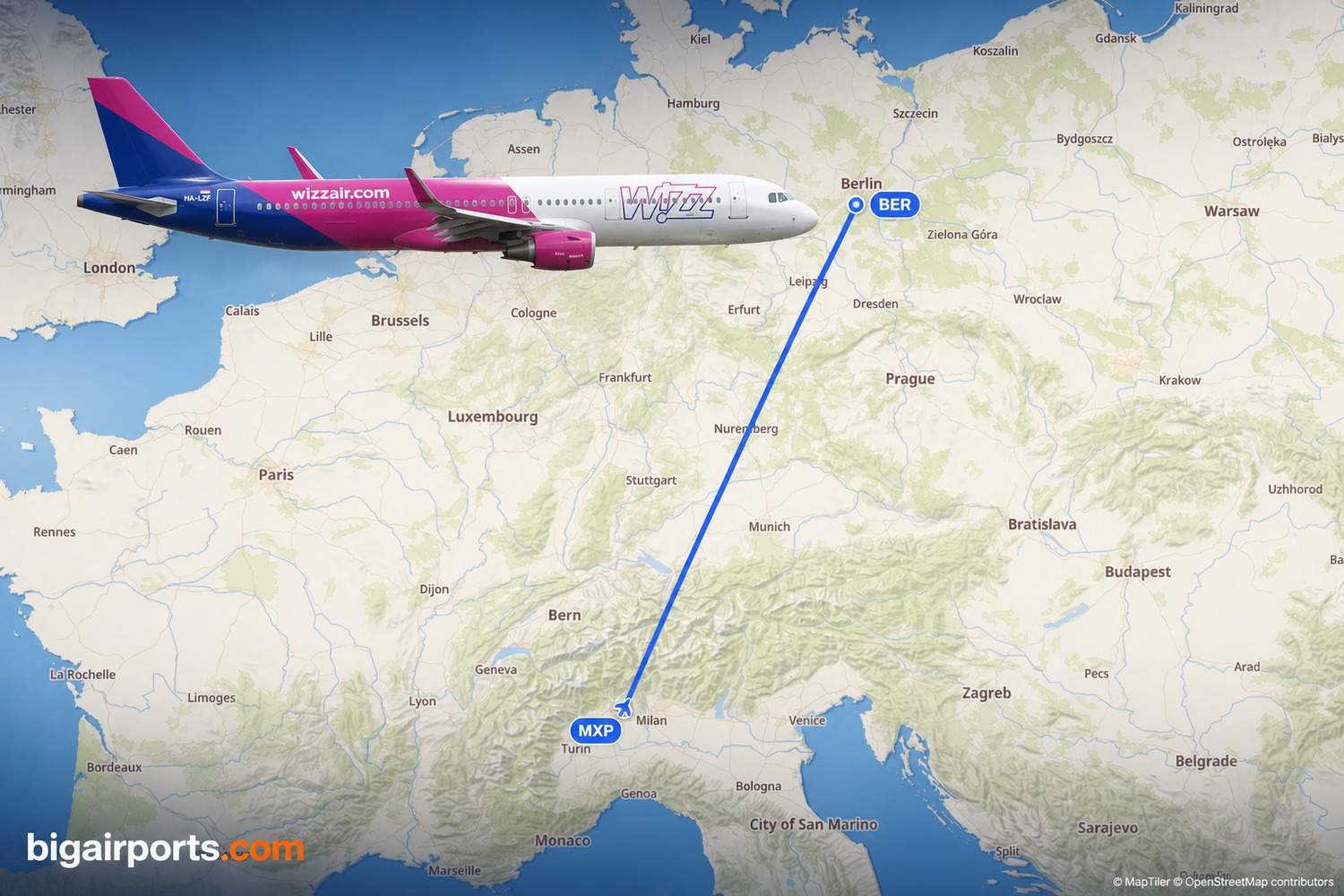
Wizz Air will launch a daily service between Berlin Brandenburg Airport and Milan Malpensa International Airport on 14 December 2026, operated with the Airbus A321neo. The route connects the German capital with Italy’s financial and industrial centre in the middle of the winter 2026/27 season and forms part of a wider build-up of the carrier’s Milan operation.
- Airline
- Wizz Air
- Route
- Berlin Brandenburg (BER) to Milan Malpensa (MXP)
- Aircraft
- Airbus A321neo
- Frequency
- Daily
- First flight
- 14 Dec 2026
Route overview
Berlin Brandenburg Airport confirmed the new connection on 30 July 2026. Wizz Air will fly one daily rotation on the roughly 840-kilometre sector, which translates into a block time of around one hour and forty minutes in each direction. A full seven-day pattern from the first week of operation is a statement of intent; low-cost carriers frequently probe new markets with three or four weekly frequencies before committing to a daily schedule. Exact departure timings had not been published at the time of the announcement.
At 239 seats per departure, the A321neo gives the route more than 1,600 seats per week in each direction from launch. Both cities anchor metropolitan regions of several million residents, and the city pair already supports traffic across all three Milan-area airports, giving the new service an established demand base rather than a market that needs to be created from scratch.
Wizz Air’s network context
The Berlin service is one of three new routes announced alongside the stationing of a twelfth based aircraft at Milan Malpensa, an expansion that consolidates the airport’s position as one of the carrier’s largest bases outside Central and Eastern Europe. The additional aircraft and the accompanying routes extend a period of sustained growth for Wizz Air in Italy, where the airline has built substantial operations at Rome Fiumicino and Milan since 2020.
The move also changes the character of the airline’s Berlin operation. Wizz Air has served the German capital since the Schönefeld era with a network centred on Central and Eastern Europe, carrying traffic to Poland, Romania, the Balkans and the Caucasus. From that base of activity, the airport has functioned primarily as a spoke for visiting-friends-and-relatives and labour-mobility traffic rather than as a launch point for intra-Western European flying. A daily link to Milan is a west-to-west addition to that profile and follows the carrier’s 2025 decision to wind down its Abu Dhabi operation and concentrate capacity on the European short-haul core, where aircraft utilisation has proved more dependable.
About the aircraft
Wizz Air will deploy the Airbus A321neo, the backbone of its all-Airbus fleet and the type on which the airline’s growth plans rest. In Wizz Air’s single-class configuration the aircraft seats 239 passengers, one of the densest single-aisle layouts in European service. Powered by geared turbofan engines, the type burns around 20 per cent less fuel per seat than the previous-generation A321ceo, which underpins the carrier’s cost position on sectors of this length.
Wizz Air is among the largest A321neo operators in the world and holds one of the largest outstanding order books for the type, with deliveries scheduled well into the 2030s. The aircraft’s unit economics are central to the airline’s ability to enter markets that already carry established low-cost capacity.
About the airports
Berlin Brandenburg, which opened in late 2020 as the successor to Tegel and Schönefeld, currently serves 172 routes, according to bigairports.com network data. Its densest link is Amsterdam, with 2,002 flights recorded across two operators, while leisure markets dominate the upper tier of the table: Palma de Mallorca draws six operators and 614 recorded flights, and Barcelona shows 649 flights across three carriers. Notably, no Milan airport features among BER’s busiest connections in the current dataset, which points to headroom on the city pair.
Milan Malpensa is the intercontinental gateway for northern Italy and operates the widest network of the three Milan-area airports, with 250 routes in the current bigairports.com data. Its heaviest links are Iberian: Barcelona leads with 1,592 recorded flights across seven operators, followed by Madrid with 1,128 flights, also across seven operators. The airport combines a dense European short-haul programme with long-haul service, including a link to Doha, and handles the bulk of Milan’s widebody traffic. For Wizz Air, the airport offers the largest catchment of the three Milan options and the airport where the carrier has chosen to concentrate its based fleet.
Market context and competition
The Berlin to Milan market is contested across all three of Milan’s airports. easyJet maintains its largest base outside the United Kingdom at Malpensa and already operates between the two airports, while Ryanair carries Berlin traffic into Milan Bergamo, roughly 50 kilometres north-east of the city. Wizz Air is therefore entering a city pair with established low-cost capacity on both the direct airport pairing and the adjacent alternatives.
That said, the absence of Milan from Berlin Brandenburg’s top-ranked routes indicates that the market is not saturated by the standards of comparable European trunk pairs; Barcelona, Palma de Mallorca and Madrid all rank higher from Berlin despite longer sector lengths. Wizz Air’s 239-seat gauge and daily frequency position the airline to compete on unit cost rather than schedule depth, the pattern it has followed in other Western European market entries.
The launch date of 14 December 2026 places the route ahead of the Christmas and New Year travel peak, followed by the northern Italian ski season and the Milan trade-fair calendar in the first quarter, giving the service consecutive demand drivers through its first months of operation.
Sources & references (4)
Generated with editorial oversight from AI research.