Wizz Air Launches Four-Weekly Málaga–Venice Marco Polo Service
The Budapest-based ultra-low-cost carrier began four-weekly flights between Málaga-Costa del Sol and Venice Marco Polo on 6 July 2026, adding a nonstop option on a previously hub-connected Spain–Italy leisure pair.
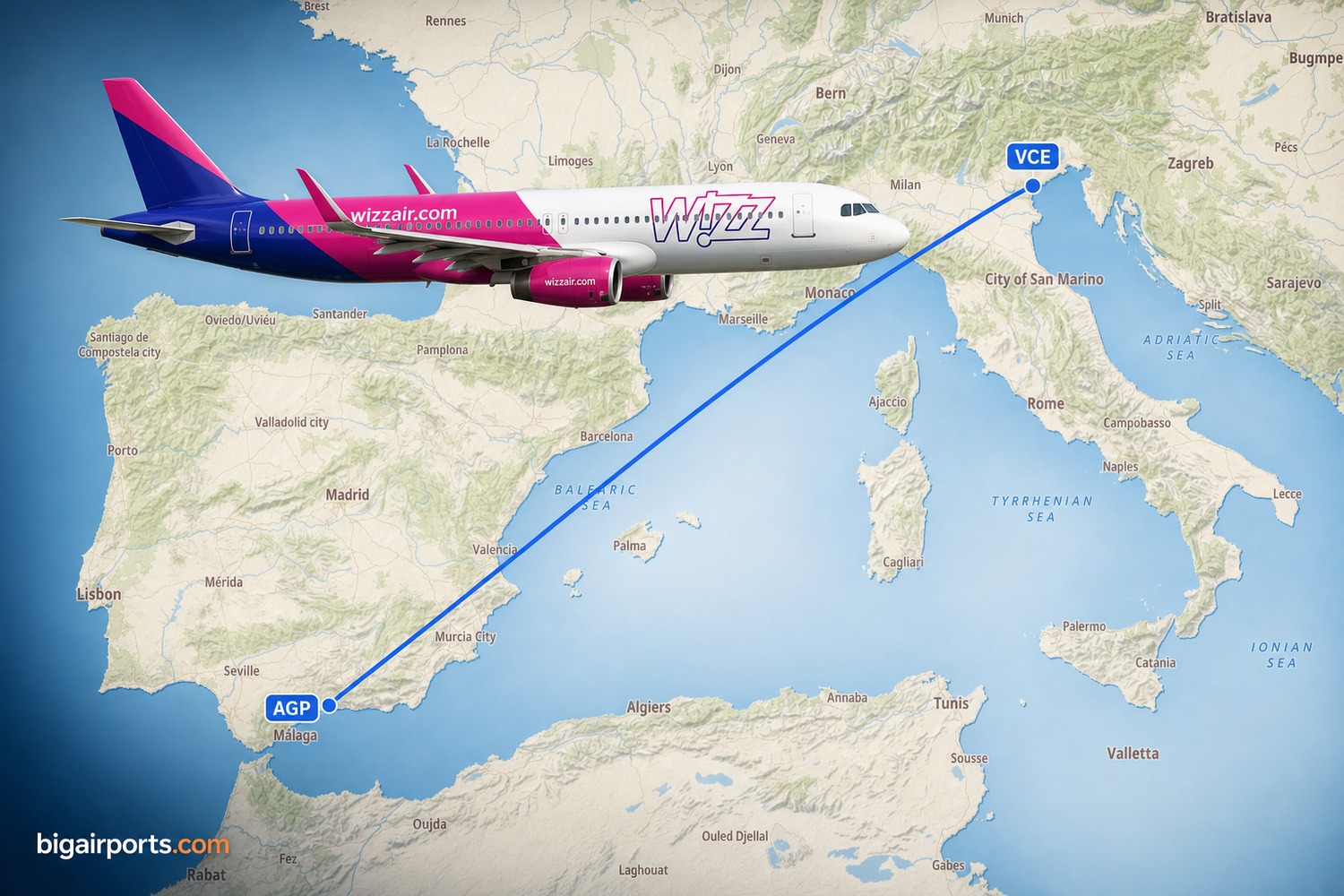
Wizz Air has launched a scheduled service between Málaga-Costa del Sol Airport and Venice Marco Polo Airport, with the first flight operating on 6 July 2026. The route runs four times weekly, on Mondays, Wednesdays, Fridays and Sundays, and adds a nonstop link between two of southern Europe’s principal leisure markets.
- Airline
- Wizz Air
- Route
- Málaga (AGP) to Venice (VCE)
- Frequency
- 4x weekly (Mon/Wed/Fri/Sun)
- First flight
- 6 July 2026
- Aircraft
- Airbus A320 family (type not specified)
Route overview
The new service pairs Andalusia’s principal airport, coded AGP/LEMG, with the main gateway to Venice and the wider Veneto region, coded VCE/LIPZ. The sector covers roughly 1,700 kilometres, or around 930 nautical miles, placing it comfortably within short-haul narrowbody economics. Spanish outlet Touristic News reported the launch as a new route for the Costa del Sol airport, while regional daily La Opinión de Málaga described it as a reinforcement of the airport’s Italian connectivity as the peak summer season got under way.
The Monday, Wednesday, Friday and Sunday pattern is a familiar configuration for leisure-driven city pairs, bracketing the weekend at both ends while keeping mid-week capacity in the market. Wizz Air has not published seasonal end dates for the service, and departure timings were not included in the launch announcements.
Wizz Air’s network context
Wizz Air, the Budapest-based ultra-low-cost carrier, built its network on Central and Eastern Europe before expanding steadily into Southern and Western European markets. Italy has become one of its largest markets outside that heartland, an expansion that began with the opening of its first Italian base at Milan Malpensa in July 2020 and has since spread across the peninsula.
The carrier’s position at Málaga has also been growing. According to Sur in English, Wizz Air has been increasing routes and seat capacity at Málaga through 2026, with the Venice service arriving as part of that broader build-up. The route is also notable as a west-to-west leisure sector, connecting two Western European airports directly rather than feeding traffic through the airline’s Central European bases, a type of flying Wizz Air has progressively added as its fleet has grown.
About the aircraft
Wizz Air has not specified which type will operate the route. The carrier flies an all-Airbus A320-family fleet in a single-class, high-density configuration: the A320ceo seats 186 passengers, the A321ceo seats 230, and the A321neo seats 239, the densest layout of the type in service. The A321neo forms the core of the airline’s orderbook and accounts for the bulk of its recent deliveries, prized for its low fuel burn per seat.
The gauge assigned to Málaga to Venice will determine the capacity added to the market. At four weekly rotations, the schedule equates to between roughly 744 and 956 seats per direction per week, depending on whether the smallest or largest variant in the fleet operates the service. On a sector of this length, any of the three types can fly the route without payload restrictions, giving the carrier flexibility to adjust gauge with seasonal demand.
About the airports
Málaga-Costa del Sol is the gateway to Andalusia’s coastal resorts and one of Spain’s busiest airports, with 174 routes in bigairports.com network data. Its densest markets are domestic and northern European: Madrid leads with 2,761 recorded flights across five operators, followed by Barcelona with 1,954 flights and Amsterdam with 1,144. London Gatwick, with 840 flights and six operators, is the airport’s most contested international route. Among Málaga’s fifteen busiest routes, Milan Malpensa is the only Italian destination, with 213 recorded flights across three operators, which leaves clear room for additional Italian city pairs such as Venice.
Venice Marco Polo serves one of the world’s most heavily visited cities and records 103 routes in the same dataset, a network weighted heavily towards short-haul European flying. Its busiest connections are Amsterdam with 793 flights, Barcelona with 714 flights across three operators, and Madrid with 594 flights across six operators. Spain therefore already supplies two of Venice’s three busiest routes, and the Wizz Air service extends that Spanish network beyond the Barcelona and Madrid trunk markets to a third major point.
Market context and competition
Spain and Italy form one of the larger intra-European country markets, but the traffic between them is concentrated on trunk routes between the two countries’ biggest cities. On the Málaga to Venice city pair itself, passengers have typically routed over intermediate hubs; Madrid, Barcelona and Amsterdam, the connecting points best placed for this journey, all rank among the busiest routes at both airports in the bigairports.com data.
A nonstop option changes that calculation on a sector of this length, cutting total journey times from five hours or more via a hub to around two and a half hours of flying. Demand drivers exist in both directions: Italian outbound traffic to the Costa del Sol’s resort economy, which draws visitors well beyond the summer peak, and Spanish leisure traffic into Venice, one of Europe’s strongest city-break destinations. Both catchments also generate visiting-friends-and-relatives traffic from the resident international communities on the Andalusian coast.
At launch, the four-weekly frequency positions the route as a point-to-point leisure operation rather than a business-oriented shuttle. It also deepens Wizz Air’s presence in two markets where the carrier has been visibly investing: Italy, home to its largest Western European operation, and Málaga, where Sur in English reports a sustained increase in the airline’s routes and seats through 2026. The route’s performance over its first full season will be reflected in future schedule filings.
Sources & references (4)
Generated with editorial oversight from AI research.