Transavia France to link Brussels and Porto from December 2026
The Air France-KLM low-cost unit will fly three weekly rotations between Brussels Airport and Porto's Sa Carneiro Airport from 14 December 2026, extending its young Belgian operation into northern Portugal.
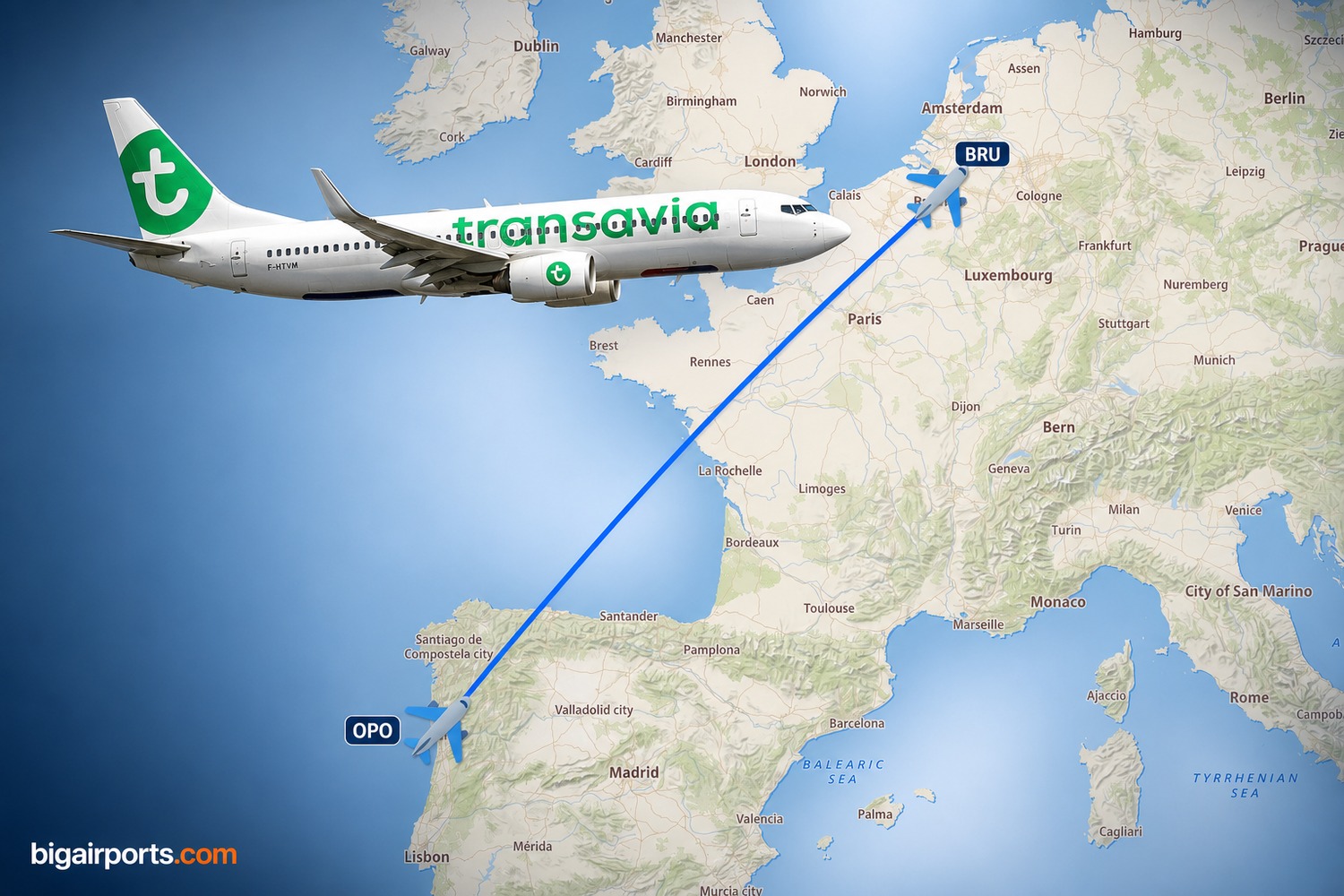
Transavia France will open a new scheduled link between Brussels and Porto on 14 December 2026, adding the Portuguese city to its Belgian operation with three weekly rotations. The Air France-KLM group’s low-cost carrier will serve the route on Mondays, Wednesdays and Saturdays, aiming the service at the leisure and visiting-friends-and-relatives traffic that dominates the Belgium–Portugal market.
- Airline
- Transavia France
- Route
- Brussels (BRU) to Porto (OPO)
- Frequency
- 3x weekly (Mon/Wed/Sat)
- First flight
- 14 December 2026
Route overview
The new service connects Brussels Airport in Zaventem with Francisco de Sá Carneiro Airport in Porto, a sector of approximately 1,470 kilometres that is typically flown in around two and a half hours of block time. The Monday, Wednesday and Saturday pattern is a classic leisure rotation, covering the weekend on both shoulders while skipping the mid-week trough, and the mid-December launch places the route at the heart of the winter 2026/27 season rather than holding it back for the summer programme.
The airline announced the route in early August 2026 and has framed it explicitly as a leisure addition to its Brussels schedule. Belgian trade coverage and the carrier’s own newsroom both describe Porto as a network expansion at Brussels rather than a one-off seasonal experiment, and the winter start date gives the service a full booking curve ahead of the Christmas and New Year travel peak, traditionally one of the strongest periods for traffic between Belgium and Portugal.
Airline network context
Transavia France is the French arm of the Air France-KLM group’s low-cost operation and the largest carrier at its Paris Orly home base. In recent years it has broadened its footprint beyond Orly, first across French regional airports and more recently into Brussels, where the Porto service extends a young but growing station. The move reflects a wider group strategy of pushing the Transavia brand into markets adjacent to its French heartland, using the same single-type operating model and direct-distribution approach that underpin its Orly operation.
Porto itself is familiar territory for the brand. The carrier already serves the city from Paris Orly, a market that ranks among Porto’s busiest: current network data shows the Orly link carrying around 400 flights across five operators. Adding a Brussels departure therefore deepens an established relationship with the airport rather than opening an untested destination, and it does so from a catchment with strong cultural and family ties to northern Portugal.
About the aircraft
Transavia France has not yet specified the aircraft type for Brussels–Porto. Its fleet is built around the Boeing 737-800, configured with 189 seats in a single class, while group-level orders for the Airbus A320neo family are progressively reshaping the operation with A320neo and higher-capacity A321neo deliveries. Flown with a 737-800, the published schedule would place roughly 567 seats per week in each direction into the market; A320neo-family equipment would move that figure up or down depending on the variant assigned. On a sector of this length, all of the carrier’s types operate comfortably within normal range and performance limits, so the eventual assignment will be a fleet-planning rather than an operational decision.
About the airports
Brussels Airport is Belgium’s principal gateway, with 207 routes in the current bigairports.com dataset. Its network is anchored by dense short-haul trunks: Amsterdam leads on volume with 1,758 flights across three operators, while Madrid is the most contested market from the Belgian capital, shared by ten operators. Iberian leisure destinations already feature heavily, with Malaga, Alicante, Palma de Mallorca and Tenerife all multi-carrier markets, underlining the southbound orientation of Brussels demand into which the Porto service will slot. Long-haul connectivity, including the Doha link, rounds out a predominantly intra-European network.
Francisco de Sá Carneiro Airport is the gateway to northern Portugal and the country’s second city, with 156 routes recorded in the same dataset. Madrid is its single densest market at 1,923 flights, ahead of Barcelona and the domestic trunk to Lisbon, while Portuguese island services to Funchal and Ponta Delgada add a further domestic leisure layer. The airport’s profile is strongly European and strongly competitive: Paris Orly, Geneva, Zurich, Luxembourg and two London airports all appear among its leading routes, reflecting the deep visiting-friends-and-relatives flows generated by the Portuguese diaspora across western Europe. Belgium, home to a substantial Portuguese community, fits that pattern squarely.
Market context and competition
The Belgium–Porto market has historically been contested from Brussels South Charleroi, where Ryanair’s long-established base has carried the bulk of point-to-point traffic between the two countries. By operating from Brussels Airport itself, Transavia France targets passengers in the capital’s immediate northern catchment, along with travellers who prefer Zaventem’s rail links and full-service airport environment over the longer transfer to Charleroi.
Indirect alternatives remain plentiful. TAP Air Portugal links Brussels with Lisbon and offers onward connections to Porto, while Amsterdam, one of Porto’s largest markets at 773 flights across three operators, provides a further one-stop path over a fellow Air France-KLM group hub. None of these options, however, offers the nonstop convenience that a point-to-point leisure and family market typically rewards.
At three weekly rotations, the new service is a measured entry rather than a frontal assault on Charleroi’s volumes. It gives Transavia France a presence in a proven Iberian leisure flow from Brussels, where Spanish and Portuguese destinations already account for a visible share of the airport’s short and medium-haul network, and it strengthens the group’s position in a city pair that has long leaned towards a single low-cost operator. The first departure is scheduled for 14 December 2026, with the route operating throughout the winter season.
Sources & references (4)
Generated with editorial oversight from AI research.