TAP Air Portugal Launches Year-Round Lisbon–Athens A320neo Service
The Star Alliance carrier began five-times-weekly Airbus A320neo flights between Lisbon and Athens on 1 July 2026, its first year-round schedule on the city pair and part of a wider summer 2026 expansion.
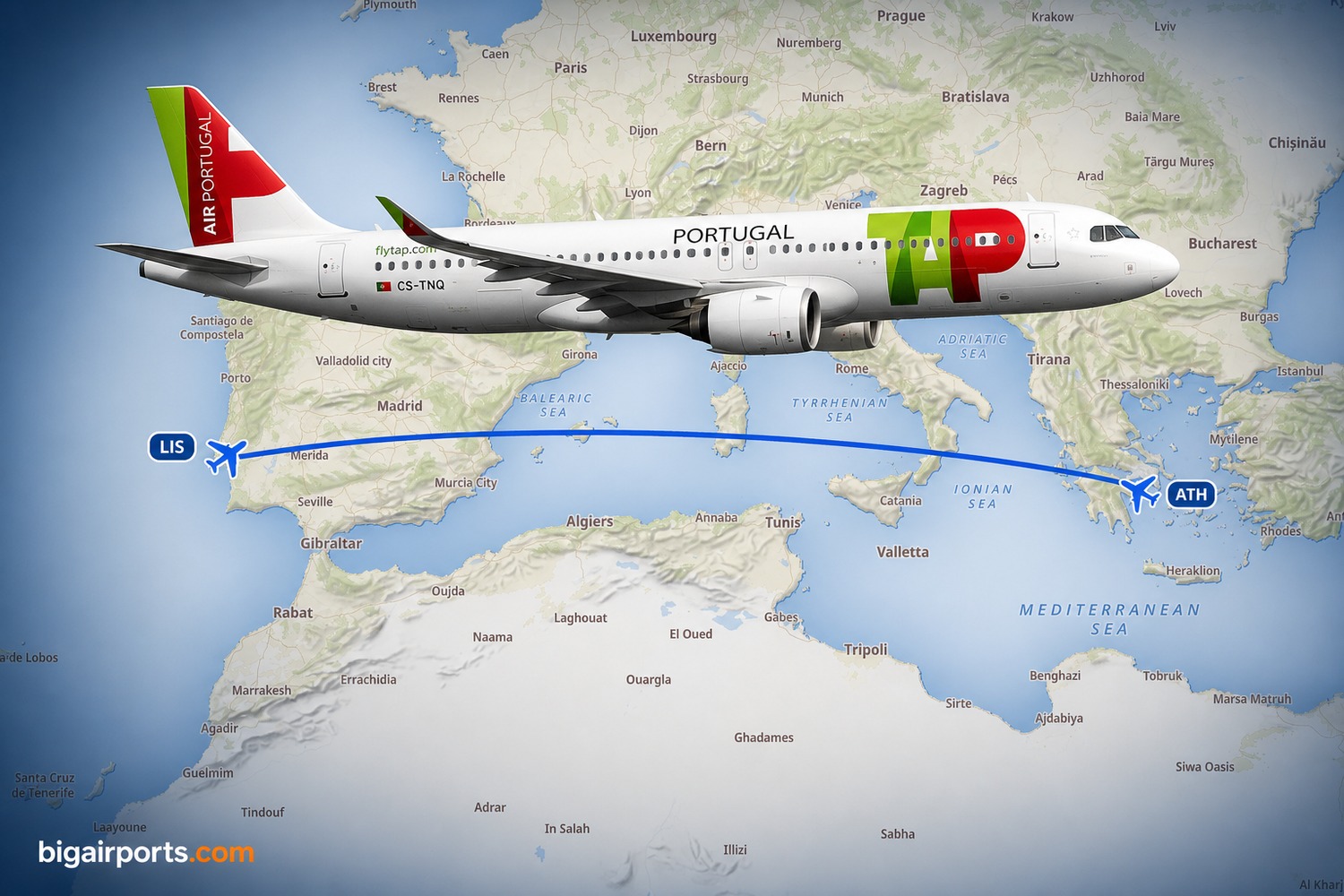
TAP Air Portugal began scheduled services between Lisbon and Athens on 1 July 2026, operating five weekly rotations with an Airbus A320neo. The year-round route links the carrier’s hub at Lisbon Humberto Delgado Airport with Athens Eleftherios Venizelos International Airport, establishing a permanent nonstop connection between the Portuguese and Greek capitals.
- Airline
- TAP Air Portugal
- Route
- Lisbon (LIS) to Athens (ATH)
- Aircraft
- Airbus A320neo
- Frequency
- 5x weekly
- First flight
- 1 July 2026
Route overview
The Lisbon to Athens sector spans approximately 2,880 kilometres, which makes it one of the longer intra-European services in TAP’s short-haul network, with block times of around four hours in each direction. At five weekly rotations, the schedule delivers roughly 870 seats per direction per week based on the carrier’s 174-seat A320neo layout.
The service is planned as a year-round operation, a point emphasised when the route was announced in January 2026. Nonstop capacity between the two capitals has historically been concentrated in the summer season, so a permanent schedule marks a structural change on the city pair rather than another seasonal addition. The inaugural flight departed Lisbon on 1 July as published, and the route entered the schedule at the height of the Greek summer peak, giving the carrier a full high season to establish the service before the first winter test.
Network context: TAP’s 2026 expansion
Athens forms part of a broader summer 2026 expansion at the Star Alliance carrier. TAP announced the Greek capital alongside Curitiba in Brazil, extending its European perimeter and its core South Atlantic franchise in the same season. One day after the Athens debut, on 2 July 2026, the airline also launched a Porto to Praia service to Cape Verde, an indication that the current growth phase is not confined to the main Lisbon hub.
The carrier’s network model remains built around connecting traffic over Lisbon, where its long-haul banks concentrate on Brazil, North America and Lusophone Africa. Athens extends the eastern edge of TAP’s European catchment and adds a capital-city spoke that can feed those banks in both directions: Greek-originating passengers connecting westbound onto the Atlantic network, and Brazilian or North American traffic continuing to Greece. For an airline whose intra-European footprint has traditionally leaned towards western and central Europe, the Greek capital is a measured but logical eastward step.
The aircraft: Airbus A320neo
TAP has assigned the Airbus A320neo to the route. The re-engined narrowbody delivers a double-digit reduction in fuel burn per seat compared with the previous-generation A320ceo, together with a smaller noise footprint, and its range covers the 2,880-kilometre sector with a comfortable margin. TAP operates the type in a 174-seat configuration, with the forward rows sold as business class behind a movable divider in line with standard European short-haul practice. The aircraft choice signals that the airline sees the route as a stable, mid-density market: large enough for standard narrowbody equipment year-round, without committing the higher-capacity A321neo from the outset. The neo’s operating economics also matter on a sector of this length, where the fuel-burn advantage over older narrowbodies compounds across roughly eight hours of round-trip flying per rotation.
The airports: Lisbon and Athens
Network data from bigairports.com shows Lisbon Humberto Delgado serving 161 active routes. Its densest markets are Iberian: Madrid leads with eight operators and more tracked flights than any other destination, followed by Barcelona with six operators. Paris Orly, Amsterdam and Zurich rank among the airport’s busiest international links, while domestic trunks to Porto, Funchal and Ponta Delgada anchor the Portuguese system. Athens has been notably absent from that top tier, so the new service adds a south-eastern European capital to a route map otherwise weighted towards western Europe and the Atlantic islands.
Athens Eleftherios Venizelos is the larger network of the two, with 195 active routes. Its single most contested market is Tel Aviv, served by 11 operators, while a dense domestic system links the capital with Thessaloniki, Heraklion, Santorini, Chania and Kos. Madrid and Amsterdam lead its western European connectivity by tracked flights, with London Heathrow and Frankfurt also prominent. Against that breadth, the absence of a year-round Lisbon link stood out as one of the more conspicuous gaps at the western end of the Athens route map.
Market context and competition
The Lisbon to Athens market has long depended on seasonal nonstop capacity and one-stop itineraries over intermediate hubs such as Madrid, Rome, Frankfurt and Istanbul, all of which appear in the top route lists of one or both airports. Aegean Airlines, itself a Star Alliance member, has served the city pair on a seasonal basis, which leaves TAP’s year-round schedule as the differentiating element rather than the nonstop product itself.
TAP’s positioning targets two distinct traffic flows. The first is point-to-point demand, both leisure and VFR, between two capital cities with strong inbound tourism profiles. The second is connecting traffic over Lisbon: Athens currently has no nonstop service to South America, so a single stop at TAP’s hub becomes a competitive routing for Brazil-bound passengers, while Portuguese and connecting North American traffic gains a simpler path into Greece outside the peak season. Both airports’ data also shows Madrid and Amsterdam among their strongest common markets, underlining how much southern European connectivity still routes over third-country hubs.
Five weekly rotations is a cautious opening frequency for a market of this size, and the winter performance of the route will determine whether the schedule holds through the off-season as published. For now, the service closes a long-standing gap between two capitals of 161 and 195 routes respectively, and does so with year-round intent.
Sources & references (4)
Generated with editorial oversight from AI research.