Turkish Airlines to Link Istanbul and Chengdu Tianfu from November
Turkish Airlines will fly three weekly Boeing 787-9 rotations between Istanbul (IST) and Chengdu Tianfu (TFU) from 11 November 2026, its fourth mainland China destination and first in the western interior.
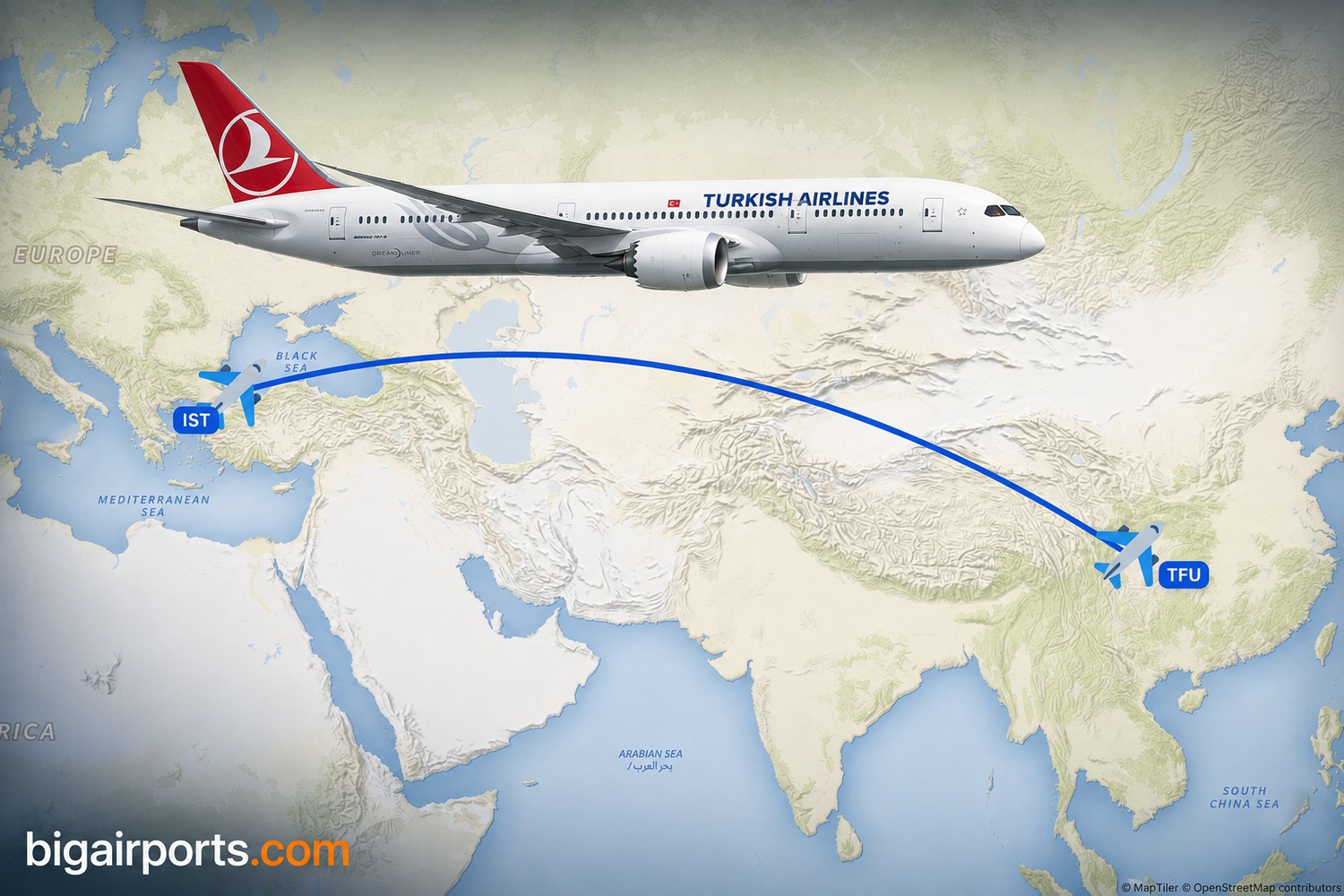
Route overview
Turkish Airlines will launch a nonstop service between Istanbul and Chengdu on 11 November 2026, linking İstanbul Airport with Chengdu Tianfu International Airport three times a week using Boeing 787-9 equipment. The route gives the Star Alliance carrier its fourth passenger destination in mainland China, after Beijing, Shanghai and Guangzhou, and its first in the country’s western interior.
- Airline
- Turkish Airlines
- Route
- Istanbul (IST) to Chengdu Tianfu (TFU)
- Aircraft
- Boeing 787-9
- Frequency
- 3x weekly
- First flight
- 11 Nov 2026
Outbound flights are scheduled to depart Istanbul on Wednesdays, Fridays and Sundays, with the return sector leaving Chengdu the following day on Mondays, Thursdays and Saturdays, a pattern consistent with an overnight eastbound arrival. The schedule was first flagged in carrier filings picked up by AeroRoutes in July 2026 and has since been confirmed across the trade press. The great-circle distance between the two airports is roughly 6,700 kilometres, placing the sector comfortably within the Boeing 787-9’s operating envelope on a year-round basis. The launch falls early in the Winter 2026/27 scheduling season, which begins at the end of October.
A deeper push into China
The Chengdu launch continues a deliberate build-up of Turkish Airlines’ Chinese operation rather than a one-off addition. The carrier already serves Beijing Capital, Shanghai Pudong and Guangzhou Baiyun from its Istanbul hub, and trade coverage has framed the new route as part of a wider Asia expansion programme that has seen the airline add both frequencies and destinations across the region.
Network breadth is central to the business case. Turkish Airlines serves more than 350 destinations and flies to more countries than any other airline, and traffic from Sichuan will be able to connect over Istanbul to points across Europe, Africa and the Americas on a single-stop itinerary. Many of those markets are difficult to reach from western China today without a double connection, which is precisely the kind of long-tail demand a large transfer hub is built to aggregate.
The Boeing 787-9 on the route
Turkish Airlines will operate all three weekly rotations with the Boeing 787-9. The carrier configures the type with 300 seats, split between 30 in business class and 270 in economy, which translates into roughly 900 weekly seats in each direction at launch frequency. That is a measured capacity commitment for a new long-haul market, and one that leaves room to grow through frequency additions before any change of gauge becomes necessary. With a range of around 14,000 kilometres, the 787-9 also operates the sector without payload restrictions in either direction, an operational consideration that matters on eastbound winter routings across Central Asia.
The type also brings belly cargo capacity to the route from day one. Sichuan is one of China’s major electronics and high-value manufacturing centres, and belly freight has historically been a meaningful contributor to the economics of new long-haul services into Chinese cities. A three-weekly widebody schedule creates a direct freight channel between Turkey and western China where none of the carrier’s existing Chinese gateways sits closer than a two-hour domestic sector away.
The airports at each end
İstanbul Airport has been Turkish Airlines’ home base since 2019 and currently posts 336 nonstop routes in bigairports.com network data, one of the largest route portfolios of any airport in the world. Its densest links underline the hub’s role as a transfer point between Europe, Asia, Africa and the Americas: Amsterdam leads the current sample with more than 1,000 tracked flights, followed by Barcelona, Dubai and Madrid. The Chengdu service will slot into the airport’s eastbound long-haul departure banks alongside the carrier’s existing Chinese and East Asian flying.
Chengdu Tianfu International Airport opened in June 2021 in Jianyang, south-east of central Chengdu, giving the Sichuan capital a second major airport alongside the older Shuangliu field. It currently shows 218 routes in bigairports.com data, with a network still dominated by domestic trunk flying: Guangzhou, Lhasa, Shanghai Pudong and Hong Kong rank among its busiest links. Long-haul international service remains a comparatively small slice of the operation, which is exactly the segment the Turkish Airlines launch addresses. The catchment is substantial: Chengdu is a city of more than 20 million people and the capital of Sichuan, a province of over 80 million.
Market context
The Istanbul–Chengdu pairing enters a China–Europe market that has been reshaped since 2022. Several European network carriers have trimmed mainland China capacity in recent seasons, in part because Russian airspace closures have lengthened their routings, while Turkish Airlines has moved in the opposite direction and continued to add Chinese frequencies and destinations. The Chengdu launch fits squarely within that divergence.
On the city pair itself, the new service will compete primarily with one-stop connections over Gulf and Central Asian hubs and with transfers via China’s coastal gateways. A three-weekly nonstop with next-day returns gives Turkey and Sichuan a scheduled direct link and positions Istanbul as a natural transfer point for Chengdu-originating traffic travelling beyond Turkey, particularly to secondary points in Europe, Africa and the Middle East where Turkish Airlines’ frequency advantage over rival hubs is greatest. In the other direction, the route opens single-connection access from the Turkish market and from Turkish Airlines’ European network to western China’s commercial centre.
For Chengdu Tianfu, the route adds a Star Alliance long-haul operator to a young international portfolio. For Turkish Airlines, it deepens exposure to one of the world’s largest aviation markets at a moment when much of the European competition is pulling back, with capacity sized conservatively enough to let demand prove itself before the schedule builds further.
Sources & references (4)
Generated with editorial oversight from AI research.