Air Cairo Launches Alexandria-Athens Nonstop, Linking HBE and ATH
The EgyptAir subsidiary began nonstop flights between Alexandria (HBE) and Athens (ATH) on 27 July 2026, giving Egypt's second city its only scheduled EU destination alongside a daily Cairo-Athens operation.
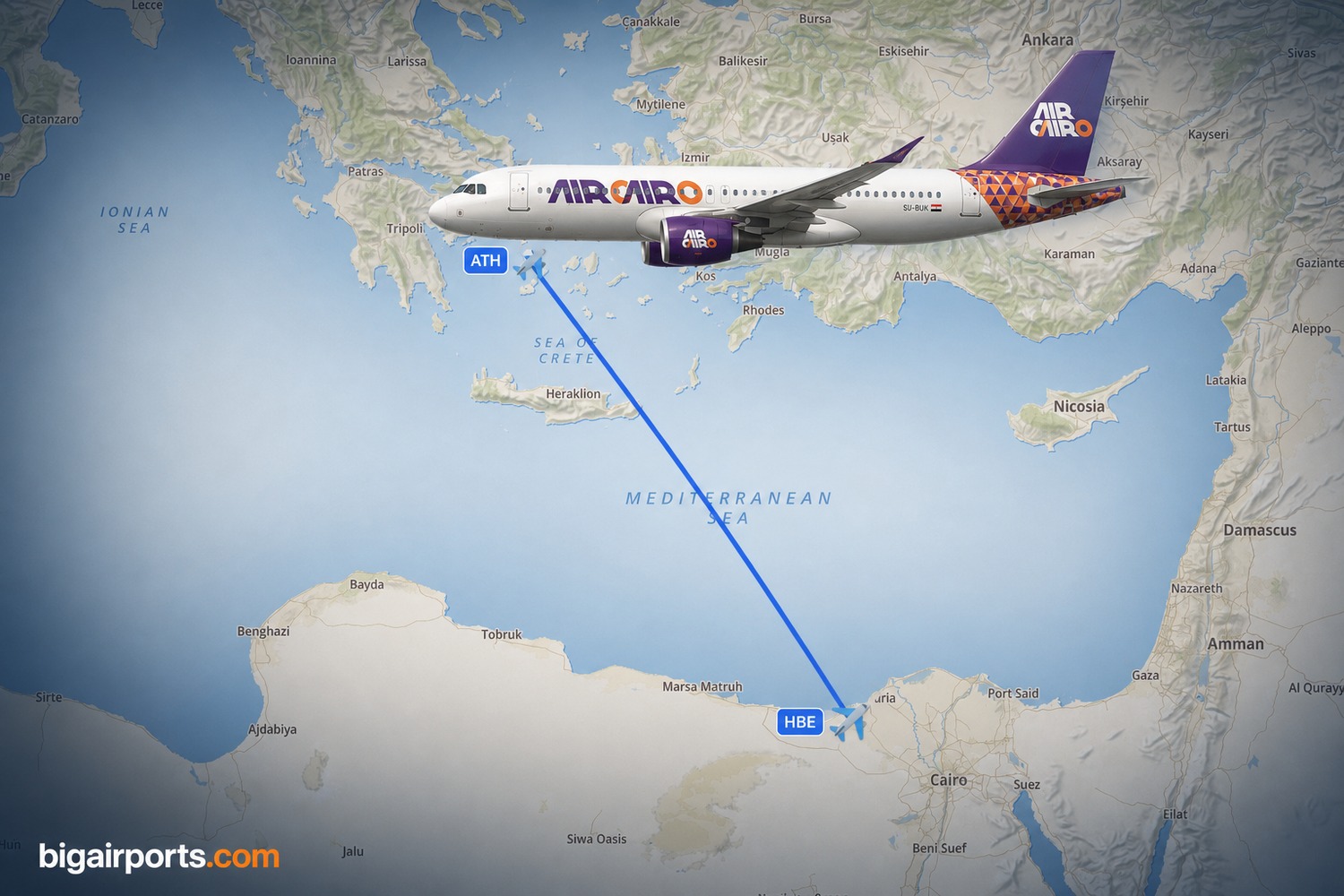
Air Cairo commenced scheduled services between Alexandria International Airport and Athens Eleftherios Venizelos International Airport on 27 July 2026, giving Egypt’s second city its first nonstop scheduled link to the Greek capital. The launch is part of a wider Greek programme by the EgyptAir subsidiary, which has also moved its Cairo to Athens service to a daily operation, and it hands Alexandria its only scheduled European Union destination.
- Airline
- Air Cairo
- Route
- Alexandria (HBE) to Athens (ATH)
- First flight
- 27 July 2026
- Aircraft
- Not confirmed
Route overview
Air Cairo’s new service links Borg El Arab, the airport serving greater Alexandria, with the Greek capital over a sector of approximately 940 kilometres, giving a block time in the region of two hours for a narrow-body aircraft. The city pair had no scheduled nonstop operator before the launch, leaving traffic between Egypt’s Mediterranean coast and Greece to connect over Cairo or Istanbul.
The carrier announced the expansion in June 2026, and the first flight operated on 27 July 2026. Greek and Egyptian press coverage has presented the launch as one half of a coordinated push that also lifts the airline’s Cairo to Athens service to a daily rotation, adding a budget option in the Egypt to Greece market.
Alexandria and Athens also share deep historical ties. The Egyptian city was home to one of the largest Greek communities in the eastern Mediterranean well into the twentieth century, and the diaspora connection continues to generate visiting friends and relatives traffic in both directions, a demand base repeatedly cited in Greek coverage of the launch.
Airline network context
Air Cairo was established in 2003 and is majority owned by EgyptAir Holding Company, with National Bank of Egypt and Banque Misr holding the remaining shares. The Cairo-based carrier runs a hybrid model, combining scheduled low-cost services with substantial charter flying into Egypt’s Red Sea resorts on behalf of European tour operators, and its scheduled network spans the Middle East, North Africa and a growing list of European cities.
Greece is a natural target for that growth. The company’s launch announcement groups the new Alexandria service with its expanded Athens flying from Cairo, treating the Greek capital as a single market served from two Egyptian gateways. For Air Cairo the route also puts scheduled capacity into Alexandria, a catchment of several million people that the carrier has historically served far less intensively than Cairo or the Red Sea resorts.
About the aircraft
Air Cairo has not confirmed which type operates the Alexandria to Athens rotation. Its fleet is centred on the Airbus A320 family, mixing A320ceo and newer A320neo narrow-bodies in single-class layouts of around 180 seats. The roughly 940 kilometre sector sits comfortably inside the family’s range and matches the stage lengths the airline flies elsewhere in the eastern Mediterranean and the Gulf.
Air Cairo’s Athens schedules from Cairo are also flown with A320-family equipment, and the airline operates no wide-bodies, so the Alexandria service will draw on the same narrow-body pool whichever variant is assigned.
The airports
Alexandria International Airport (HBE)
Alexandria International Airport sits at Borg El Arab, south-west of the city, and has carried Alexandria’s scheduled traffic since commercial operations consolidated there. bigairports.com data shows 10 nonstop routes before the Athens launch, and a network pointed almost entirely east and south. Dubai is the densest market, with 44 flights in the current data window, while Jeddah draws four separate operators on the strength of worker and pilgrimage flows. Sharjah, Abu Dhabi, Riyadh and Kuwait City complete the Gulf schedule, Libyan services run to Tripoli, Misrata and Benghazi, and Istanbul had been the only point on the map north of the Mediterranean.
Athens Eleftherios Venizelos International Airport (ATH)
Athens Eleftherios Venizelos International Airport is Greece’s principal gateway and by far the larger end of the new route. Current bigairports.com data records 196 nonstop routes, spanning dense domestic island links, the full European network and long-haul services. Madrid is the busiest single route by flights in the dataset at 643, ahead of Amsterdam on 597 and Barcelona on 425, while Tel Aviv attracts the deepest operator field with 11 airlines competing. Heavy seasonal flows to Santorini, Heraklion, Chania and Kos underline the airport’s leisure profile, and for passengers originating in Alexandria the breadth of that network makes Athens the nearest major European hub.
Market context and competition
Air Cairo enters the Alexandria to Athens city pair with no direct competition, since the market had no scheduled nonstop operator before 27 July. Competitive pressure instead sits one step away on Cairo to Athens, where EgyptAir and Aegean Airlines both operate year-round and where Air Cairo’s move to a daily frequency sharpens the contest on price and schedule.
The wider Egypt to Greece market rests on several distinct traffic streams: Greek leisure demand for Egyptian destinations, Egyptian business and student traffic into the European Union, and the visiting friends and relatives flows tied to Alexandria’s Greek heritage. Greek press coverage of the launch has emphasised the cultural dimension, presenting the direct link as a restoration of a historic connection between the two cities as much as a commercial addition.
For Alexandria the service is a measurable step in the rebuilding of a network that has leaned heavily on the Gulf. One route does not change an airport’s profile, but it does extend the map: with Athens included, Alexandria International serves 11 nonstop destinations, and for the first time in the current schedule one of them lies inside the European Union. How the market responds will be visible in the schedule data that bigairports.com tracks across both airports.
Sources & references (4)
Generated with editorial oversight from AI research.