Air Cairo Launches Daily Cairo-Athens Flights from 25 July 2026
The EgyptAir-backed low-cost carrier began daily services between Cairo International and Athens on 25 July 2026, becoming the third scheduled operator on the pair alongside a new Alexandria-Athens link.
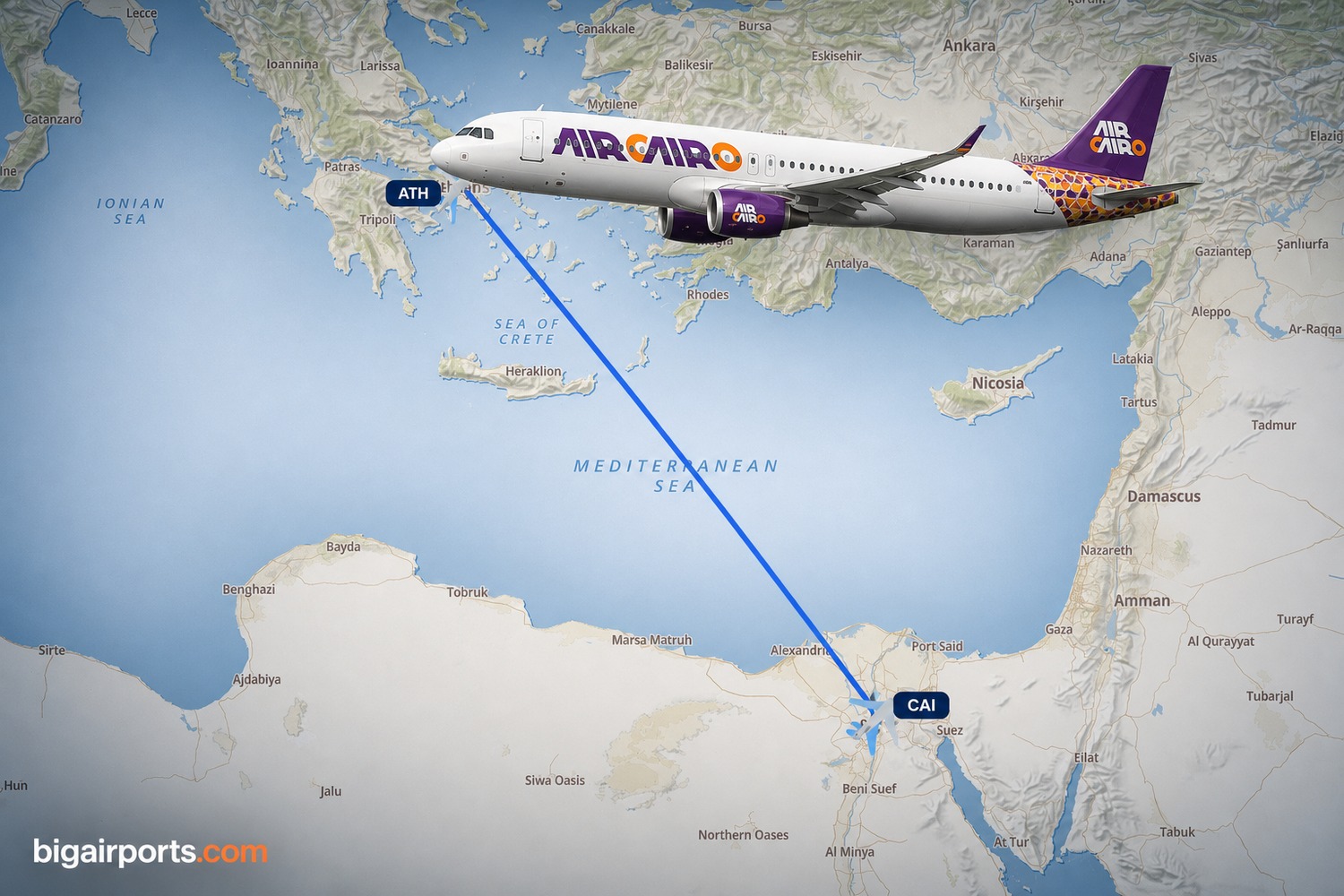
Air Cairo launched scheduled services between Cairo International Airport and Athens Eleftherios Venizelos International Airport on 25 July 2026, adding a low-cost option on one of the principal air corridors between Egypt and Greece. Greek and Egyptian media report the service operates daily, and the launch forms part of a wider Egypt-Greece expansion that also includes a new Alexandria-Athens link.
- Airline
- Air Cairo (SM/MSC)
- Route
- Cairo (CAI) to Athens (ATH)
- Frequency
- Daily (per launch reporting)
- First flight
- 25 July 2026
Route overview
The new service connects the Egyptian capital with Athens on a sector of roughly 1,120 kilometres, or about 605 nautical miles, with block times of around two hours in each direction. That places the route at the short end of the medium-haul spectrum, comfortably within narrow-body range and short enough to be rotated several times a day within a wider schedule.
Coverage of the launch in the Greek and Egyptian press describes a daily operation from Cairo, supplemented by the parallel service from Alexandria, giving the carrier two Egyptian gateways into the Greek capital. Egypt’s State Information Service presented the launch as part of efforts to grow tourism and trade traffic between the two countries, which sit under three hours apart by air yet have historically been connected almost entirely by their two flag carriers. The timing is also deliberate: a late-July start puts the service into the market at the peak of the Mediterranean summer season, when demand between the two capitals is at its strongest and load factors on the corridor are easiest to build.
Air Cairo’s network context
Air Cairo is a Cairo-based carrier majority owned by EgyptAir Holding Company and positioned as the group’s low-cost and leisure arm. Established in 2003, the airline built its business on charter flying between European markets and Egypt’s Red Sea resorts before layering a scheduled network on top, weighted towards labour and religious traffic to Saudi Arabia and the Gulf.
That footprint is visible in the traffic data at its home base. Cairo’s densest corridor is Jeddah, with 698 tracked flights and nine operators, and Riyadh, Dammam, Medina and Kuwait City all rank among the airport’s busiest links, markets in which Air Cairo competes alongside its parent and the Gulf carriers. Scheduled flying to Europe is a smaller but growing part of the operation, and Athens now joins it as a short, high-utilisation sector that fits naturally between the airline’s Gulf rotations.
About the aircraft
Air Cairo has not publicly confirmed which aircraft type is assigned to the Athens schedule. The airline operates an all-narrow-body fleet built around the Airbus A320 family, including current-generation A320neo aircraft alongside earlier A320s, and every type in the fleet can fly the two-hour sector without restriction.
On a stage of this length the choice of variant matters less than utilisation. A single-aisle aircraft can complete the Cairo-Athens round trip in well under five hours of block time, which allows the daily rotation to be slotted around existing Gulf and Red Sea flying rather than requiring dedicated capacity. The commonality of the A320 family also gives the carrier flexibility to swap variants on the route as seasonal demand moves, without retraining crews or splitting maintenance provision across types.
About the airports
Cairo International Airport is Egypt’s primary gateway and the country’s largest hub, currently served on 133 routes according to bigairports.com network data. Its schedule is dominated by Gulf and domestic flying: Jeddah, Riyadh, Dammam and Kuwait City lead the international rankings, while Aswan, Luxor, Hurghada and Sharm El Sheikh anchor a dense domestic trunk network. European coverage is comparatively thin, with Madrid, Barcelona and Istanbul among the principal links, which leaves clear room for additional scheduled capacity into southern Europe.
Athens Eleftherios Venizelos International Airport, located at Spata-Artemida east of the Greek capital, is a substantially larger network airport with 196 routes. Madrid, with 643 tracked flights, and Amsterdam, with 597, are its heaviest corridors, while Thessaloniki, Heraklion, Santorini, Chania and Kos provide year-round domestic feed. Tel Aviv stands out with eleven operators, the widest carrier field on any Athens route in the dataset, underlining the airport’s position as an eastern Mediterranean crossroads into which Cairo traffic now plugs directly. For Air Cairo, that breadth matters even for a point-to-point operation, since a well-connected destination airport deepens the pool of local demand in both directions.
Market context and competition
Cairo-Athens is an established origin-and-destination market served by EgyptAir and Aegean Airlines, both flying full-service products between their respective hubs. Air Cairo’s entry makes it the third scheduled carrier on the pair and the first positioned squarely at the low-cost end of the market, a segment that has driven much of the recent growth in Mediterranean short-haul flying.
The demand base is broad for a route of this length. Greek leisure traffic to Egypt, Egyptian visiting-friends-and-relatives and business flows, and student and medical travel all move over the corridor, alongside connecting passengers feeding into each hub. At the Athens end, the airport’s 196-route network offers onward links across Europe and the Greek islands; at Cairo, the schedule connects into the Gulf and Africa, although as a leisure-focused operator Air Cairo is expected to sell predominantly point-to-point traffic.
The carrier’s simultaneous launch from Alexandria reinforces the strategy: rather than contesting the flag carriers frequency-for-frequency from Cairo alone, Air Cairo now serves Athens from two Egyptian cities, spreading capacity across catchments that previously routed over Cairo or travelled by sea. For Athens, the additions extend a long run of network growth at an airport that has been adding both carriers and destinations on its eastern Mediterranean flank.
Sources & references (4)
Generated with editorial oversight from AI research.