SAS to Launch Nonstop Copenhagen-Mumbai A330 Service on 1 October 2026
Scandinavian Airlines will operate five weekly Airbus A330 rotations between Copenhagen Kastrup and Mumbai from 1 October 2026, restoring the only nonstop air link between Scandinavia and India.
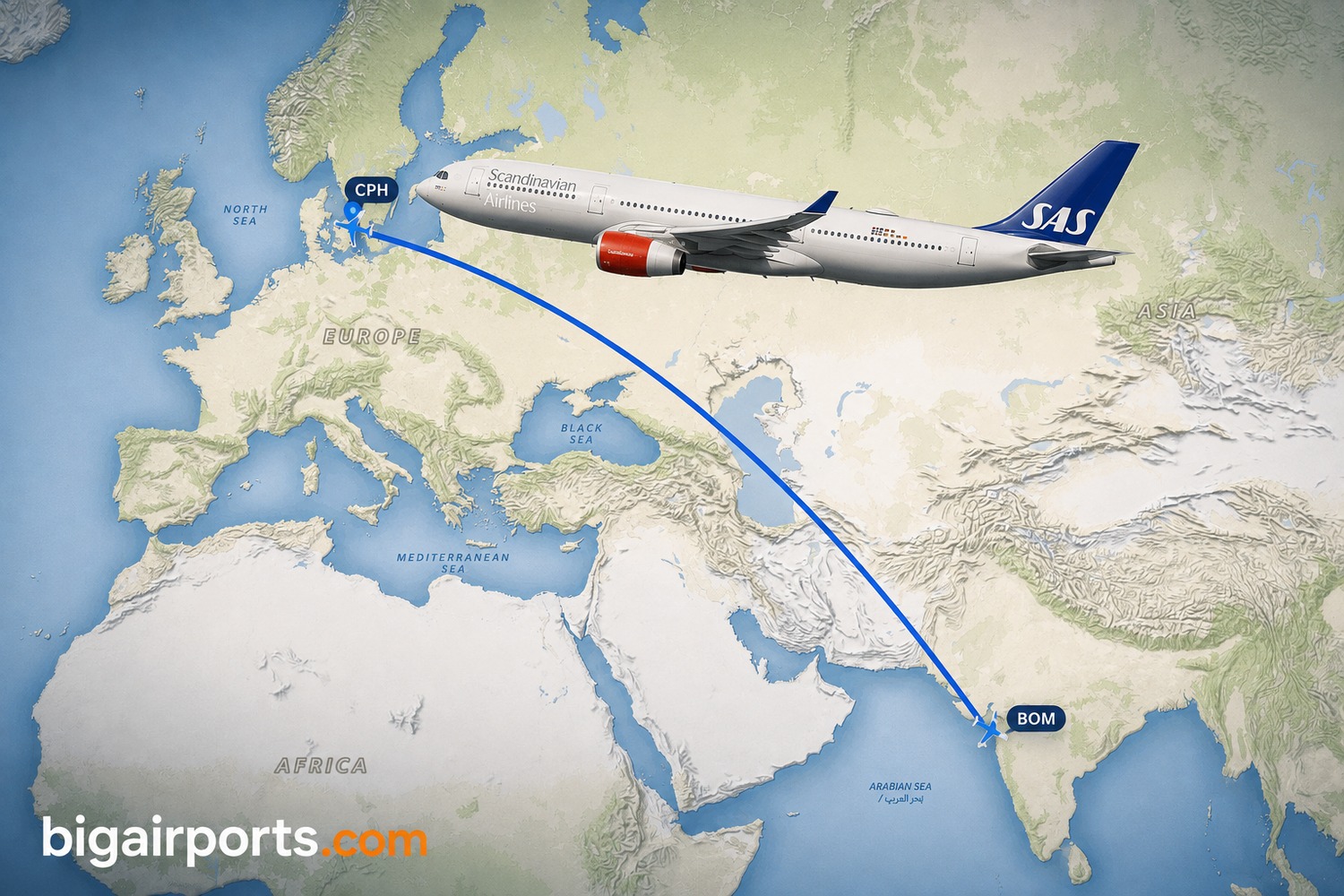
Scandinavian Airlines (SAS) will open a nonstop service between Copenhagen Kastrup Airport and Mumbai’s Chhatrapati Shivaji International Airport on 1 October 2026, operating five weekly rotations with an Airbus A330. The launch restores a nonstop air link between Scandinavia and India and gives the SkyTeam carrier its only direct service to the subcontinent.
- Airline
- Scandinavian Airlines (SK)
- Route
- Copenhagen (CPH) to Mumbai (BOM)
- Aircraft
- Airbus A330
- Frequency
- 5x weekly
- First flight
- 1 October 2026
Route overview
The Copenhagen to Mumbai sector runs to roughly 6,400 kilometres, putting block times in the region of eight to nine hours depending on direction and seasonal winds. SAS has scheduled five rotations a week, with departures timed to connect at Kastrup into the carrier’s short-haul network across Denmark, Norway, Sweden and northern Europe. At the published frequency the operation puts roughly 1,300 seats a week per direction into the market, a deliberately measured opening position for a corridor with no nonstop history in recent decades.
The start date has shifted once already. SAS had initially targeted an earlier launch before fixing 1 October 2026 in its most recent announcement, and the airline has framed the route as a long-planned addition to its network rather than an opportunistic one. At launch, Copenhagen to Mumbai will be the only nonstop service between Scandinavia and India on any carrier’s schedule, and SAS’s sole route into the Indian market.
SAS network context
SAS operates its principal hub at Copenhagen, with further bases in Oslo and Stockholm. The airline joined SkyTeam in September 2024 after an investor group led by Air France-KLM took a stake in the restructured carrier, ending its decades-long membership of Star Alliance. Its long-haul network from Kastrup remains weighted towards North America, with a smaller set of Asian destinations; Mumbai extends that Asian footprint and marks the carrier’s return to India after an absence of several decades.
A five-weekly long-haul operation depends on connecting feed as much as on point-to-point demand, and Kastrup supplies it. In bigairports.com route data, Copenhagen’s trunk routes to Oslo (1,350 flights) and Stockholm (1,322 flights) sit just behind Amsterdam in density, with Bergen, Stavanger and Aalborg adding further Scandinavian feed. That catchment gives the Mumbai service access to passengers from across the Nordic region rather than Danish demand alone.
The Airbus A330 on the route
SAS will fly the route with the Airbus A330, the smaller of the two widebody types in its long-haul fleet alongside the A350-900. The carrier’s A330s carry a three-cabin layout, with SAS Business up front, SAS Plus premium economy and SAS Go economy behind it, seating just over 260 passengers in total.
The type suits the profile of the market. Copenhagen to Mumbai is a classic long, thin route, better served with a mid-size widebody at five weekly than with a larger aircraft flown daily, and the A330’s belly hold matters on a corridor that carries pharmaceutical and industrial freight in both directions: Denmark’s pharmaceutical exporters cluster around Copenhagen, while western India is one of the world’s largest producers of generic medicines.
The airports at each end
Copenhagen Kastrup is Scandinavia’s busiest airport, handling around 30 million passengers a year, and serves 189 routes in bigairports.com data. Its densest market by a wide margin is Amsterdam, at 4,287 flights across eight operators in the sample, ahead of the Oslo and Stockholm trunks. Beyond the Nordic feed, its route mix pairs dense hub links such as Paris and Helsinki, each served by eight operators, with high-volume southern-European leisure markets including Palma de Mallorca, Barcelona, Málaga and Alicante. As the main hub of the SAS system, Kastrup already functions as the intercontinental gateway for Denmark, southern Sweden and much of the Nordic region, and the Mumbai departure slots into its existing long-haul bank structure rather than requiring a new one.
Chhatrapati Shivaji International is India’s second-busiest airport, with 151 routes and annual traffic of more than 50 million passengers. Its single busiest market is Dubai, at 758 flights across five operators, ahead of the domestic trunk to Delhi (580 flights); Amsterdam, at 319 flights, is its strongest link into northern Europe and a marker of what long-haul services on this corridor can sustain. The airport is also severely slot-constrained: its two runways intersect and operate in effect as a single runway, so a set of five weekly long-haul slot pairs represents a material commitment on the Mumbai side of the route as well.
Market context and competition
With no nonstop competitor, traffic between Copenhagen and Mumbai currently flows entirely over intermediate hubs. The strongest one-stop products run over the Gulf, where Emirates feeds Mumbai’s busiest route from Dubai and Etihad connects over Abu Dhabi, and over Amsterdam, where KLM links Mumbai to a Schiphol hub that is also Copenhagen’s largest single market. London Heathrow and Frankfurt carry additional transfer traffic between the two cities, and the Gulf carriers hold the largest share of connecting capacity out of western India.
From October, SAS becomes the sole nonstop operator on the city pair and will compete on elapsed time against those one-stop routings. The underlying market combines Indian communities in Denmark and Sweden, Nordic corporate traffic tied to IT, engineering and shipping operations in Mumbai, and Indian business and leisure travel into Scandinavia. SAS has not published capacity plans beyond the five-weekly schedule, and any move in frequency will show up in the winter and summer timetables that follow the launch. For now, the significant fact is the simpler one: from 1 October 2026, Scandinavia and India are connected nonstop again, on an Airbus A330 wearing SAS colours.
Sources & references (4)
Generated with editorial oversight from AI research.