Riyadh Air Launches Riyadh-Milan Malpensa 787-9 Flights Dec 2026
Saudi start-up Riyadh Air will open a four-times-weekly Boeing 787-9 service between King Khalid International and Milan Malpensa on 16 December 2026, its first route to Italy.
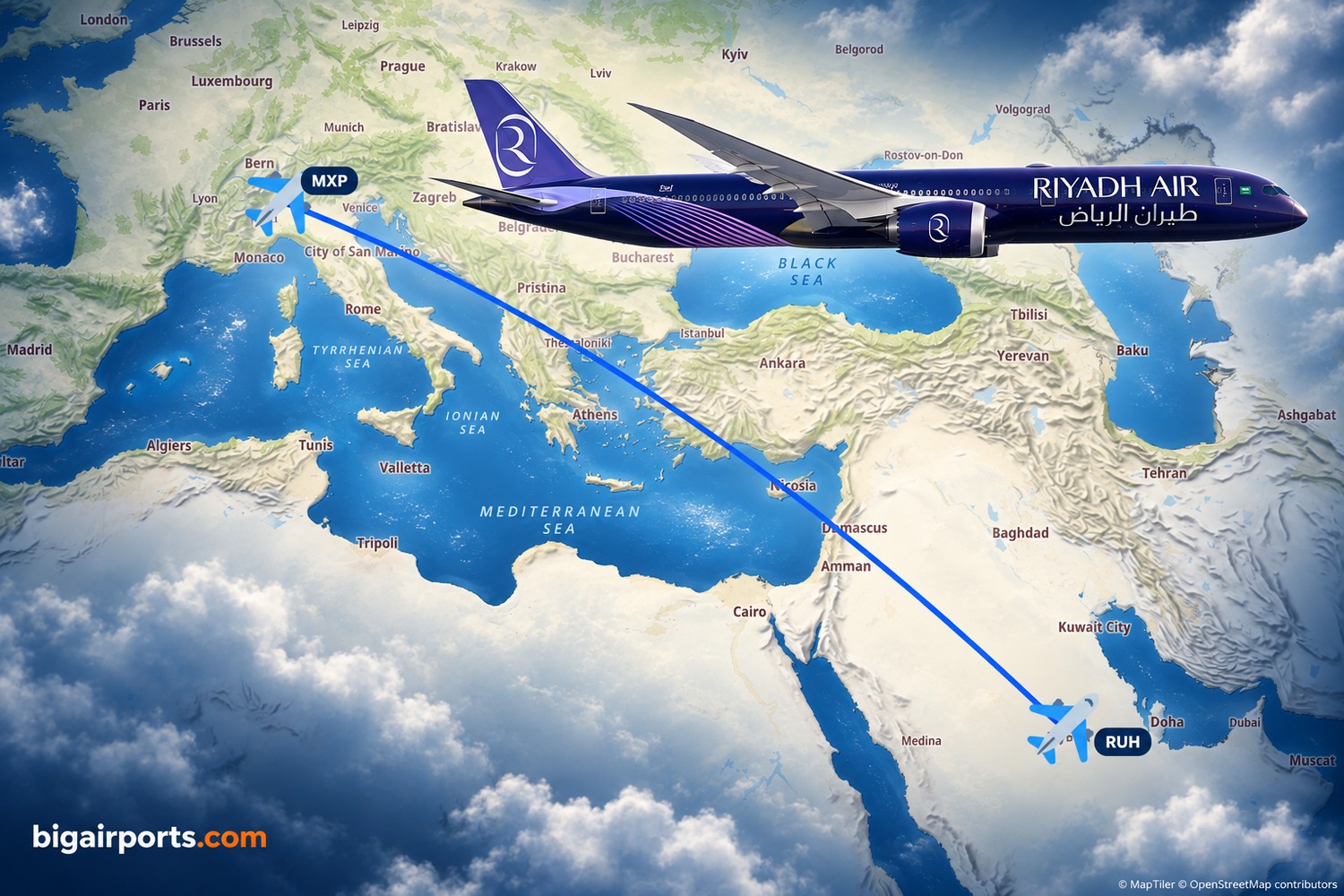
Riyadh Air will open a nonstop link between the Saudi capital and northern Italy on 16 December 2026, flying Riyadh to Milan Malpensa four times weekly with Boeing 787-9 equipment. The service is the start-up carrier’s first route to Italy and extends a European network anchored at its Riyadh base.
- Airline
- Riyadh Air (RX)
- Route
- Riyadh (RUH) to Milan Malpensa (MXP)
- First flight
- 16 Dec 2026
- Frequency
- 4x weekly (Mon, Wed, Fri, Sun)
- Aircraft
- Boeing 787-9
Route overview
The new service will operate on Mondays, Wednesdays, Fridays and Sundays, linking King Khalid International Airport with Milan Malpensa International Airport. The sector covers roughly 4,200 kilometres on a great-circle basis, a distance typically flown in around six hours, and sits comfortably inside the payload-range envelope of the 787-9.
The route was first flagged by schedule trackers in late September 2026, when the carrier filed the flights in distribution systems, and was subsequently confirmed through Saudi state media. Milan becomes Riyadh Air’s first Italian destination, joining a European portfolio that the airline has been assembling since its launch. Four weekly rotations is a conservative opening frequency by long-haul standards, and it is consistent with how the carrier has introduced other new markets before adjusting capacity to demand. The mid-December start also positions the route ahead of the northern winter peak, when leisure flows between the Gulf region and the Alps are traditionally at their strongest.
Riyadh Air’s network build-out
Riyadh Air, the carrier backed by Saudi Arabia’s Public Investment Fund and established in March 2023, began commercial operations in October 2025 with a first flight from Riyadh to London Heathrow. Since then it has been adding destinations from its King Khalid International base at a steady cadence, with the stated ambition of serving more than 100 destinations by 2030 as part of the kingdom’s Vision 2030 diversification programme.
The fleet plan underpinning that growth rests on an order for 39 Boeing 787-9s, with options for a further 33, placed at the airline’s unveiling in 2023, supplemented by an order for 60 Airbus A321neo-family aircraft announced in October 2024 for regional and medium-haul flying. Italy is a logical early addition to the widebody network: Milan is one of Europe’s principal business and financial centres, and the market has had no nonstop link to the Saudi capital in recent schedules.
About the aircraft
The Boeing 787-9 is the mid-size member of the Dreamliner family and the sole widebody type currently in Riyadh Air service. Powered by General Electric GEnx-1B engines in the carrier’s configuration, the type offers a range of around 7,500 nautical miles, far beyond what the Riyadh to Milan sector requires, which gives the airline full payload flexibility for passengers and belly cargo.
In typical two-class layouts the 787-9 seats around 290 passengers; Riyadh Air markets a premium-oriented cabin product across business, premium and economy sections. The type’s fuel efficiency relative to previous-generation widebodies has made it the standard tool for opening long and medium long-haul routes at moderate frequency, precisely the profile of the new Malpensa service, where four weekly flights allow the airline to test demand without committing daily capacity.
About the airports
King Khalid International Airport is the principal gateway to the Saudi capital and the home base of Riyadh Air, alongside Saudia and flynas operations. Bigairports network data currently tracks 135 routes from RUH, a network in which dense domestic trunk flying sits alongside a growing set of international services. Its densest domestic link is Jeddah, with 908 tracked flights, while Dubai is the leading international market at 1,762 tracked flights across six operators. Cairo leads on operator count, with nine carriers competing on the sector, and London Heathrow stands out as the airport’s busiest tracked long-haul market with five operators, a route Riyadh Air itself now serves.
Milan Malpensa International Airport, located at Ferno some 50 kilometres northwest of central Milan, is northern Italy’s primary intercontinental gateway and the country’s busiest cargo airport. The bigairports dataset shows a substantially larger network than Riyadh’s, at 264 tracked routes. Short-haul European trunk markets dominate: Barcelona is the top route with 3,191 tracked flights and seven operators, followed by Madrid at 2,183 flights. The airport’s two-runway, two-terminal layout handles a mix of legacy, low-cost and long-haul traffic, and its route count underlines the onward connectivity available to arriving passengers, from Italian domestic points such as Catania and Palermo to the major Iberian and French markets.
Market context
The Riyadh to Milan city pair has been an indirect market, with traffic flowing over hubs such as Dubai, Doha and Istanbul on Gulf and Turkish carriers, or over Western European hubs including Frankfurt and Paris, both of which appear among Malpensa’s tracked routes. A nonstop product removes a connection of two hours or more in each direction and gives corporate and government traffic between the two capitals of commerce a materially faster option.
Demand drivers run in both directions. Saudi Arabia is targeting a sharp increase in inbound tourism and business travel this decade, while Milan generates steady outbound premium traffic in fashion, finance and manufacturing, sectors in which Saudi-Italian commercial ties have been deepening. For Malpensa, the service adds a Gulf-region spoke to a long-haul map that has been rebuilding since the pandemic; for Riyadh Air, it establishes a second major Western European market alongside London.
Competitive response will be worth watching once the flights go on sale, but as filed the carrier will have the nonstop market to itself at launch. Frequency, rather than aircraft gauge, is the obvious lever if the route matures: the pattern leaves room to move from four weekly services towards a daily operation within the existing 787-9 fleet plan. With four weekly rotations from 16 December 2026, Riyadh Air is sizing the route for a measured start, with the fleet depth to scale if the market performs.
Sources & references (4)
Generated with editorial oversight from AI research.