Riyadh Air to Launch Daily Riyadh–Manila Boeing 787-9 Service
The Saudi start-up will begin daily Boeing 787-9 flights between King Khalid International and Ninoy Aquino International on 9 September 2026, its first route to the Philippines.
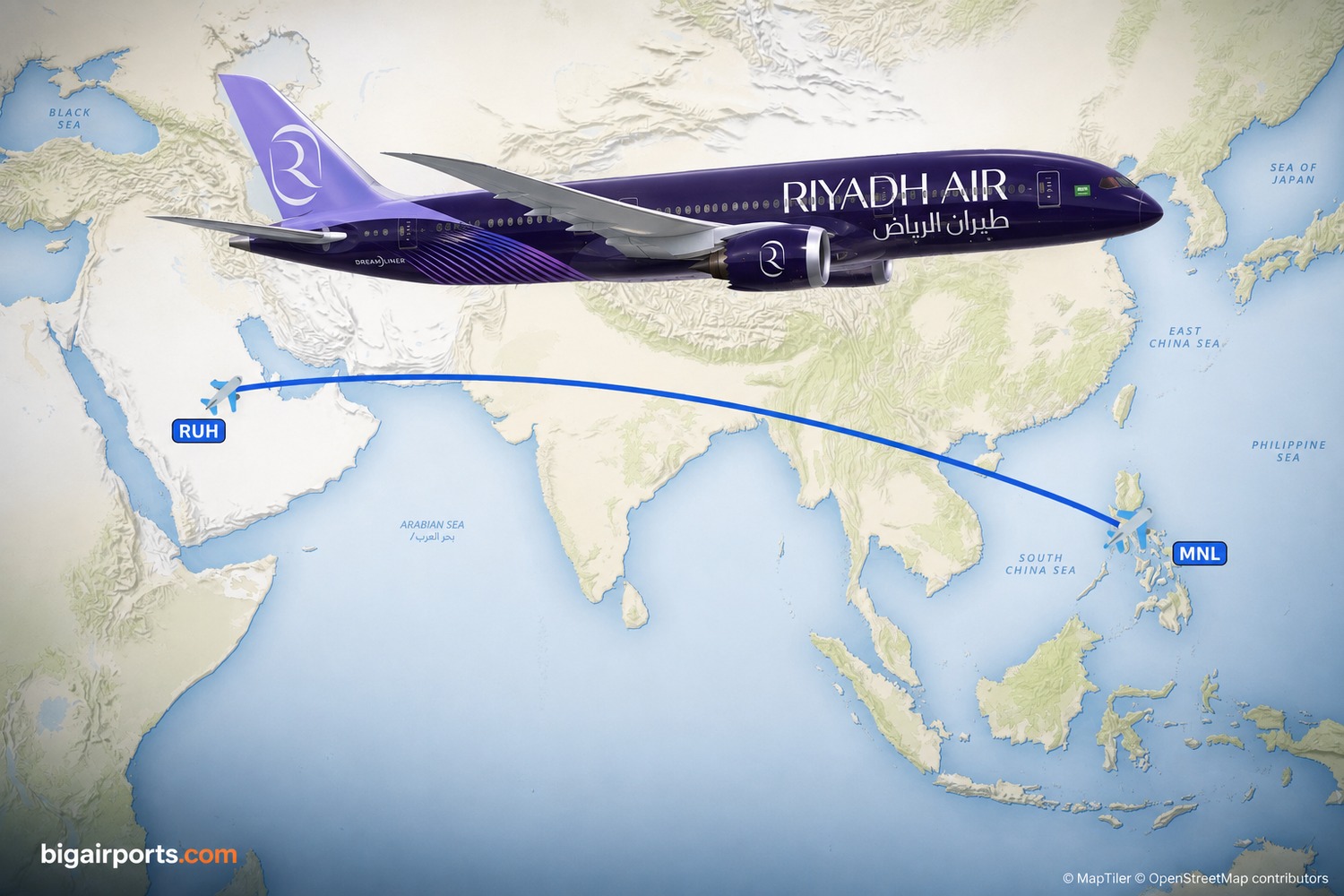
Riyadh Air will launch daily flights between Riyadh and Manila on 9 September 2026, deploying the Boeing 787-9 on the carrier’s first route to the Philippines. The nonstop service links King Khalid International Airport with Ninoy Aquino International Airport and was confirmed through schedule filings published in August 2026.
- Airline
- Riyadh Air (RX)
- Route
- Riyadh (RUH) – Manila (MNL)
- Aircraft
- Boeing 787-9
- Frequency
- Daily
- First flight
- 9 September 2026
Route overview
The daily rotation covers a great-circle distance of roughly 7,800 kilometres (4,200 nautical miles), placing the sector comfortably within the 787-9’s operating envelope while making it one of the longer flights in the carrier’s published schedule. For comparison, Riyadh Air’s Riyadh–London Heathrow sector measures around 4,900 kilometres, so Manila extends the airline’s operating radius by a wide margin.
The service first appeared in reservation systems in early August 2026, with the schedule refined in a subsequent filing later that month. Manila is one of three new Asian destinations confirmed in the airline’s own announcement, and the route launches at daily frequency from the outset rather than building up from a lower rotation, a notably assertive opening for a new long-haul market. Aviation Week counted the service among roughly 50 new routes launching worldwide in September 2026, one of the month’s more prominent long-haul entries.
Riyadh Air’s network context
Riyadh Air, wholly owned by Saudi Arabia’s Public Investment Fund, was established in March 2023 and operated its first commercial flight in October 2025. The carrier is a central element of the Kingdom’s Vision 2030 aviation strategy, which aims to grow Riyadh into a global transfer hub alongside the incumbent flag carrier Saudia in Jeddah, and it has stated an ambition to serve more than 100 destinations by 2030.
The network built out from regional Middle East points and European capitals in its first year, with London Heathrow among the earliest long-haul destinations. The Manila launch forms part of a broader Asian expansion announced in 2026, pushing the operation into Southeast Asia and adding a large, well-defined origin-and-destination market to a schedule that has so far leaned on business and connecting traffic. Beyond the 787-9, the airline’s order book includes Airbus A321neo narrowbodies and Boeing 777-9s for later delivery, giving it the fleet depth to layer frequency onto routes that prove themselves.
About the aircraft
The Boeing 787-9 is the backbone of Riyadh Air’s long-haul fleet. The airline placed an order for 39 of the type, with options for a further 33, in March 2023, and the aircraft has operated its services since launch. Boeing’s published figures give the 787-9 a range of 14,010 kilometres (7,565 nautical miles) and a typical two-class capacity of around 290 seats, powered on Riyadh Air’s aircraft by General Electric GEnx engines.
The type’s economics are well matched to this mission profile. Its range covers the sector with margin in both directions, and the lower deck accommodates up to 36 LD3 containers, useful belly capacity on a corridor where parcel and freight flows track the movement of workers between the two countries.
Riyadh and Manila: the airports
King Khalid International Airport currently offers nonstop service on 134 routes, according to bigairports.com network data. Its densest corridors are regional: Dubai leads with 1,371 tracked flights across six operators, followed by Jeddah at 908 flights, while Cairo attracts the widest operator field at nine airlines. Long-haul service remains comparatively thin, with London Heathrow, at 146 tracked flights across five operators, the largest intercontinental market in the dataset. Islamabad, notably, draws nine operators on just 66 tracked flights, the fragmented pattern typical of labour-flow corridors, and Manila now joins that category as a substantial new long-haul spoke. The airport is also due to be absorbed into the planned King Salman International Airport project, which Saudi authorities have targeted at up to 120 million passengers by 2030.
Ninoy Aquino International Airport, the primary gateway for the Philippine capital region, shows 100 nonstop routes in the same dataset. Domestic trunk flying dominates the schedule: Cebu records 561 tracked flights, with Davao, Iloilo, Caticlan and Cagayan de Oro close behind. Hong Kong is the busiest international corridor at 1,038 flights across ten operators, and Dubai, at 323 flights and three operators, stands out as the airport’s principal long-haul market, underlining how much of Manila’s intercontinental traffic already routes through the Gulf.
Market context and competition
Demand on the Saudi Arabia–Philippines corridor is anchored by overseas Filipino workers, with the Kingdom long ranked among the largest destinations for Filipino labour deployment. The traffic mix skews towards worker and visiting-friends-and-relatives flows, segments where fares, baggage allowances and schedule reliability weigh more heavily than premium cabins, alongside steady remittance-linked cargo demand. Philippine Airlines and Cebu Pacific have both operated Middle East services from Manila over the past decade, though Gulf hub carriers have absorbed much of that flying.
Saudia already connects the Philippines with Saudi Arabia, giving the new entrant an established nonstop incumbent on the country pair. The larger competitive set, however, sits in the Gulf: Manila’s own network data shows Dubai as its leading long-haul corridor, and one-stop capacity over Dubai, Doha and Abu Dhabi has historically carried much of the traffic between Manila and Riyadh. The new daily 787-9 service gives passengers bound for the Saudi capital a single-carrier nonstop alternative to those hub connections.
For Riyadh Air, the route also tests a different commercial formula from its early European flying: a dense, price-sensitive labour and leisure market rather than a corporate one. How the carrier balances point-to-point demand against connections over its 134-route Riyadh hub will be one of the clearer early indicators of how its Asian expansion performs.
Sources & references (5)
Generated with editorial oversight from AI research.