Riyadh Air to Launch Riyadh-Madrid Boeing 787-9 Flights in July
The Saudi start-up will link King Khalid International with Madrid-Barajas three times weekly from 17 July 2026, its first service to the Spanish capital and second announced Spanish destination.
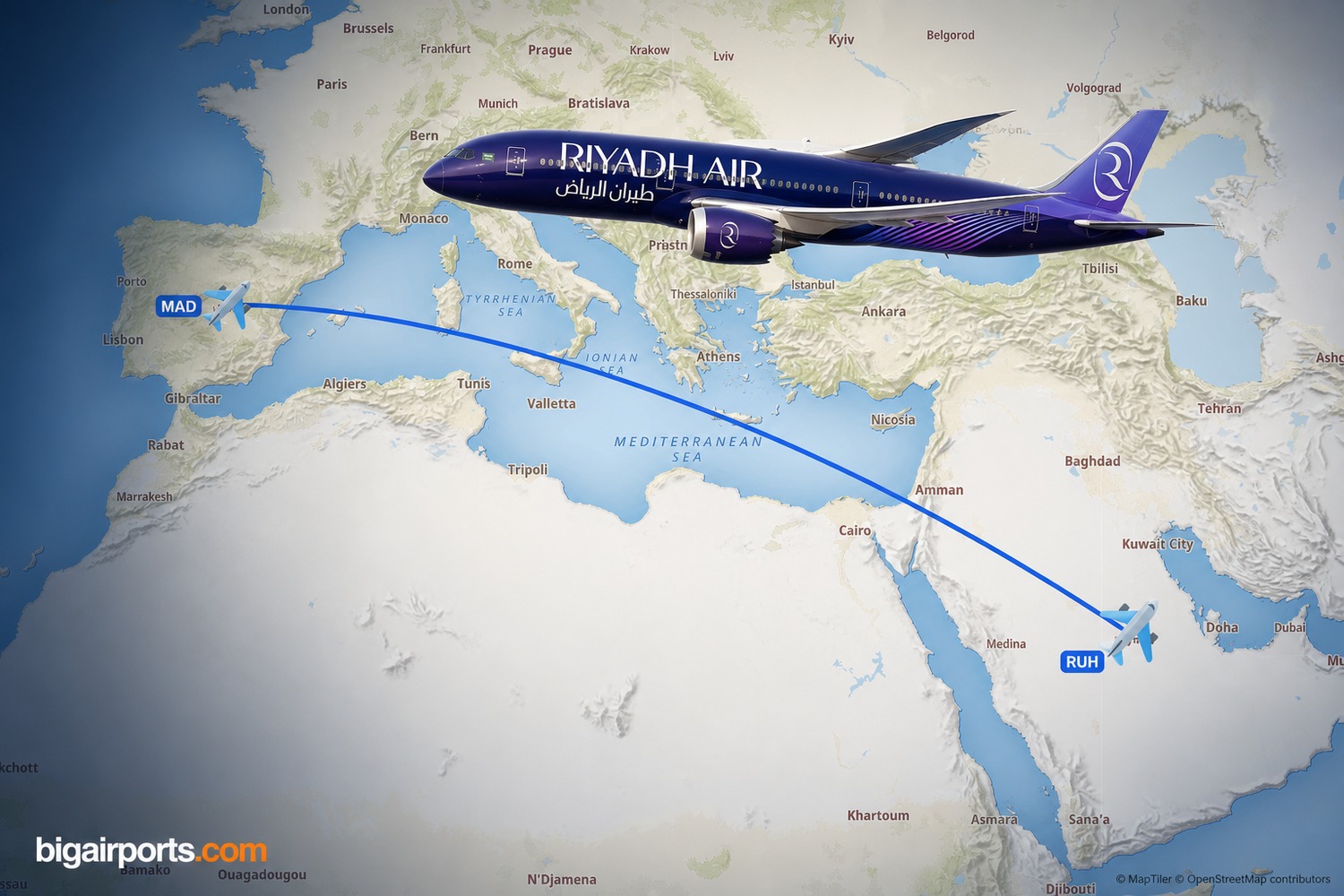
Riyadh Air will launch scheduled services between Riyadh and Madrid on 17 July 2026, adding Spain’s capital to its network less than a year after the carrier’s first commercial flight. The start-up will operate the sector three times weekly with the Boeing 787-9, linking King Khalid International Airport in the Saudi capital with Adolfo Suárez Madrid-Barajas Airport.
- Airline
- Riyadh Air (RX)
- Route
- Riyadh (RUH) to Madrid (MAD)
- Aircraft
- Boeing 787-9
- Frequency
- Three times weekly
- First flight
- 17 July 2026
Route overview
The new service covers a great-circle distance of roughly 4,950 kilometres, or about 2,670 nautical miles, placing it firmly in long-haul territory with a westbound block time of around seven hours. Madrid becomes one of two Spanish points in Riyadh Air’s published network; the carrier opened bookings for Málaga earlier in 2026, alongside Kuala Lumpur and Dhaka.
The Madrid launch deepens a European footprint anchored by London Heathrow, the route that opened Riyadh Air’s commercial operation in October 2025 and one of broadly comparable sector length. The carrier has framed its early expansion around a target of roughly 15 destinations in its initial network phase, and the Spanish capital is a natural component of that plan given the size of the market it unlocks. Tickets are sold through the airline’s direct channels, which opened progressively across the network after the carrier’s initial sales launch.
Airline network context
Riyadh Air is the Public Investment Fund-backed carrier created to give Saudi Arabia a second full-service international airline, based at King Khalid International rather than the traditional Jeddah gateway. Since beginning commercial flights in October 2025, it has moved quickly to broaden its map, with recent booking openings covering Kuala Lumpur, Dhaka and Málaga in addition to earlier European and regional points.
The network strategy leans on Riyadh’s geographic position between Europe, Asia and Africa, with a schedule built for transfer traffic over the home base as well as local demand. Madrid extends the airline’s reach into Southern Europe and gives it a second major European gateway to pair with Heathrow at the western end of its map.
About the aircraft
Riyadh Air will fly the route with the Boeing 787-9, the type on which its entire initial fleet plan rests. The airline holds 39 firm orders for the variant, with options covering a further 33 aircraft, and operates it in a three-cabin layout with business, premium economy and economy sections.
The 787-9 seats around 290 passengers in Boeing’s reference two-class configuration and offers a range of 7,565 nautical miles (14,010 kilometres), far beyond what the Riyadh to Madrid sector requires. Boeing puts the type’s fuel burn per seat at roughly 25 per cent below the previous-generation widebodies it replaces, economics that suit a three-times-weekly long-haul rotation where trip costs matter more than sheer capacity. The composite airframe also allows a lower cabin altitude and higher humidity than older metal-fuselage types, a passenger-comfort argument the airframer routinely makes for sectors in the six-to-eight-hour band.
About the airports
King Khalid International Airport is Riyadh Air’s home base and currently offers 137 nonstop routes, according to bigairports.com network data. Its densest link is domestic: Jeddah, with around 910 tracked flights across four operators, sits well ahead of Dammam, Medina and the rest of the Saudi trunk network. Among international routes, Dubai (296 flights, six operators) and Cairo (271 flights, eight operators) lead, while London Heathrow is the airport’s busiest long-haul connection with 146 flights across five operators. Cairo and Islamabad share the distinction of being the most contested markets from Riyadh, each served by eight operators, a sign of how much carrier competition the Saudi capital already supports on regional trunk routes.
Adolfo Suárez Madrid-Barajas Airport operates on a different scale, with 259 nonstop routes in the same dataset. Short-haul density dominates: Palma de Mallorca (2,888 flights) and Barcelona (2,871 flights) are the two heaviest links, with the Canary Islands, Lisbon and Porto close behind, and Amsterdam the strongest link beyond Iberia at 1,286 flights. The airport’s long-haul network skews heavily towards Latin America, led by Bogotá at 494 flights across six operators. No Gulf or Middle Eastern destination appears among Madrid’s fifteen busiest routes, a picture that underlines how thin nonstop capacity between the Spanish capital and the Gulf region remains.
Market context
Traffic between Riyadh and Madrid has historically moved over intermediate hubs. On the Riyadh side, Dubai and Doha both rank among the airport’s best-served international routes, and both feed onward networks that include Madrid. From the Spanish side, Paris and Amsterdam are among Madrid’s densest European links and carry a share of eastbound connecting traffic. The new nonstop removes the intermediate stop for point-to-point passengers and cuts total journey times materially in both directions.
Two-way demand rests on Saudi Arabia’s push to grow inbound tourism alongside established Saudi outbound leisure travel to Spain. Madrid also adds onward connectivity across Iberia and Latin America through its resident hub carriers, the network breadth reflected in the Bogotá figures above, which gives the route utility beyond the local market at either end.
The service starts at three weekly rotations from 17 July 2026, operated by the 787-9 throughout. At that frequency the route adds a modest but strategically placed block of capacity to a country pair that has lacked density on the Madrid end. With the Spanish capital now on sale alongside Málaga, Kuala Lumpur and Dhaka, Riyadh Air moves a further step towards its stated initial-phase network of around 15 destinations, and towards a schedule in which Southern Europe carries meaningful weight.
Sources & references (4)
Generated with editorial oversight from AI research.