Riyadh Air to Launch Riyadh–Kuala Lumpur Boeing 787-9 Service
Saudi Arabia's start-up carrier will link King Khalid International and Kuala Lumpur International three times weekly from 30 July 2026, deploying the Boeing 787-9 on its first Southeast Asian route.
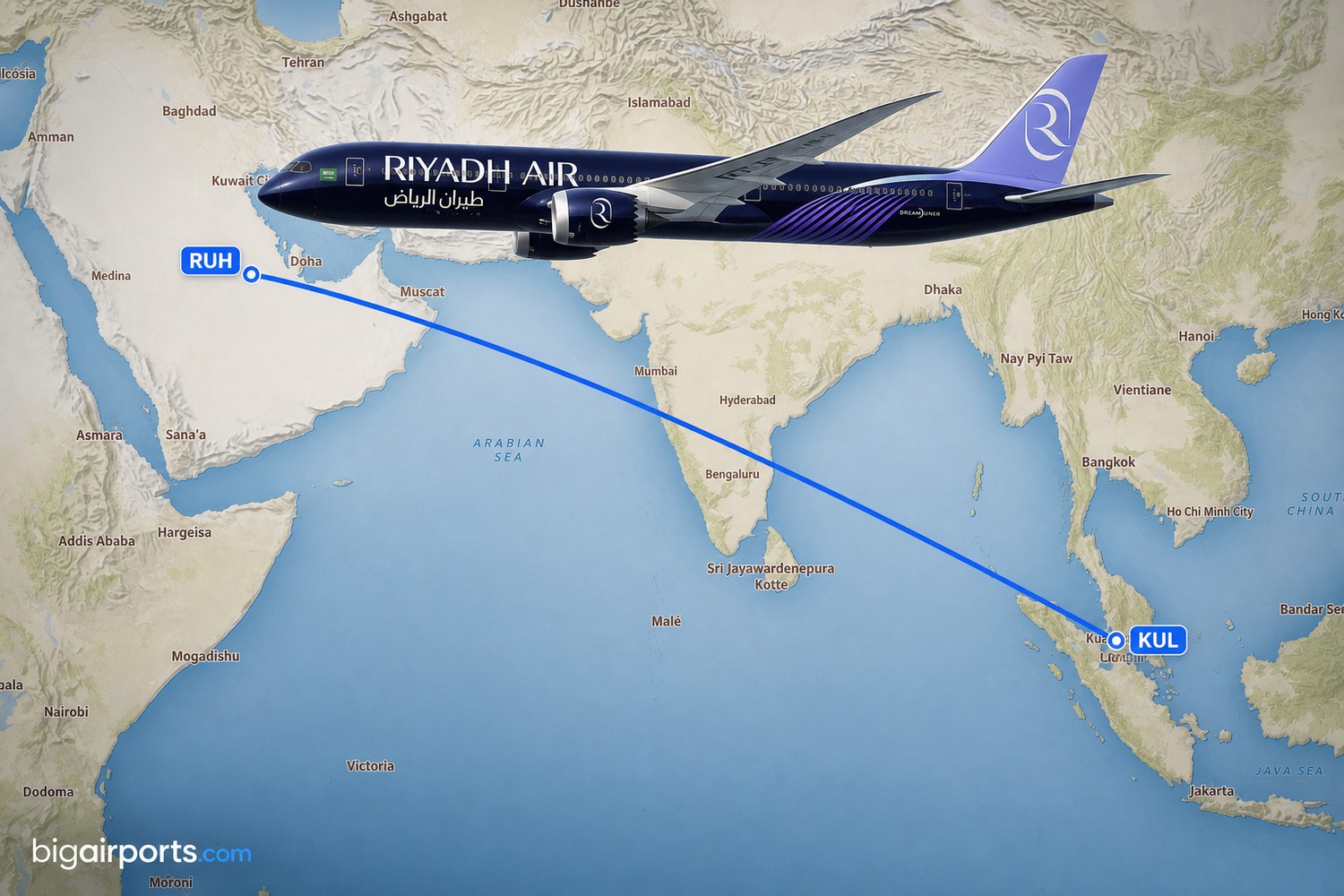
Route overview
Riyadh Air will begin scheduled service between Riyadh and Kuala Lumpur on 30 July 2026, adding its first Southeast Asian destination less than a year after the carrier’s commercial debut. The route will operate three times weekly with Boeing 787-9 equipment, linking King Khalid International Airport (RUH) with Kuala Lumpur International Airport (KUL) in Sepang, south of the Malaysian capital.
- Airline
- Riyadh Air
- Aircraft
- Boeing 787-9
- Frequency
- 3x weekly
- First flight
- 30 Jul 2026
The great-circle distance between the two airports is approximately 6,400 kilometres, or around 3,450 nautical miles, placing the sector comfortably within the 787-9’s operating envelope and pointing to block times in the region of seven to eight hours depending on direction and winds. On launch it will rank among the longest sectors in the carrier’s published network, exceeding the roughly 4,900-kilometre Riyadh–London Heathrow sector.
Kuala Lumpur was announced alongside Malaga as part of the airline’s mid-2026 network expansion, and it extends the start-up’s footprint beyond the initial cluster of European, Middle Eastern and South Asian points built since launch. For Kuala Lumpur, the service adds a nonstop link into the Saudi capital; for Riyadh, it opens a direct connection to one of Southeast Asia’s principal hubs.
Riyadh Air’s network context
Riyadh Air (IATA code RX, ICAO code RXI) is Saudi Arabia’s second flag carrier, established in March 2023 and wholly owned by the kingdom’s Public Investment Fund. The airline operated its first commercial flight in late October 2025, from its Riyadh base to London Heathrow, and has been adding destinations at a steady cadence since.
The carrier is positioned as a premium, digitally led operator and forms part of Saudi Arabia’s wider Vision 2030 programme, which targets a substantial increase in inbound tourism and air connectivity through the capital. Management has publicly stated an ambition to serve more than 100 destinations by 2030, a target that implies sustained network growth across Europe, Asia and Africa over the coming years.
Kuala Lumpur fits that trajectory as the airline’s first point east of the Indian subcontinent. The Malaysian hub offers substantial onward connectivity across Southeast Asia and Australasia, while the Riyadh end of the route feeds Riyadh Air’s growing short- and medium-haul network across the Gulf and the Levant. The route launches at three rotations per week, an entry-level schedule typical of new long-haul markets.
About the aircraft
The Boeing 787-9 is the backbone of Riyadh Air’s long-haul fleet plan. The airline placed an order for 39 of the type, with options for a further 33, in March 2023, one of the launch commitments made before the carrier had flown a single service. The -9 variant typically seats around 290 passengers in two-class layouts and offers a range of roughly 14,000 kilometres, giving the airline coverage of Europe, Africa and most of Asia from its centrally located Riyadh base. Alongside its widebody commitments, the airline has also ordered Airbus A321neo-family narrowbodies for short- and medium-haul flying.
Riyadh Air’s 787-9s are fitted with a premium-oriented cabin featuring business class, premium economy and economy sections, in line with the carrier’s positioning at the upper end of the market. On a sector of roughly 6,400 kilometres, the type operates well inside its design range, leaving no meaningful payload restrictions on the Kuala Lumpur service. The type’s combination of range and moderate capacity makes it suited to opening thinner long-haul markets, the role it performs on the Kuala Lumpur launch.
The airports: Riyadh and Kuala Lumpur
King Khalid International is Riyadh Air’s home base and one of the two principal gateways to Saudi Arabia, alongside Jeddah. Current network data tracked by BigAirports shows 135 active routes from the airport. The densest single link is the domestic corridor to Jeddah, with three operators and more than 900 tracked flights in the recent sample, followed by domestic trunk routes to Dammam, Abha, Medina, Tabuk and Ta’if. Internationally, Cairo stands out with eight operators, while Dubai (five operators), Doha, Abu Dhabi and Amman anchor the Gulf and Levant network, and Islamabad leads the South Asian markets with eight operators. Long-haul service remains comparatively thin: London Heathrow, served by five operators, is the airport’s most significant long-haul market in the current data, which underlines how much room the new national carrier has to build eastward.
Kuala Lumpur International is larger by route count, with 156 active routes in the same dataset. Its busiest links are regional: Singapore leads with eight operators and roughly 300 tracked flights, followed by Kota Kinabalu, Jakarta and Penang. The airport also carries a broad China network, with Guangzhou, Shanghai and Shenzhen all featuring among its top markets, plus dense domestic connectivity to Kuching, Langkawi, Kota Bharu, Johor Bahru and Tawau, and leisure links to Bali and Bangkok Don Mueang. For Riyadh Air, that spread is the commercial logic of the route: Kuala Lumpur functions as a distribution point for secondary Southeast Asian cities that are beyond the reach of nonstop service from Riyadh in current schedules.
Market context and competition
Kuala Lumpur does not appear among the densest routes from Riyadh in current schedule data, and Riyadh is similarly absent from Kuala Lumpur’s leading markets, an indication of how thin nonstop capacity on this city pair has been. Traffic between the Saudi capital and Malaysia has instead flowed largely over intermediate hubs, with Dubai, Doha and Abu Dhabi all offering one-stop routings and each connected to Riyadh by multiple operators.
At launch, Riyadh Air’s principal competition on the origin-and-destination market will therefore be the Gulf network carriers’ one-stop products rather than another nonstop operator. Emirates, Qatar Airways and Etihad Airways all serve both Riyadh and Kuala Lumpur from their respective hubs, and their combined frequency and connectivity set the effective price and schedule benchmark on the pair.
The underlying demand base spans several segments. Malaysia is an established destination for Gulf leisure travellers, while Saudi Arabia draws significant religious traffic from Malaysia, although Umrah and Hajj flows are concentrated on Jeddah and Medina rather than the capital. A three-times-weekly nonstop gives point-to-point passengers in both cities a first scheduled alternative to connecting itineraries.
The inaugural flight is scheduled for 30 July 2026, with the 787-9 operating all frequencies from the outset.
Sources & references (4)
Generated with editorial oversight from AI research.