Riyadh Air to Launch Twice-Daily Riyadh-Islamabad 787-9 Service
The Saudi start-up will open its first Pakistan route on 14 August 2026, linking King Khalid International and Islamabad International with two daily Boeing 787-9 rotations.
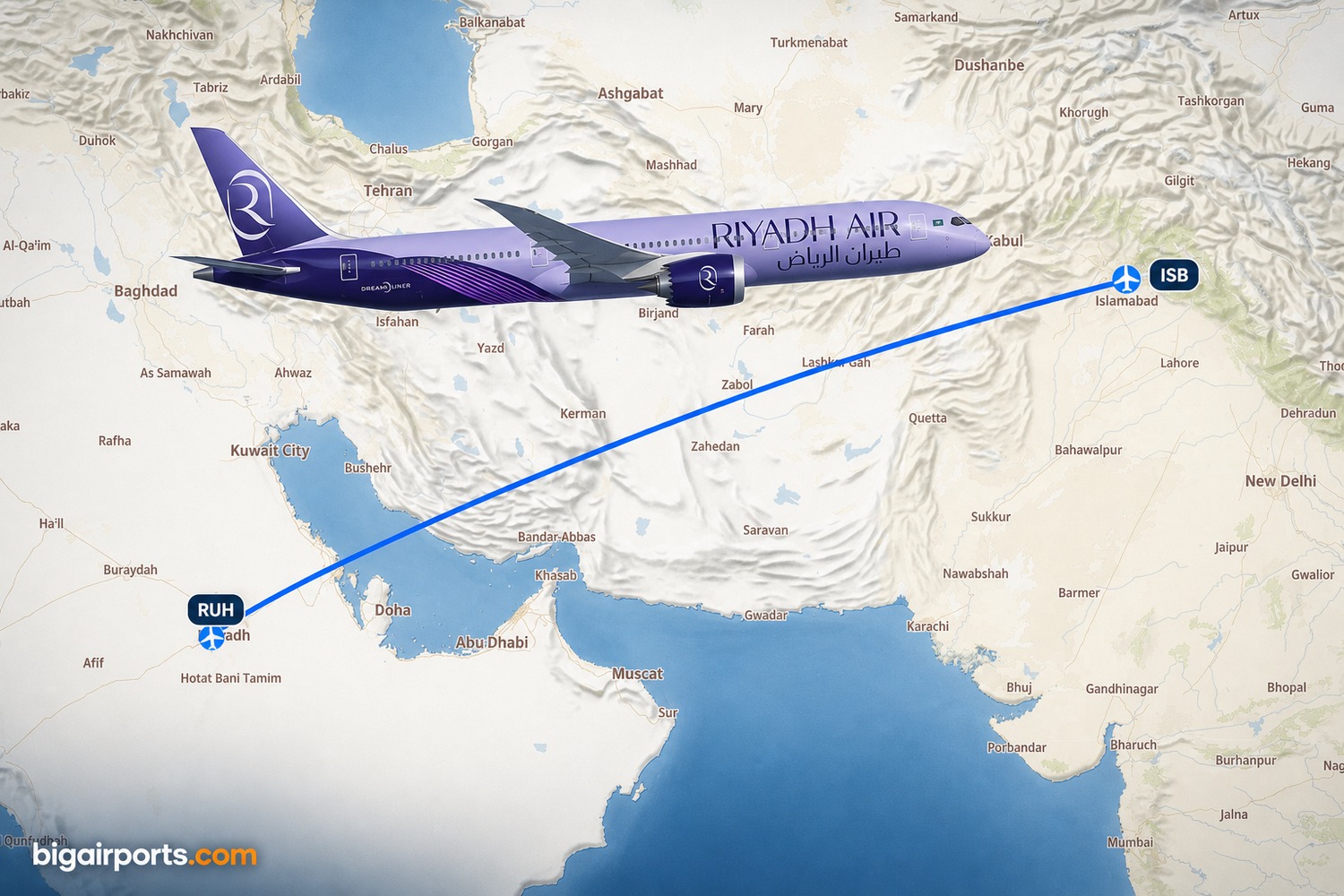
Riyadh Air will begin scheduled flights between Riyadh and Islamabad on 14 August 2026, operating the sector with Boeing 787-9 equipment on a twice-daily basis. The route is the Saudi start-up’s first scheduled service to Pakistan, according to schedule data published by AeroRoutes, and forms part of a broader push into Asian markets in the second half of 2026.
- Airline
- Riyadh Air (RX)
- Route
- Riyadh (RUH) to Islamabad (ISB)
- Aircraft
- Boeing 787-9
- Frequency
- Twice daily
- First flight
- 14 Aug 2026
Route overview
The new service links King Khalid International Airport in the Saudi capital with Islamabad International Airport, located in Attock and serving Pakistan’s capital region. The sector covers roughly 2,700 kilometres, a medium-haul stage length for both airports. Riyadh Air has scheduled two daily frequencies, equivalent to 14 weekly rotations in each direction, an assertive opening commitment for a carrier entering the country for the first time.
Deploying the 787-9 gives the airline widebody capacity on the route from the outset, along with belly cargo space on a corridor that carries steady freight and courier traffic. The double-daily pattern also gives Islamabad passengers same-day access to onward connections over the carrier’s Riyadh hub. The launch comes in a busy month for network openings, with Aviation Week listing the service among 50 new routes starting in August 2026.
Riyadh Air’s network context
Riyadh Air, wholly owned by Saudi Arabia’s Public Investment Fund, was established in March 2023 and operated its first commercial flight in October 2025, between Riyadh and London Heathrow. The carrier has since been building out its network from King Khalid International at pace, and the Islamabad launch is reported by Connecting Travel as part of an Asian expansion covering three new destinations.
The airline is a central element of Saudi Arabia’s national aviation strategy, which targets 330 million passengers and links to 250 destinations by 2030. Pakistan is a logical early market in that build-out: the country supplies one of the largest expatriate workforces in the Kingdom, and traffic between the two states is dense, year-round and comparatively resilient to seasonality.
About the aircraft
The Boeing 787-9 is the mid-sized member of the Dreamliner family, typically seating around 290 passengers in a two-class layout and offering a range of approximately 14,000 kilometres. That capability makes the type comfortably suited to the Riyadh-Islamabad sector while preserving the flexibility to rotate the same airframes onto longer missions elsewhere in the network.
Riyadh Air committed to the type at launch, announcing an order in March 2023 for 39 firm 787-9s with options for a further 33, a potential fleet of up to 72 aircraft. The Dreamliner is the backbone of the carrier’s current operation, and its use on a medium-haul sector such as Islamabad reflects both the volume of traffic on offer and the cargo capability of a widebody.
The airports at each end
King Khalid International is Riyadh Air’s home base and one of the Kingdom’s two principal hubs. bigairports.com network data shows the airport serving 133 routes. Its densest links are domestic and regional trunks: Jeddah leads with 908 tracked flights across four operators, followed by Dubai with 749 flights and Cairo with 272 flights spread across nine carriers. The rest of the top tier is dominated by Saudi domestic routes, including Dammam, Medina, Abha and Tabuk, underlining Riyadh’s role at the centre of the Kingdom’s internal network. Long-haul service includes London Heathrow, with 146 flights and five operators on the pairing, and the airport is set to be folded into the planned King Salman International Airport development as the capital’s capacity expands.
Islamabad International opened in 2018 as the replacement for the former Benazir Bhutto International Airport and now handles 40 routes, according to the same dataset. The airport serves the twin cities of Islamabad and Rawalpindi along with a wide northern Pakistani catchment. Its network is strongly oriented towards the Gulf: Dubai is the largest international link with 199 tracked flights, ahead of domestic services to Karachi with 123 flights and Jeddah with 75 flights across six operators. Abu Dhabi, Sharjah, Dammam, Doha and Muscat fill out a schedule shaped by Pakistan’s overseas workforce, while thin domestic links to Skardu and Gilgit connect the capital to the country’s mountainous north.
Market context and competition
Riyadh Air will not have the city pair to itself. Network data records eight operators on the Riyadh-Islamabad sector, with 65 tracked flights from Riyadh and 59 in the opposite direction, making it one of Islamabad’s better-served international links even before the new entrant arrives. Saudi Arabia is already a major country market at the Pakistani airport, with Jeddah, Riyadh and Dammam all served nonstop. The corridor’s fundamentals are well established: more than two million Pakistani nationals live and work in Saudi Arabia, sustaining steady labour and family traffic, while Umrah pilgrimage demand adds a year-round layer that also flows through Jeddah and Medina.
At a typical two-class 787-9 configuration, the new schedule equates to roughly 4,000 seats per week in each direction, a material addition of capacity on the sector. The competitive picture also extends beyond the direct market: Islamabad’s largest international links are to Gulf hubs, led by Dubai, through which much of Pakistan’s long-haul traffic currently connects, and a twice-daily widebody operation positions Riyadh as an additional transfer point for passengers travelling beyond Saudi Arabia on Riyadh Air’s network. The first flight is scheduled for 14 August 2026.
Sources & references (3)
Generated with editorial oversight from AI research.