Riyadh Air to Launch Three-Weekly Riyadh–Jakarta 787-9 Service
The Saudi start-up opens its first Southeast Asian route on 16 November 2026, with Boeing 787-9 rotations linking King Khalid International and Soekarno-Hatta three times weekly.
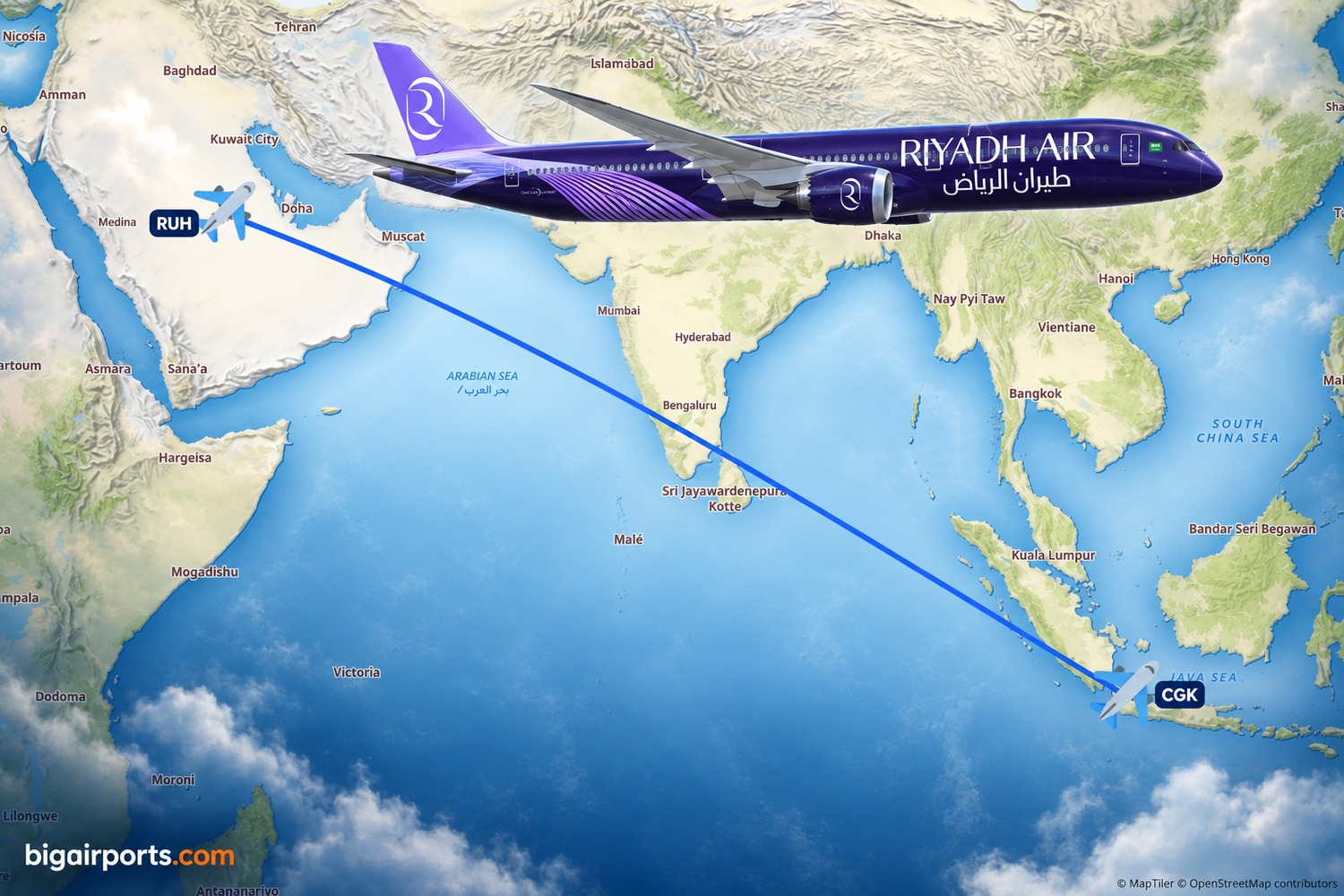
Riyadh Air will open a scheduled link between Saudi Arabia and Indonesia on 16 November 2026, launching three-weekly Boeing 787-9 services from King Khalid International Airport in Riyadh to Soekarno-Hatta International Airport in Jakarta. The route is the Saudi carrier’s first scheduled service to Southeast Asia, and bookings opened in early October 2026.
- Airline
- Riyadh Air (RX)
- Route
- Riyadh (RUH) to Jakarta (CGK)
- Aircraft
- Boeing 787-9
- Frequency
- Three weekly
- First flight
- 16 Nov 2026
Route overview
Flights will depart Riyadh on Mondays, Wednesdays and Fridays, with the return legs leaving Jakarta on Tuesdays, Thursdays and Saturdays. The sector covers roughly 7,300 kilometres on a great-circle basis, which points to block times in the region of nine hours and places the route firmly in long-haul territory for both airports.
A three-weekly pattern is a conventional entry frequency for a new long-haul market, and the chosen days give the carrier an even spread across the week rather than a weekend-skewed operation. The launch date of 16 November falls on a Monday, aligning the first departure with the start of the outbound rotation. Riyadh Air loaded the service for sale in early October 2026, roughly six weeks ahead of the first departure, with distribution through its standard direct and agency channels.
Riyadh Air’s network context
Riyadh Air began commercial operations on 26 October 2025, with a first flight from Riyadh to London Heathrow. Wholly owned by Saudi Arabia’s Public Investment Fund, the airline was created as the kingdom’s second flag carrier with a mandate to develop Riyadh as an intercontinental connecting hub, complementing Saudia’s long-established base in Jeddah.
The carrier has set itself a target of serving more than 100 destinations by 2030, a goal tied to Saudi Arabia’s wider Vision 2030 tourism and aviation programme, and it has been adding points steadily since the Heathrow launch. Jakarta is its first destination in Southeast Asia and among the longest sectors in its published schedule to date, and it signals the eastern reach the airline intends to build from its Riyadh base as the 787-9 fleet grows.
About the aircraft
The route will be operated by the Boeing 787-9, the type on which Riyadh Air launched and the backbone of its current fleet. The airline ordered 39 of the type, with options for a further 33, in March 2023, and followed up with an order for 60 Airbus A321neo-family aircraft in October 2024 to cover shorter regional flying.
With a published range of around 14,000 kilometres, the 787-9 handles the Riyadh–Jakarta sector with a comfortable margin, leaving flexibility for payload and seasonal routing adjustments. The type typically seats around 290 passengers in a multi-class layout, though capacity varies by operator, and its efficiency on thinner long-haul sectors is a central reason it has become the default aircraft for carriers opening medium-density intercontinental markets.
The airports
King Khalid International, the carrier’s home base, currently offers 135 nonstop routes according to bigairports.com network data. Dubai is its busiest link, with 2,079 flights across six operators in the current schedule, ahead of the domestic trunk route to Jeddah on 908 flights. Cairo and Islamabad are the most contested markets by carrier count, each served by nine operators, and the domestic network is dense, with Dammam, Medina, Abha, Tabuk and Ta’if all among the airport’s busiest spokes. Long-haul coverage remains comparatively thin: London Heathrow, with five operators and 146 flights, is the stand-out intercontinental entry in the current data. A nine-hour widebody route to Southeast Asia is therefore a meaningful addition to the Riyadh timetable, and one that deepens the airport’s reach beyond its Gulf and subcontinent core.
Soekarno-Hatta, Jakarta’s principal gateway, fields 110 nonstop routes and a network heavily weighted towards domestic trunk flying. Makassar is the single busiest route by flight count at 955 flights, ahead of Bali/Denpasar and Surabaya, while regional spokes such as Palembang, Padang, Yogyakarta and Balikpapan fill out the top of the table. Singapore, with 11 operators, is the most contested market from the airport, with Bali/Denpasar and Kuala Lumpur each served by ten carriers. All fifteen of its busiest routes are short-haul, which leaves the airport with relatively few nonstop widebody links beyond the region for a hub of its size; the new Riyadh service goes some way towards closing that gap.
Market context and competition
Traffic between Indonesia and Saudi Arabia is anchored by religious travel. Indonesia is the largest source market for umrah pilgrims and holds the largest national hajj quota, flows that have historically been concentrated on Jeddah and Medina and carried by Saudia, Garuda Indonesia and charter operators. A Riyadh nonstop addresses a different slice of demand: government, business and labour traffic between the two capitals, together with connecting passengers routed over the carrier’s growing Riyadh hub.
On the origin-and-destination market itself, the dominant alternatives are one-stop itineraries over the Gulf hubs. Riyadh’s schedule shows frequent links to Dubai, Doha and Abu Dhabi, and each of those hubs connects onwards to Jakarta, while Singapore and Kuala Lumpur, both dense short-haul markets from Soekarno-Hatta, perform the same role from the eastern end. Against that backdrop, a nonstop product gives Riyadh Air a clear schedule advantage on point-to-point Riyadh–Jakarta journeys, removing a connection that typically adds several hours to total travel time in each direction.
The first departure is scheduled for 16 November 2026, with three rotations a week in each direction thereafter. Any change to frequency or equipment will be reflected in the airline’s published schedules as the route beds in.
Sources & references (4)
Generated with editorial oversight from AI research.