Riyadh Air to Launch Daily Riyadh–Mumbai Boeing 787-9 Flights
The Saudi start-up opens its first Indian route on 4 August 2026 with a daily Boeing 787-9 service between King Khalid International and Mumbai's Chhatrapati Shivaji International. Bookings are open.
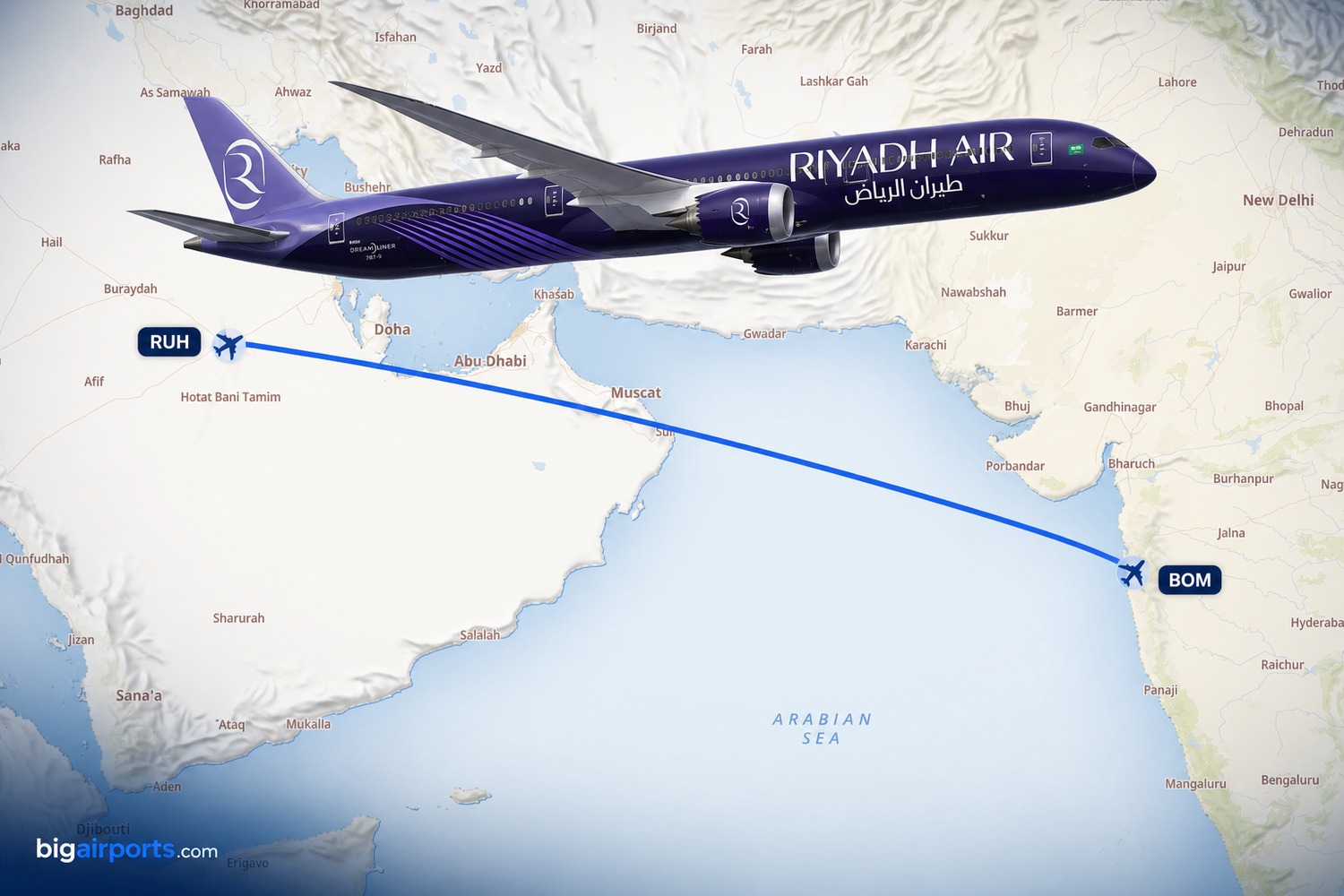
Route overview
Riyadh Air will launch a daily service between King Khalid International Airport (RUH) in Riyadh and Chhatrapati Shivaji International Airport (BOM) in Mumbai on 4 August 2026, the Saudi start-up carrier’s first scheduled route to India. The service will be flown with Boeing 787-9 aircraft. The launch date was confirmed through schedule filings reported by AeroRoutes in early July, and the airline has since opened reservations through its direct sales channels.
- Airline
- Riyadh Air
- Aircraft
- Boeing 787-9
- Frequency
- Daily
- First flight
- 4 Aug 2026
The great-circle distance between the two cities is just under 2,800 kilometres, which puts typical block times in the region of four to four and a half hours. Mumbai becomes the tenth destination on the Riyadh Air network and its first in India. A daily frequency gives the route seven weekly rotations from the outset, rather than the sub-daily starts common among new entrants on medium-haul sectors.
Airline network context
Riyadh Air was established in March 2023 as a wholly owned subsidiary of Saudi Arabia’s Public Investment Fund and began commercial operations in late 2025. The carrier forms part of the kingdom’s Vision 2030 programme, which seeks to diversify the economy away from oil and to position Riyadh as a global aviation hub in its own right, complementing rather than replacing Saudia’s long-established Jeddah operation. Saudi Arabia’s national aviation strategy targets 330 million passengers a year across the kingdom’s airports by 2030, and a second full-service carrier based in the capital is central to that plan.
The airline’s early network has concentrated on a mix of regional and long-haul trunk routes from its King Khalid International base, with London Heathrow among the first destinations served. Mumbai extends that pattern eastwards and opens the Indian market, long one of the largest sources of traffic for Gulf-based carriers.
On the fleet side, Riyadh Air holds firm orders for 39 Boeing 787-9s with options for a further 33, placed at the airline’s launch in 2023, and added an order for 60 Airbus A321neo-family aircraft in 2024. Management has stated an ambition to serve more than 100 destinations by 2030, a target that implies a sustained cadence of route launches over the coming years.
The Boeing 787-9
The 787-9 is the mid-size member of Boeing’s Dreamliner family, typically seating around 290 passengers in a two-class layout and offering a range of roughly 14,000 kilometres. That capability is far in excess of what the four-hour Riyadh–Mumbai sector requires, but operating a single widebody type across regional and long-haul missions simplifies crewing, maintenance and scheduling for a young carrier still building scale.
The type’s composite fuselage permits a lower cabin altitude and higher humidity than earlier-generation metal airframes, and Boeing quotes fuel-burn improvements of around 20 per cent over the aircraft it was designed to replace. Passenger-facing features include larger electrochromic windows, lower cabin noise and gust-alleviation systems that soften the effects of turbulence. For Riyadh Air, the 787-9 is the launch aircraft of the fleet plan and carries the carrier’s full cabin product, which the airline has positioned with a premium-heavy configuration aimed at both corporate and connecting leisure traffic. The carrier took delivery of its first examples ahead of its late-2025 launch and has scheduled the type across its network to date.
The airports: Riyadh and Mumbai
King Khalid International is Riyadh’s sole commercial airport and the centre of Riyadh Air’s operation. Route data tracked by BigAirports shows 135 nonstop destinations from RUH. The domestic trunk to Jeddah is by some distance the busiest link, with 909 tracked flights across three operators, followed by services to Dammam, Abha, Medina, Tabuk, Ta’if, Gizan and Najran — a dense internal network reflecting the kingdom’s reliance on air transport for inter-city travel. Internationally, Cairo leads on operator count with eight carriers on the route, while Dubai (279 tracked flights), Amman, Abu Dhabi, Doha and Islamabad round out the main short- and medium-haul flows. London Heathrow, with five operators and 146 tracked flights, is the airport’s principal long-haul market.
Chhatrapati Shivaji International is India’s second-busiest airport and a heavily slot-constrained field operating on intersecting runways. BigAirports data records 152 nonstop destinations from BOM. Domestic flying dominates: New Delhi is the top route with 580 tracked flights across seven operators, followed by Bangalore (366 tracked flights), Kolkata, Ahmedabad, Hyderabad and Chennai. On the international side, Abu Dhabi is served by five operators, and the long-haul portfolio includes London Heathrow and Amsterdam, each with five operators and 83 tracked flights. Riyadh Air’s daily 787-9 will use Terminal 2, which handles Mumbai’s international traffic.
Market context and competition
The India–Saudi Arabia market is among the larger international corridors touching the subcontinent, underpinned by an Indian expatriate community in the kingdom estimated at well over two million people, alongside growing business traffic tied to Saudi Arabia’s economic diversification programmes and steady religious travel demand. Mumbai, as India’s financial capital, is a logical first Indian point for a carrier courting corporate traffic.
Nonstop competition on the Saudi Arabia–Mumbai market comes principally from Saudia, while a substantial share of Riyadh–Mumbai journeys currently flows one-stop over the Gulf hubs. The network data illustrates the strength of those intermediaries: Dubai, Abu Dhabi and Doha all feature prominently among Riyadh’s top routes, and Abu Dhabi is served by five operators from Mumbai. A nonstop product removes the connection penalty on a sector short enough that a stopover materially extends total journey time.
For Riyadh Air, the route also feeds its own connecting proposition: Mumbai passengers arriving in Riyadh gain one-stop access to the carrier’s westward network, including London Heathrow. Daily frequency from day one signals that the airline views Mumbai as a core market rather than a seasonal experiment, and the 787-9 provides headroom for premium demand as well as belly cargo, a meaningful revenue line on India–Gulf routes.
Sources & references (4)
Generated with editorial oversight from AI research.