Riyadh Air to Launch Riyadh–Bangkok 787-9 Service in September 2026
The Saudi start-up will fly four weekly Boeing 787-9 rotations between King Khalid International and Suvarnabhumi from 2 September 2026, marking its first destination in Southeast Asia.
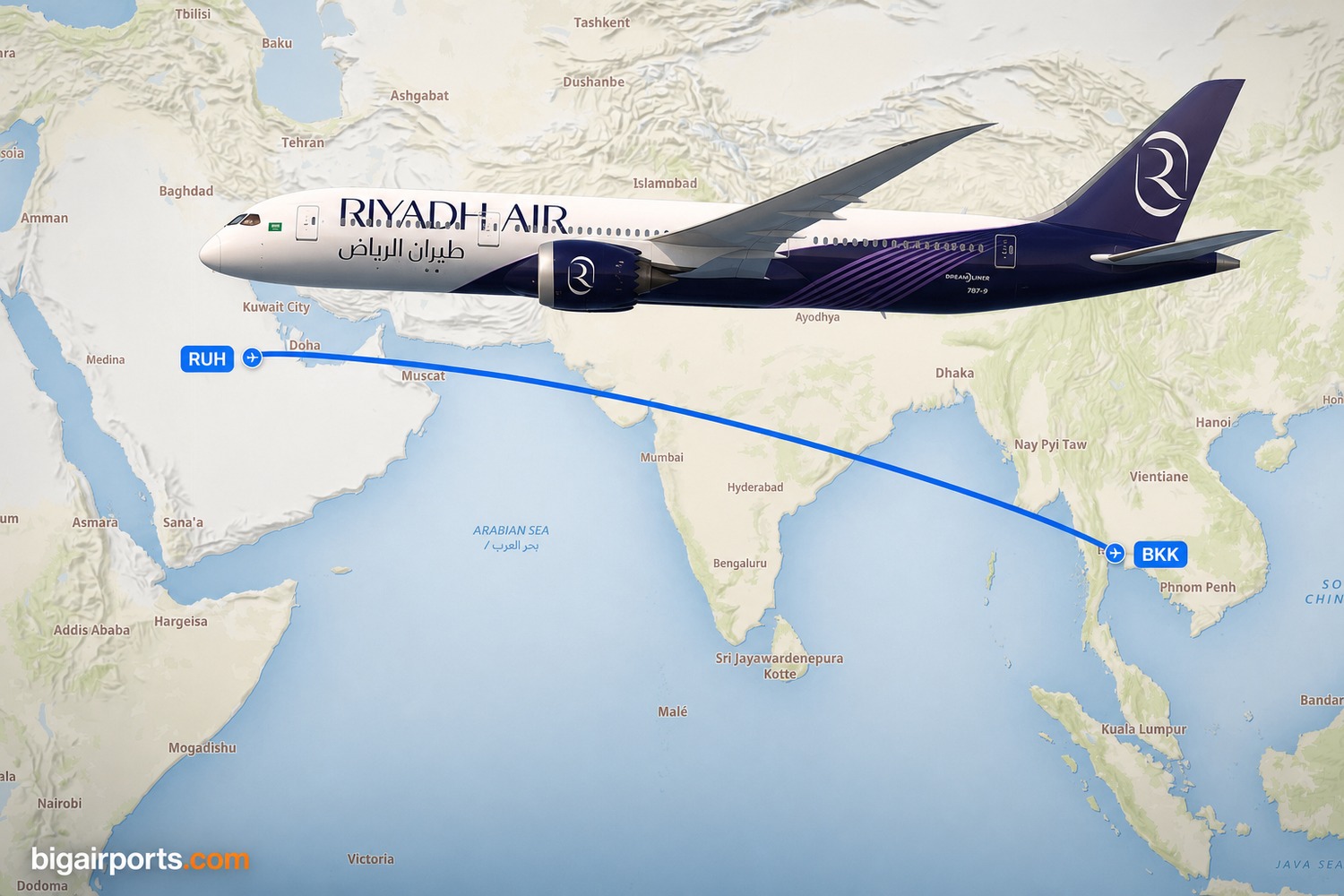
Riyadh Air will begin scheduled flights between Riyadh and Bangkok on 2 September 2026, opening its first route into Southeast Asia. The Saudi start-up will operate the sector four times weekly with Boeing 787-9 equipment, linking King Khalid International Airport with Suvarnabhumi Airport, Thailand’s principal international gateway. Schedule filings for the service were reported by AeroRoutes in early August 2026, and bookings have opened across the carrier’s distribution channels.
- Airline
- Riyadh Air (RX)
- Route
- Riyadh (RUH) to Bangkok (BKK)
- Aircraft
- Boeing 787-9
- Frequency
- 4x weekly
- First flight
- 2 September 2026
Route overview
The Riyadh to Bangkok sector covers a great-circle distance of roughly 5,770 kilometres, producing block times of around six and a half hours eastbound and somewhat longer on the westbound return against prevailing winds. Four weekly rotations put the route firmly in year-round scheduled territory rather than a seasonal filing, and the launch was confirmed through official channels, with the Saudi Press Agency carrying the announcement alongside the airline’s own booking release.
Bangkok is the airline’s first destination in Southeast Asia and extends the widebody network it has been assembling from its Riyadh base since entering service. The Thai capital pairs a substantial origin-and-destination leisure and labour market with one of Asia’s deepest connecting banks, giving the new service both local and transfer traffic to draw on from day one. A four-times-weekly start is a conventional opening pattern for a long-haul entrant, allowing the carrier to test demand before committing additional widebody capacity.
Riyadh Air’s network context
Riyadh Air was established in March 2023 and is owned by Saudi Arabia’s Public Investment Fund. The carrier operated its first commercial flight in late October 2025, between Riyadh and London Heathrow, and has added routes steadily as new aircraft deliver, with announcements through 2026 spanning Europe, the Middle East and now Southeast Asia.
The airline is a central instrument of Saudi Arabia’s national aviation strategy, which targets 330 million passengers across the kingdom’s airports by 2030 and seeks to establish Riyadh as a transfer hub between Europe, Africa and Asia. An anchor point in Southeast Asia fits that eastward build-out: Bangkok can be sold both as a destination in its own right and as a connection over Riyadh from Europe and the wider region.
About the aircraft: Boeing 787-9
Riyadh Air will fly the route with the Boeing 787-9, the type on which it launched operations. The airline placed an order for 39 of the type, with options for a further 33, in March 2023, and the 787-9 remains its sole in-service aircraft family. With a range in the region of 14,000 kilometres, the aircraft covers the 5,770-kilometre Bangkok sector with substantial payload and routing flexibility.
The carrier’s 787-9 cabin is arranged across four classes, headlined by its Business Elite suites and supported by business, premium economy and economy cabins. Riyadh Air has also ordered the Airbus A350-1000 for later long-haul growth, leaving the 787-9 as the workhorse of the current network phase. The type’s efficiency relative to earlier-generation widebodies suits medium-density sectors of this kind, where four weekly frequencies must carry the economics of the route.
About the airports
King Khalid International Airport serves 133 nonstop routes, according to bigairports.com network data. Its densest markets are domestic, led by the Jeddah trunk, with Dammam, Abha and Medina among the busiest onward links. Internationally, Dubai leads with six operating carriers, Cairo is served by nine carriers and Islamabad by eight, and London Heathrow, its principal long-haul market, hosts five operators. The airport also sits at the centre of the King Salman International Airport development, the multi-runway expansion project intended to lift Riyadh’s capacity substantially over the coming decade.
At the other end of the route, Suvarnabhumi Airport offers 168 nonstop routes, ranking it among Southeast Asia’s most connected hubs. Hong Kong is its busiest international market, with 13 operating carriers, while Seoul Incheon, Shanghai Pudong and Hanoi each host ten. Its domestic network to Phuket, Chiang Mai, Krabi and Ko Samui offers Riyadh Air passengers onward access to Thailand’s principal leisure destinations, while Tokyo Narita, served by seven carriers, anchors its long-haul schedule. The airport opened its third runway in late 2024 and brought the SAT-1 satellite terminal into service in 2023, capacity additions aimed at supporting Thailand’s tourism recovery and the airport’s continued growth as a transfer point.
Market context and competition
Saudia restored Bangkok services from Saudi Arabia in 2022, following the restoration of diplomatic relations between Riyadh and Bangkok that ended a rupture dating back to 1989. Riyadh Air’s arrival therefore adds a second Saudi carrier to the Saudi Arabia to Thailand market within four years of its reopening, on a country pair where nonstop capacity remains young and where schedules are still being rebuilt after a three-decade absence.
One-stop competition is significant. bigairports.com data shows six carriers operating Riyadh to Dubai and three each to Doha and Abu Dhabi, feeding Gulf hubs that carry dense Bangkok schedules of their own. Riyadh Air will be competing against those connecting options on price and schedule as much as against the nonstop incumbent.
Demand fundamentals have moved in the route’s favour. Thai visitor traffic from Saudi Arabia has grown from a negligible base since 2022, supported by targeted tourism promotion, while labour movement and expanding bilateral trade add point-to-point volume in both directions. The first flight is scheduled for 2 September 2026, with all four weekly frequencies already on sale.
Sources & references (5)
Generated with editorial oversight from AI research.