Akasa Air Opens Mumbai–Hanoi Route with 4x-Weekly Boeing 737-8
Akasa Air's seventh international destination is its first east of India, linking BOM and HAN four times weekly with 189-seat Boeing 737-8s from 4 September 2026.
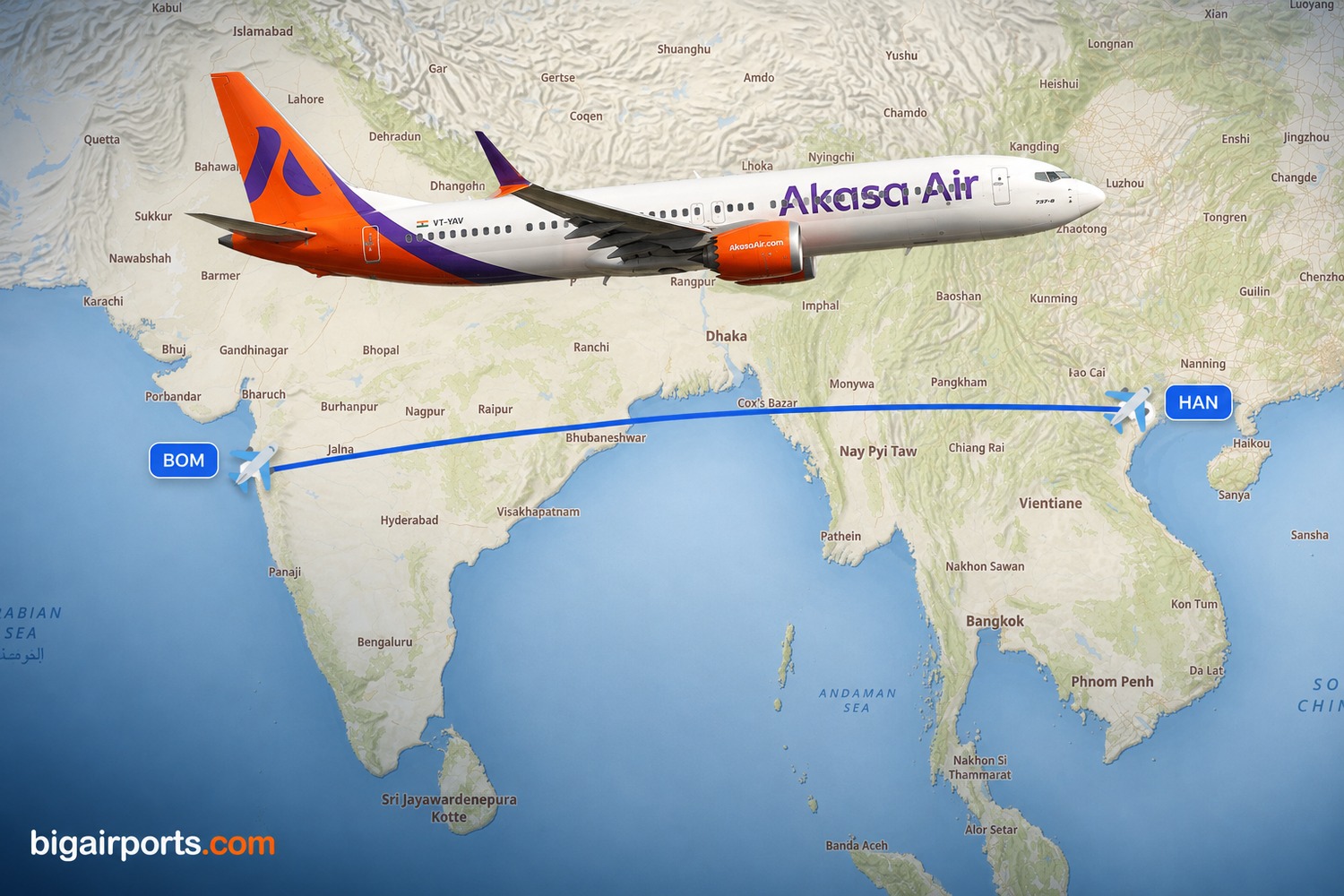
Akasa Air operated its first scheduled service from Mumbai to Hanoi on 4 September 2026, opening a four-times-weekly link between India’s financial capital and the Vietnamese capital with the Boeing 737-8. Hanoi is the carrier’s seventh international destination and its first in Southeast Asia, marking the airline’s entry into a market it has not previously served in any form.
- Airline
- Akasa Air (QP)
- Route
- Mumbai (BOM) – Hanoi (HAN)
- Aircraft
- Boeing 737-8
- Frequency
- 4x weekly
- First flight
- 4 Sep 2026
Route overview
The new service connects Chhatrapati Shivaji Maharaj International Airport (BOM/VABB) with Noi Bai International Airport (HAN/VVNB), a sector of roughly 3,200 kilometres with a block time of around four and a half hours eastbound. Four weekly rotations with Akasa’s standard 189-seat 737-8 configuration put approximately 756 seats per week into the market in each direction.
The route serves point-to-point demand between two cities with no prior Akasa presence on either end of the country pair, and it also connects over Mumbai to the carrier’s domestic network, which spans metro and secondary cities across India. Belly capacity on the 737-8 adds a modest but regular cargo link on a corridor where electronics and textiles dominate bilateral trade flows. Akasa announced the route in April 2026 and confirmed the 4 September start date in late August.
Airline network context
Akasa Air began operations in August 2022 and flew its first international sector in March 2024, when it opened Mumbai–Doha. The six international destinations added before Hanoi (Doha, Jeddah, Riyadh, Dammam, Kuwait City and Abu Dhabi) all sit in the Gulf region, reflecting the strength of labour and VFR traffic between India and the Arabian peninsula. Hanoi is therefore the airline’s first destination east of India and its first route aimed primarily at leisure and trade flows rather than the Gulf migrant corridor.
The carrier operates an all-Boeing fleet of 737-8 and 737-8-200 aircraft and holds an order book of 226 737 MAX jets, giving it the delivery pipeline to sustain further network growth through the decade. Mumbai is Akasa’s largest base and the origin of the majority of its international flying.
About the aircraft
Akasa’s Boeing 737-8 seats 189 passengers in a single-class layout and is powered by CFM LEAP-1B engines. With a maximum range of around 6,480 kilometres, the type covers the Mumbai–Hanoi sector with margin to spare, and its trip economics on four-to-five-hour stages are central to Akasa’s ability to open thinner international markets at four weekly frequencies rather than daily.
The airline also operates the higher-density 737-8-200, seating 197, though the standard 737-8 is the workhorse of its international operation. The type’s payload-range performance means the aircraft can fly the sector year-round without seasonal restrictions, and its commonality across the fleet keeps crewing, maintenance and spares provisioning on a single type rating, a structural cost advantage for a carrier still scaling its international footprint from a young fleet.
About the airports
Chhatrapati Shivaji Maharaj International Airport is India’s second-busiest airport, handling more than 50 million passengers annually from a constrained site with two intersecting runways, which effectively operate as a single runway and make slots at the airport among the scarcest in India. It currently offers nonstop service to 151 destinations. Its busiest domestic link is New Delhi, served by seven operators, while Dubai is its densest international route, with five carriers and roughly 736 flights on current schedules. The airport’s long-haul map extends as far as Amsterdam, served by five operators, underlining Mumbai’s role as a genuine intercontinental gateway rather than a purely regional hub.
Noi Bai International Airport is Vietnam’s second-busiest airport and the gateway to the capital, located in Soc Son district roughly 27 kilometres north of central Hanoi. Domestic flights use Terminal 1 and international services the newer Terminal 2. The airport serves 121 destinations, anchored by the Hanoi–Ho Chi Minh City trunk route, which sees around 1,307 flights across seven operators, making it one of the busiest domestic city pairs in the world. Its international network skews heavily to Northeast Asia: ten carriers compete on Hanoi–Hong Kong, nine on Seoul Incheon and eight on Shanghai, while Bangkok and Kuala Lumpur lead its Southeast Asian links.
Market context
Nonstop capacity between India and Vietnam has grown steadily since the post-pandemic reopening of both markets, with VietJet Air, Vietnam Airlines and IndiGo all operating between the two countries across a range of city pairs. Rising Indian outbound tourism to Vietnam, supported by the country’s e-visa regime for Indian nationals, has been the principal driver, alongside expanding bilateral trade. Vietnam has become one of the fastest-growing outbound destinations for Indian travellers, and carriers on both sides have responded by layering new city pairs onto what was, before 2019, an almost entirely one-stop market.
For the Mumbai–Hanoi city pair specifically, Akasa’s entry adds an Indian low-cost operator to a corridor previously dominated by Vietnamese carriers on the wider country market. At four weekly frequencies and 189 seats per departure, the service is sized conservatively for a developing leisure and business market rather than an established trunk route, consistent with how Akasa has entered its Gulf markets since 2024.
The launch also gives Noi Bai an additional South Asian link at a time when its network of 121 destinations remains concentrated on East and Southeast Asia, and it deepens Mumbai’s Southeast Asian connectivity beyond the established Bangkok, Singapore and Kuala Lumpur trunks. Whether frequencies increase will depend on how the market matures; Akasa has made no announcement beyond the current schedule.
Sources & references (5)
Generated with editorial oversight from AI research.