SalamAir Launches Twice-Weekly Muscat-Kigali (MCT-KGL) Service
Oman's low-cost carrier began nonstop Muscat-Kigali flights on 21 July 2026, operating Tuesdays and Thursdays and opening the first scheduled air link between Oman and Rwanda.
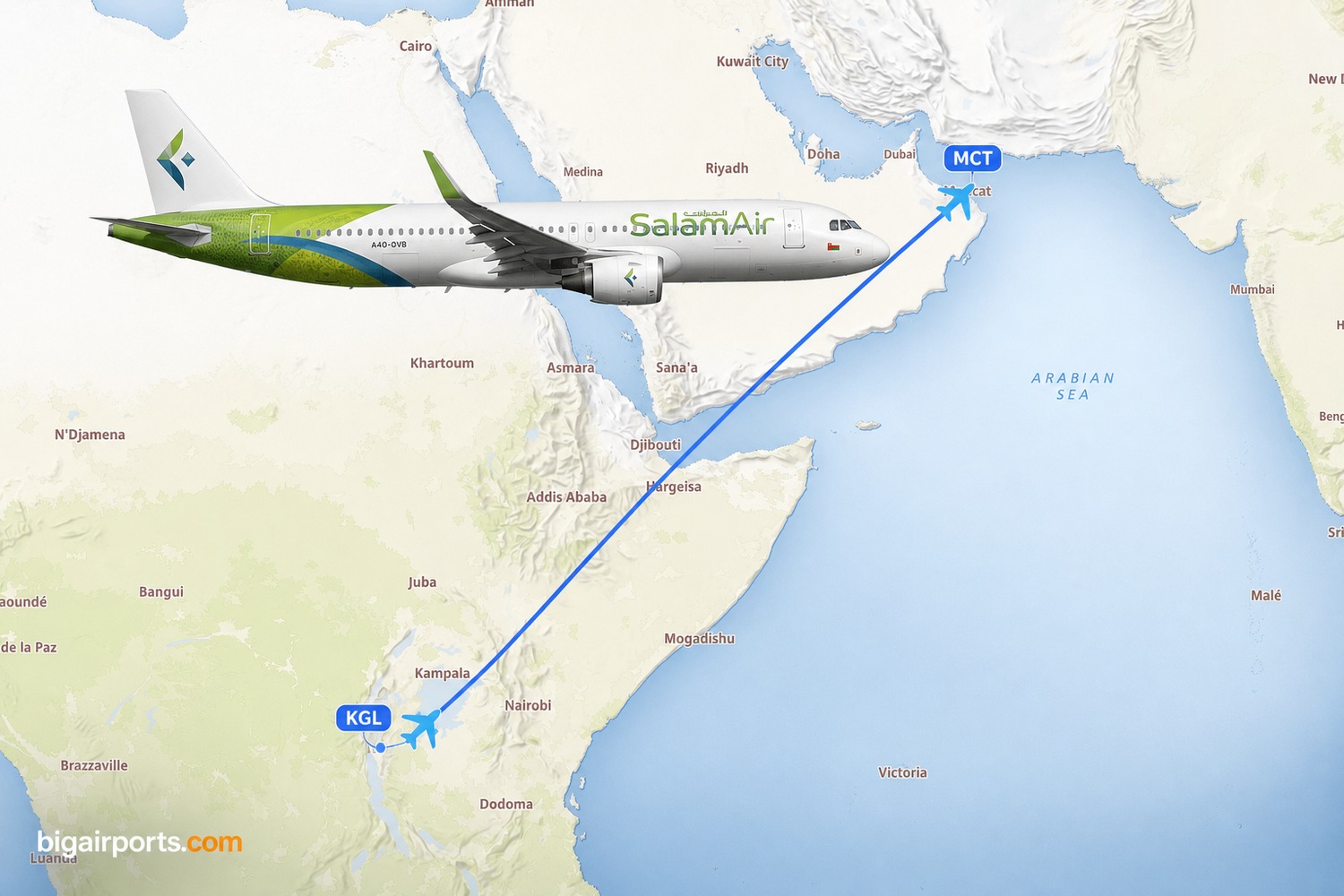
SalamAir operated its first scheduled service between Muscat and Kigali on 21 July 2026, opening the first nonstop air link between Oman and Rwanda. The Omani low-cost carrier flies the route twice weekly, on Tuesdays and Thursdays, from its home base at Muscat International Airport to Kigali International Airport, hub of Rwandan flag carrier RwandAir.
- Airline
- SalamAir (OV/OMS)
- Route
- Muscat (MCT) to Kigali (KGL)
- Frequency
- Twice weekly (Tue/Thu)
- First flight
- 21 July 2026
- Aircraft
- Not disclosed
Route overview
The Muscat-Kigali sector covers a great-circle distance of roughly 4,200 kilometres, tracking south-west across the Arabian Sea and the Horn of Africa into the East African interior. It is a long sector by narrow-body standards, although one that sits comfortably within the capability of current-generation single-aisle aircraft.
The inaugural service arrived in Kigali on 21 July, an event covered by Rwandan state broadcaster RBA. Regional reporting placed the launch in the context of deepening economic and diplomatic ties between Oman and Rwanda, with both governments looking to grow trade, investment and tourism flows between the Gulf and East Africa. Rwanda has actively courted Gulf capital in its aviation and hospitality sectors in recent years, and the new service is the country’s first scheduled link to Oman in either direction.
Published schedule data lists the operation as twice weekly, on Tuesdays and Thursdays. SalamAir has announced no additional frequencies, and the current filing shows no further expansion of the pattern.
SalamAir’s network context
SalamAir began operations in early 2017 as Oman’s first low-cost carrier and remains the sultanate’s only budget airline. Its network is built around its Muscat hub, with Salalah as a secondary base, and concentrates on three regions: the Gulf, the Indian subcontinent and East Africa.
Kigali is the airline’s first destination in Rwanda and takes its African footprint into the Great Lakes region for the first time. It also ranks among the longer sectors in the carrier’s schedule, a stage length more commonly associated with the medium-haul markets SalamAir serves in South Asia.
At home, SalamAir operates alongside Oman Air, the state-owned full-service carrier, at an airport where four operators compete on the densest route to Dubai alone. The budget carrier has grown by targeting price-sensitive point-to-point traffic in markets underserved by the region’s major hubs, a template the Kigali service follows.
Fleet and equipment
SalamAir operates an all-Airbus narrow-body fleet centred on the A320neo family. The carrier has not stated which type operates the Kigali service, and launch announcements did not specify the equipment, which remains publicly unconfirmed.
Both principal variants in the fleet have the range to fly the roughly 4,200-kilometre sector nonstop in either direction, and the neo generation’s fuel economics are a key enabler of thin, longer-haul routes of exactly this profile for low-cost operators.
The airports
Muscat International (MCT/OOMS) is Oman’s principal gateway, with 97 nonstop routes in current bigairports.com network data. Its densest link is Dubai, with 495 tracked flights across four operators, followed by the domestic trunk to Salalah (399 flights) and Doha (283). The wider table is split between the Gulf and the Indian subcontinent: Jeddah (276 flights), Riyadh (164), Manama (152) and Kuwait (102) on one side; Mumbai (160), Kochi (146) and Dhaka (139) on the other, the latter cluster reflecting Oman’s large South Asian workforce. Cairo (141), Istanbul (89) and Bangkok (130) lead the airport’s longer markets, while domestic energy-sector strips such as Fahud (59 flights) and Marmul (44) round out a route map that mixes oil-industry shuttle traffic, diaspora demand and leisure flows.
Kigali International (KGL/HRYR) is smaller but strategically positioned, with 26 nonstop routes tracked. Its network is anchored in East Africa: Entebbe is the densest route, with 506 flights across seven operators, ahead of Nairobi (373 flights) and Addis Ababa (250). Regional connectivity runs to Bujumbura (80 flights), Mwanza (87) and the domestic link to Kamembe (83). Beyond the region, the airport holds long-haul services to London (79 flights), Dubai (67) and Lagos (93), alongside Johannesburg (155), Lusaka (59) and Accra (39). As RwandAir’s home base, Kigali has been developed into a transfer point between eastern, western and southern Africa.
Market context and competition
No carrier previously operated Muscat-Kigali nonstop, and traffic between the two cities has historically moved over intermediate hubs. Both airports connect to Doha, with 283 tracked flights from Muscat and 115 into Kigali across two operators, and both connect to Dubai, Muscat’s densest route and a single-operator, 67-flight market at the Kigali end. Addis Ababa, with 250 flights into Kigali from a single operator, is the other natural transfer point between the Gulf and Rwanda.
Competition for connecting traffic will come principally from those hubs, where established carriers offer materially higher weekly frequencies between the Gulf and Kigali than a twice-weekly nonstop can match. On the direct city pair itself, however, SalamAir enters as the sole nonstop operator, with a journey-time advantage over every one-stop routing. The Tuesday and Thursday spread also places the service entirely midweek, with no weekend rotation in the current filing.
For Kigali, Muscat becomes the airport’s third Gulf gateway after Doha and Dubai, and its first nonstop link to the Arabian Peninsula beyond those two hubs. For SalamAir, the service extends a 97-route Muscat network deeper into sub-Saharan Africa on a measured, twice-weekly footing, the capacity posture low-cost carriers typically adopt when opening long, unproven sectors.
Sources & references (5)
Generated with editorial oversight from AI research.