SalamAir to Launch Muscat to Damascus Flights from 28 October 2026
Oman's low-cost carrier adds a twice-weekly Muscat to Damascus service, becoming the first Omani airline on the route and taking its network past 46 destinations.
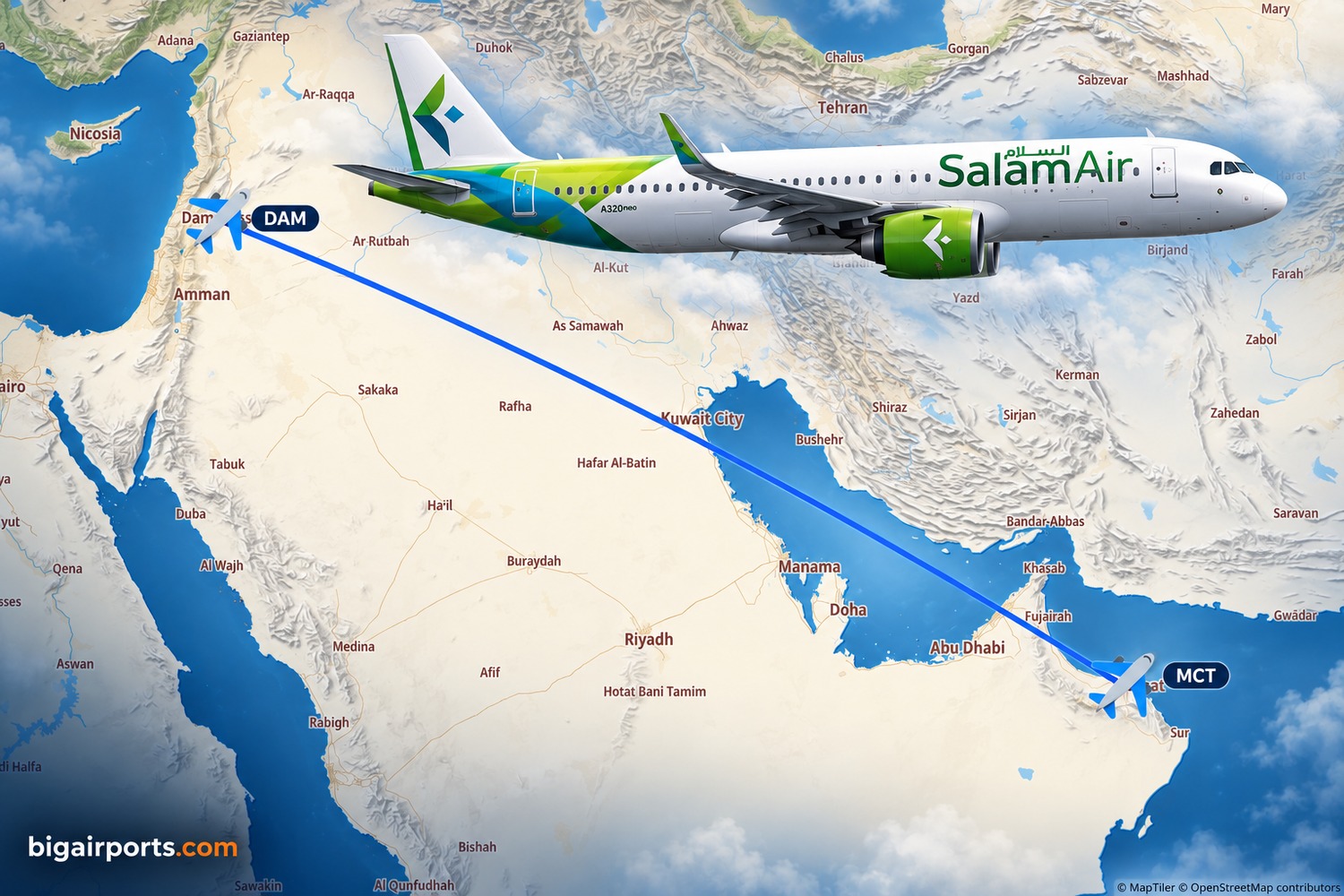
SalamAir will begin twice-weekly services between Muscat International Airport and Damascus International Airport on 28 October 2026, becoming the first Omani airline to operate a direct scheduled link to the Syrian capital. The low-cost carrier confirmed the launch at a joint ceremony at its Muscat base on 22 October, where it also marked the start of a Muscat to Erbil service three days earlier.
- Airline
- SalamAir
- Route
- Muscat (MCT) to Damascus (DAM)
- Frequency
- Twice weekly
- First flight
- 28 Oct 2026
- Aircraft
- Not specified
Route overview
The sector covers roughly 2,384 km (1,287 nautical miles) on a north-westerly track across the Arabian Peninsula, a medium-haul flight by SalamAir’s standards and well within the range of its narrowbody fleet. The carrier has not published departure days or local timings for the service in its launch announcements, and the aircraft type has not been confirmed.
SalamAir positions the route as a tourism and business link between Oman and Syria, with onward connections across its network via Muscat. The ceremony on 22 October was held under the patronage of Khamis bin Mohammed Al Shamakhi, Undersecretary of Oman’s Ministry of Transport, Communications and Information Technology and chairman of SalamAir, and was attended by Khalid Al Ayoubi, chargé d’affaires at the Syrian embassy in Muscat, together with representatives of Oman Airports.
Airline network context
Damascus and Erbil are SalamAir’s seventh and eighth destination additions in 2026, taking the network to more than 46 destinations, according to chief executive Yaqoob Al Kiyumi. The Erbil service, which started on 25 October with two weekly flights, gives the airline a second Iraqi point alongside Baghdad.
Al Kiyumi said the two routes reinforce the airline’s strategy of “connecting Oman with underserved markets” and noted that the fleet has grown to 18 aircraft, which he described as enhancing capacity to serve more markets. The pattern is consistent with SalamAir’s recent expansion, which has favoured secondary and under-served cities in South Asia, the Levant and the wider Gulf over head-to-head competition with full-service carriers on trunk routes.
For Oman Airports, the launch adds a new country pair to the Muscat route map at a time when the operator is actively courting regional growth, including reported plans for a new terminal at Suhar. Acting chief executive Haitham bin Nasser bin Said Al Tai welcomed the addition of both routes at the ceremony.
About the aircraft
SalamAir has not named the aircraft for the Damascus service. The airline operates an all-Airbus single-aisle fleet of A320-family aircraft, including A320neo and A321neo variants, and all of its scheduled network is flown with these types. Whichever variant is assigned, the route length falls comfortably within the operating envelope of the narrowbody fleet, and the carrier’s standard single-class, low-cost product can be expected to apply.
The 18-aircraft fleet cited by Al Kiyumi represents a material step up from the carrier’s size at launch in 2017, and the additional capacity is what has allowed SalamAir to open eight new destinations in a single year while maintaining its existing schedule.
About each airport
Muscat International Airport is Oman’s principal gateway and SalamAir’s sole base. Bigairports.com data lists 98 routes from the airport. The densest link by far is Dubai, with four operators and 1,005 recorded flights, followed by the domestic trunk to Salalah with four operators and 399 flights. Doha, Jeddah, Riyadh, Manama and Kuwait City round out a Gulf-heavy short-haul profile, while Mumbai, Kochi, Dhaka and Cairo are the leading medium-haul markets. Bangkok, served by two operators, is the airport’s main long-haul leisure link. Damascus does not appear among the airport’s established links in the current data and will join the network as a comparatively low-frequency addition.
Damascus International Airport is a considerably smaller operation, with 24 routes recorded. Its traffic is overwhelmingly weighted towards the Gulf: Dubai leads with 711 flights across three operators, followed by Kuwait City with 509 and Sharjah with 413. Amman, Riyadh, Abu Dhabi, Doha, Jeddah, Istanbul, Erbil and Baghdad complete the regional picture, and a handful of thin European links to Amsterdam, Bucharest and Stockholm indicate the early stages of a return of longer-haul services. The absence of any Omani carrier from the airport until now is notable given Oman’s otherwise broad coverage of Arab capitals.
Market context and competition
The Muscat to Damascus city pair has no established scheduled operator in current bigairports.com data, so SalamAir enters a market where traffic has been moving on one-stop itineraries. The strongest indirect competitors are the UAE hubs, where Dubai and Sharjah both carry heavy Damascus schedules and sit less than an hour’s flying time from Muscat, together with Kuwait City and Doha, which also connect to both ends of the route.
Damascus’s recorded route count of 24 indicates that scheduled capacity into Syria remains concentrated on a small number of Gulf and Levant links. Three of the airport’s four densest routes are to UAE and Kuwaiti points, which have historically served as the main transit points for Syria-bound traffic from the Gulf. A nonstop Omani service with two weekly rotations is unlikely to shift that balance on its own, but it establishes SalamAir as the only Omani carrier offering a direct option and removes a connection for Oman-originating passengers.
The route also extends SalamAir’s presence in the Levant and Iraq, which already included Baghdad. With Erbil and Damascus added in the same week, the airline now serves three points in Iraq and Syria from Muscat, giving it a footprint in those two markets that no other Omani carrier matches.
Sources & references (5)
Generated with editorial oversight from AI research.