SalamAir to Link Muscat and Copenhagen via Baghdad from November
The Omani low-cost carrier will fly a twice-weekly Airbus A320neo rotation between Muscat and Copenhagen via Baghdad from 14 November 2026, with fifth-freedom rights reported on the Iraqi sector.
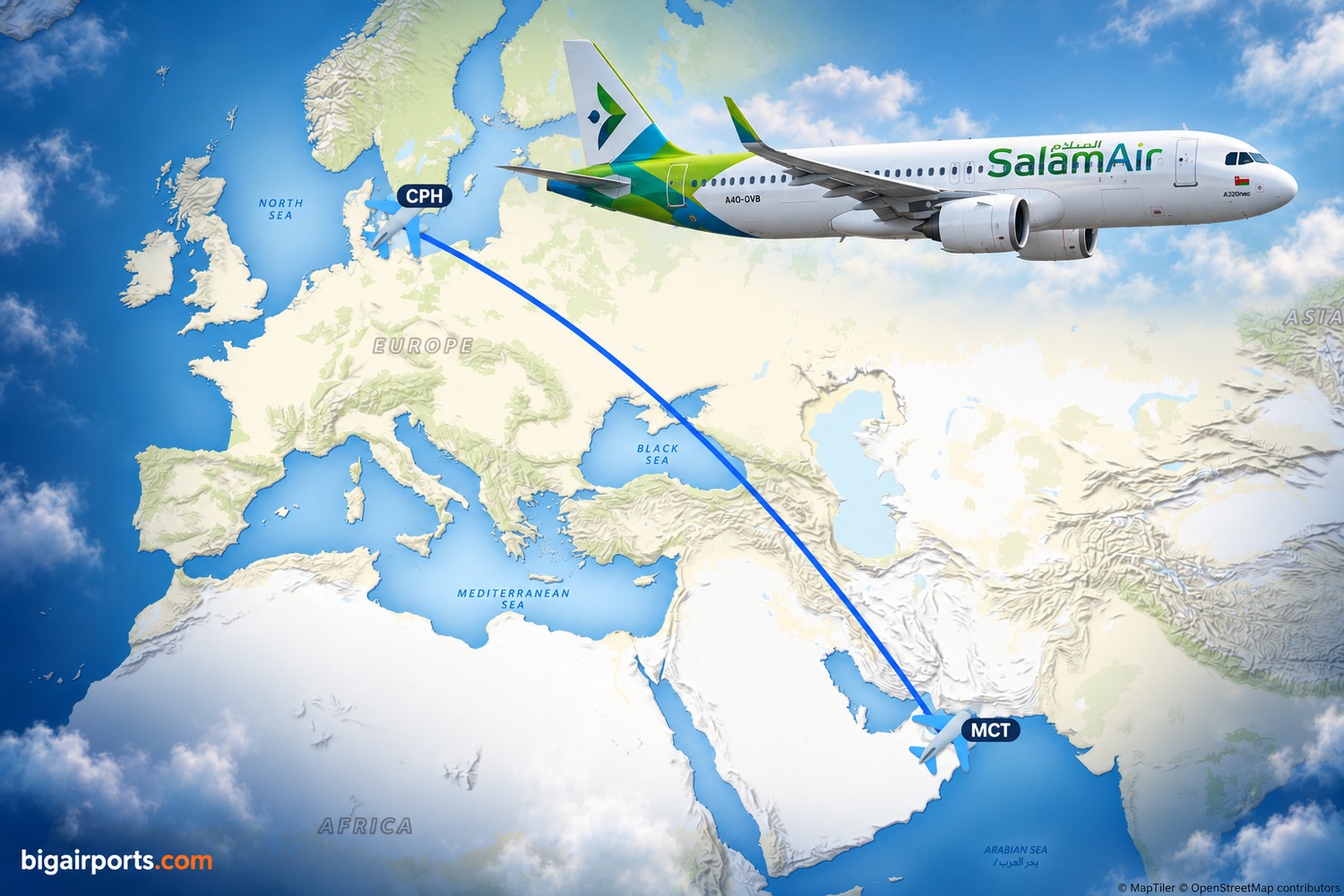
SalamAir will open a twice-weekly service between Muscat and Copenhagen on 14 November 2026, routing an Airbus A320neo via Baghdad. The Omani low-cost carrier’s new operation creates the first scheduled link between Oman and Denmark, takes the airline into Northern Europe for the first time, and carries reported fifth-freedom traffic rights on the Baghdad to Copenhagen sector.
- Airline
- SalamAir
- Route
- Muscat to Copenhagen via Baghdad
- Aircraft
- Airbus A320neo
- Frequency
- Twice weekly
- First flight
- 14 Nov 2026
Route overview
The service pairs Oman’s principal gateway with the busiest airport in the Nordic region across a great-circle distance of roughly 5,100 kilometres. Flying the sector nonstop would sit at the outer edge of narrowbody economics; the stop in Baghdad instead divides the journey into legs of approximately 1,700 and 3,500 kilometres, both comfortably within the A320neo’s capability. The 14 November start date also places the launch early in the northern winter 2026/27 season.
SalamAir fits its A320neos with 174 seats in a single economy cabin, giving the new route around 348 weekly seats in each direction at launch frequency. According to ch-aviation, the carrier holds fifth-freedom rights on the Baghdad to Copenhagen leg, allowing it to sell that sector as a standalone market. The rotation therefore addresses two distinct traffic flows, Oman to Denmark and Iraq to Denmark, on a single aircraft. The service was announced in early September 2026 and first reported via Zawya, with ch-aviation subsequently confirming the fifth-freedom structure of the operation.
SalamAir’s network context
SalamAir began operations in January 2017 as Oman’s first budget airline, operating from its home base in Muscat. It flies an all-Airbus fleet of A320neo and A321neo narrowbodies across the Gulf, the wider Middle East, the Indian subcontinent and Southeast Asia, largely in point-to-point markets driven by labour, trade and visiting-friends-and-relatives traffic. Its scheduled network sits alongside that of Oman Air, the national carrier with which it shares its home airport, while SalamAir concentrates on price-sensitive demand.
Copenhagen becomes the carrier’s first destination in Northern Europe and one of the longest itineraries in its network. The launch follows a pattern now well established among Gulf narrowbody operators, which have used latest-generation Airbus and Boeing types to open long, thin routes that could not support widebody capacity. For SalamAir, the fifth-freedom stop reduces risk further: the aircraft can fill from two origin markets rather than relying on Oman to Denmark demand alone.
About the Airbus A320neo
The Airbus A320neo is the re-engined evolution of the A320 family, offered with CFM International LEAP-1A or Pratt & Whitney GTF engines. Airbus quotes fuel savings of around 15 to 20 per cent per seat against the previous generation, together with a smaller noise footprint and a range of roughly 6,300 kilometres with a full passenger load. That capability is what makes a Muscat, Baghdad and Copenhagen routing workable for a low-cost operator: each sector sits well inside the aircraft’s range, while single-class narrowbody economics keep trip costs far below those of a widebody. SalamAir’s 174-seat layout is typical of low-cost configurations for the type, which most full-service operators fly with closer to 150 seats in two classes. The neo family is currently the best-selling narrowbody programme in production.
The airports: Muscat and Copenhagen
Muscat International Airport is Oman’s principal gateway, with 95 scheduled routes in current network data. Its densest markets are regional: Dubai leads with four operators on the sector, ahead of the domestic trunk to Salalah and Gulf links to Doha, Riyadh, Manama and Kuwait City. The airport also has a pronounced Indian subcontinent profile, with four operators each on Mumbai and Dhaka and three on Kochi, reflecting heavy labour and family traffic to South Asia, alongside Jeddah, Cairo and Istanbul. Long-haul service remains sparse, with Bangkok the clearest example in the present schedule, underlining how much unserved space remains between Muscat and Europe.
Copenhagen Kastrup Airport is Denmark’s largest airport and the busiest in the Nordic region, with 189 scheduled routes. Its top markets reflect its role as a Scandinavian hub: Amsterdam is the densest link with eight operators, ahead of Oslo, Stockholm and a wide set of Norwegian regional connections including Bergen and Stavanger. Southern European leisure routes to Barcelona, Palma de Mallorca, Málaga and Alicante also rank highly, while Paris, Madrid, Helsinki and London Heathrow sit near the top of the table. The airport is the principal hub of SAS, and its long-haul network reaches North America, Asia and the Gulf, giving SalamAir’s arrival a competitive backdrop of established intercontinental connectivity.
Market context and competition
There is currently no nonstop service between Muscat and Copenhagen, and traffic on the city pair moves over intermediate hubs. Dubai, Doha and Istanbul all rank among Muscat’s busiest routes, and each offers onward connections to Copenhagen with Emirates, Qatar Airways and Turkish Airlines respectively. Against multiple daily connecting itineraries, SalamAir’s two weekly through-plane rotations will compete on price and the convenience of a single booking rather than on schedule depth.
The Baghdad stop adds a second dimension. Denmark is home to a sizeable Iraqi community, and the fifth-freedom sector gives SalamAir direct access to visiting-friends-and-relatives demand that has few low-cost alternatives. Filling the aircraft from two origin markets is a hedge that Gulf fifth-freedom operations have used before, and it materially improves the odds of sustaining a long narrowbody route at low frequency.
For Copenhagen, the service adds a new Middle Eastern link to a route map already spanning 189 routes, including its first scheduled connection to Muscat. For Oman, it opens a direct air tie to Denmark for the first time. The carrier has not announced plans beyond the twice-weekly launch schedule.
Sources & references (4)
Generated with editorial oversight from AI research.