Breeze Airways Links Tampa and San José with Twice-Weekly A220
The US low-cost carrier began two-weekly Airbus A220-300 service between Tampa International and Juan Santamaría International on 3 October 2026, its first scheduled route to Costa Rica.
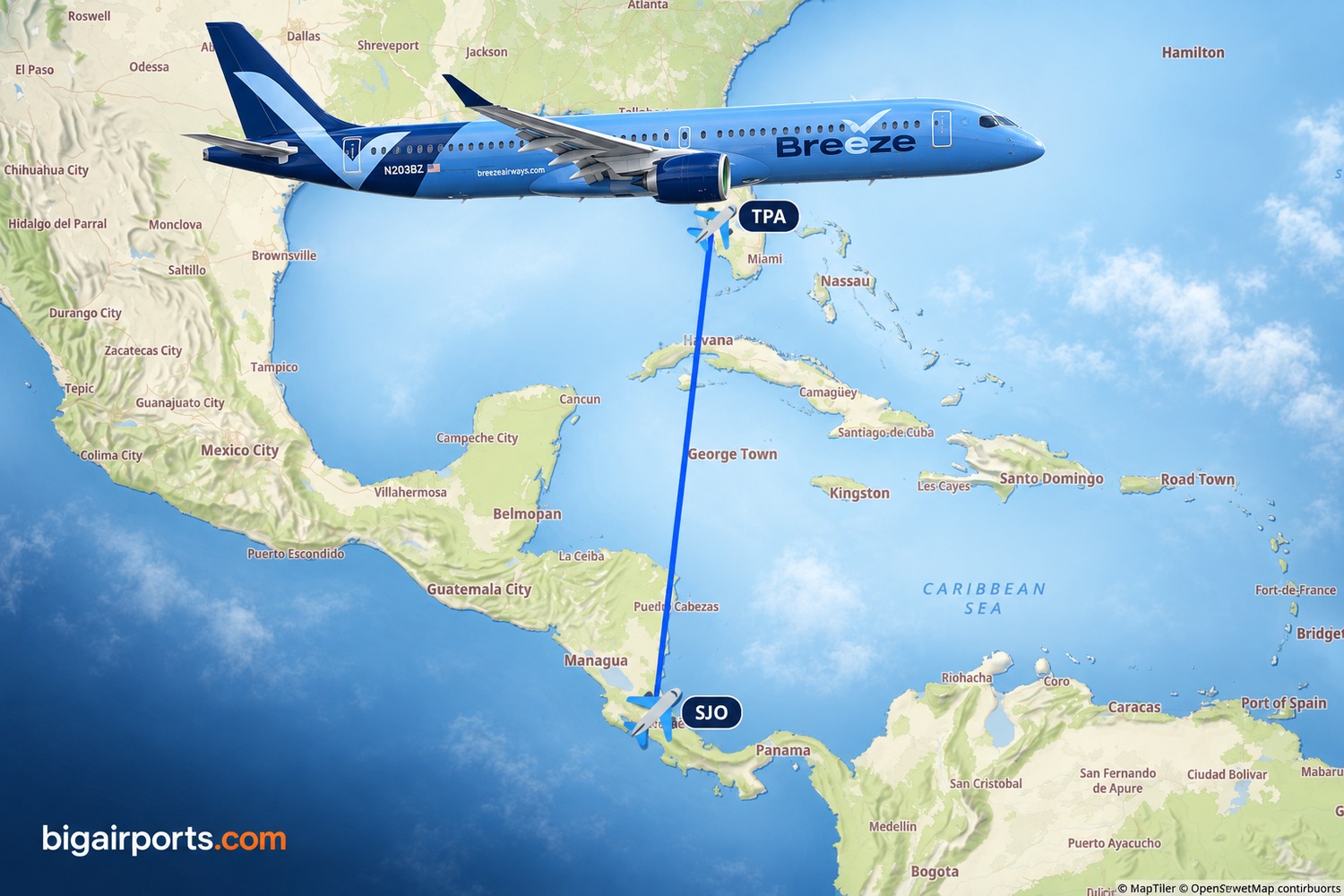
Breeze Airways began nonstop service between Tampa International Airport and Juan Santamaría International Airport in San José, Costa Rica, with the first flight operating on 3 October 2026. The route runs twice weekly on the Airbus A220-300 and is the carrier’s first scheduled service to Costa Rica, announced by the airline and the Florida airport alongside new Tampa service to the Dominican Republic.
- Airline
- Breeze Airways
- Aircraft
- Airbus A220-300
- Frequency
- Twice weekly
- First flight
- 3 Oct 2026
Route overview
The sector covers roughly 2,000 kilometres (1,240 miles) between Florida’s Gulf coast and Costa Rica’s Central Valley, giving block times in the region of three and a half hours southbound. At two rotations per week, Breeze is offering about 274 seats per direction per week on the pair, a deliberately cautious opening commitment that reflects the carrier’s practice of starting thin and adding frequency where demand proves out.
The route is aimed squarely at the leisure market. San José sits within reach of Costa Rica’s Pacific beach resorts, cloud forests and national parks, while Tampa serves a large Florida catchment that has until now reached Costa Rica only via connecting itineraries. Inbound demand runs in both directions: Costa Rica’s outbound market has grown steadily, and Florida remains its most frequented US destination. The launch formed part of a wider week of network activity at Breeze, which brought several new nonstop routes online across its system in early October.
Breeze Airways’ network context
Founded by David Neeleman and operating since May 2021, Breeze has built its business on point-to-point routes between city pairs that larger carriers serve only via connections. Tampa is one of the airline’s largest bases, and the airport has been central to Breeze’s gradual push beyond the domestic United States.
Costa Rica is a new country on the Breeze map, and the San José service extends an international programme that the carrier has so far concentrated on leisure destinations reachable with the A220’s range from its East Coast and Florida bases. The simultaneous announcement of Dominican Republic flights from Tampa underlines the airport’s role as the carrier’s principal springboard into the Caribbean basin and Central America. For Tampa International, the addition deepens a partnership with a carrier that has steadily grown its local footprint since arriving in the airline’s first year of operations.
About the aircraft
The Airbus A220-300 is the backbone of the Breeze fleet and the type the airline has used to open nearly all of its longer and international sectors. Breeze configures the aircraft with 137 seats, including 36 recliner seats in its Ascent premium cabin, a relatively generous premium share for a low-cost operator and one the carrier markets heavily on leisure routes of this length.
The remainder of the cabin is split between extra-legroom and standard economy seating, all sold under the airline’s à la carte fare structure.
Powered by Pratt & Whitney GTF engines, the A220-300 offers a range of around 3,400 nautical miles, far more than the Tampa to San José sector requires. Its real value on a route like this is economic: the type’s per-trip costs allow Breeze to serve a market at twice-weekly frequency that would be difficult to sustain with a larger narrowbody. The aircraft’s range and seat count have become the template for the airline’s international growth, letting it probe mid-haul leisure markets without committing hub-scale capacity.
Tampa and San José: the airports
Tampa International is a major origin-and-destination leisure and business airport with 119 nonstop routes in the current schedule. Its densest links are the classic domestic trunks: Atlanta leads with six operators and more than 160 weekly flights, followed by Miami, Charlotte and Chicago O’Hare, with substantial medium-haul service to Denver, Newark, Boston and both New York airports. The network remains overwhelmingly domestic, which makes each new international spoke proportionally significant for the airport’s connectivity.
Juan Santamaría International, located in Alajuela outside San José, is Costa Rica’s principal international gateway with 51 nonstop routes. Its schedule blends high-frequency domestic turboprop feeders to tourism points such as Puerto Jiménez, Quepos, Tamarindo and Nosara with dense regional links to San Salvador, Guatemala City and Panama City, each served by multiple operators. Miami is the airport’s busiest medium-haul market, with nine operators active on the city pair, confirming Florida’s position as the dominant corridor between Costa Rica and the United States.
Market context
Breeze enters the Tampa to San José market as the only nonstop operator on the city pair. Traffic between the two cities has historically moved over intermediate hubs, principally Miami and Atlanta on the US side and Panama City on the Latin American side, so the new service converts a one-stop journey of six hours or more into a direct flight of under four. For San José, the route also adds a second Florida gateway alongside the long-established Miami corridor, broadening the airport’s reach into the US Southeast.
Competition for Costa Rica-bound traffic from Florida remains concentrated at Miami, where the legacy carriers and Avianca hold the bulk of capacity into San José. Breeze’s bet is that a nonstop product at a lower fare will pull Tampa-area originating traffic away from those connecting options while stimulating demand that the hub routings never captured. Twice-weekly frequency keeps the risk modest: the schedule suits leisure travel patterns built around week-long stays, and the A220’s economics give the carrier room to add rotations if load factors justify it. The route’s performance through the winter peak season will be the first real test of whether Costa Rica becomes a durable part of the Breeze network rather than a seasonal experiment.
Sources & references (4)
Generated with editorial oversight from AI research.