Egyptair Launches Cairo to Birmingham Flights on the 737 MAX 8
Egyptair began four-weekly Cairo to Birmingham flights on 25 October 2026 with the Boeing 737 MAX 8, adding its third UK destination and the Midlands airport's first direct Cairo link.
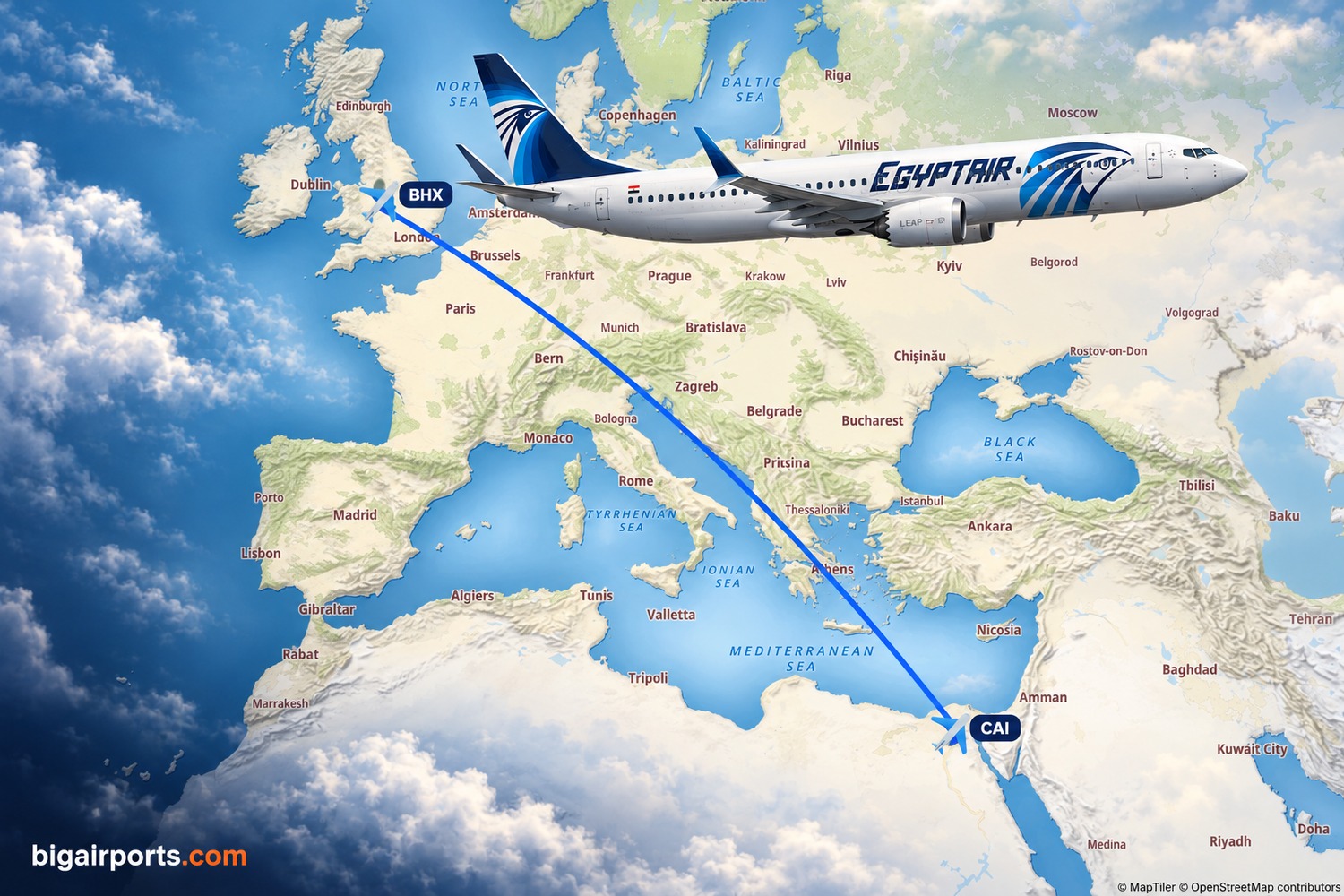
Egyptair has launched a four-weekly service between Cairo and Birmingham, with the inaugural flight operating on 25 October 2026, the opening day of the northern winter 2026/27 schedule. The route is flown with the Boeing 737 MAX 8 and gives the Star Alliance carrier its third United Kingdom destination after London Heathrow and Manchester. Egyptair is the only airline operating non-stop between the two cities.
- Airline
- Egyptair
- Route
- Cairo (CAI) to Birmingham (BHX)
- Aircraft
- Boeing 737 MAX 8
- Frequency
- 4x weekly (Tue, Thu, Fri, Sun)
- First flight
- 25 Oct 2026
- Flight numbers
- MS769 / MS770
Route overview
The service operates on Tuesdays, Thursdays, Fridays and Sundays. Flight MS769 departs Cairo International Airport at 08:40 local time and arrives at Birmingham Airport at 12:30. The return sector, MS770, leaves Birmingham at 13:30 and lands in the Egyptian capital at 20:40. The 60-minute turnaround at Birmingham keeps the aircraft on a single-day rotation, with the aircraft back in Cairo for the evening connecting bank.
The great-circle distance is 3,665 kilometres, which places the sector among the longer narrowbody flights in Egyptair’s European programme. Birmingham Airport has marketed the service as a year-round operation since tickets went on sale in September, and it is the airport’s first direct link to Cairo.
Airline network context
Egyptair is Africa’s second-largest airline by international seat capacity, behind Ethiopian Airlines. According to Air Service One, the flag carrier will offer 12.97 million one-way international seats in 2026, up 2 per cent on the record set in 2025. Africa accounts for 7.55 million of those seats, followed by the Middle East with 2.74 million, Europe with 1.84 million, Asia with 463,000 and North Asia with 371,000.
Europe represents 14 per cent of the airline’s international capacity, and available seats to the continent are up 3 per cent year on year to a record. Almost all of that European flying, 96 per cent, departs from the Cairo hub, with the balance originating in Hurghada, Luxor and Sharm El Sheikh.
Birmingham is one of three European additions in 2026. Venice launched on 29 July, and Stockholm Arlanda is scheduled to begin on 18 December, bringing Sweden into the network for the first time. By year end Egyptair will serve 27 airports across 18 European countries. Fifteen existing European destinations see capacity growth in 2026, with the strongest country-level gains in Italy at 25 per cent, followed by France and Russia at 7 per cent, and Belgium and the United Kingdom at 5 per cent.
Mohamed Elian, Chairman and CEO of Egyptair, said the Birmingham service “will connect Birmingham seamlessly to EGYPTAIR’s extensive network across Africa, the Middle East, and the Far East, offering passengers enhanced travel options and convenient connections to a wide range of destinations worldwide.”
About the aircraft
The route is operated by the Boeing 737 MAX 8, which Birmingham Airport describes as a brand-new addition to the Egyptair fleet. The type succeeds the 737-800 that has long been the carrier’s narrowbody workhorse on Europe and Middle East sectors. Boeing quotes a two-class capacity of 162 to 210 seats depending on configuration and a range of 3,500 nautical miles, or roughly 6,480 kilometres, powered by CFM LEAP-1B engines.
That range covers the 3,665-kilometre Cairo to Birmingham sector with margin, and the manufacturer claims a double-digit improvement in fuel burn per seat over the 737-800. Birmingham Airport has also highlighted the carrier’s wider cabin investment, including complimentary Wi-Fi on selected aircraft and expanded digital services.
About the airports
Cairo International is Egyptair’s main hub and, according to bigairports.com route data, currently connects to 135 destinations. The network is weighted towards the Gulf and the Levant. Jeddah is the most contested route with 9 operators and 698 scheduled flights in the dataset, while Dammam has 10 operators and Riyadh has 9. Dubai records the highest flight count at 1,063 across just 2 carriers.
On the European side, Madrid registers 812 flights across 4 operators and Barcelona 521 flights across 4 operators, with Istanbul served by 3 carriers. Domestic trunk routes to Aswan, Luxor, Hurghada and Sharm El Sheikh each carry 4 to 5 operators. Birmingham enters this mix as a thinner four-weekly leisure, business and visiting-friends-and-relatives route rather than a high-density trunk.
Birmingham Airport serves the West Midlands and, per bigairports.com data, offers 159 routes. Its busiest link by scheduled flights is Amsterdam, with 3,097 flights across 4 operators, reflecting the airport’s reliance on KLM and other hub feeds for long-haul connectivity. The remainder of the top tier is dominated by Southern European leisure markets: Palma de Mallorca at 1,321 flights, Barcelona at 1,100, Alicante at 1,007, Tenerife at 870 and Malaga at 805. Dublin is the most competitive route with 6 operators.
Egypt was already represented at Birmingham through Hurghada and Sharm El Sheikh, both leisure-driven Red Sea destinations. Cairo adds the first capital-city link and the first scheduled Egyptian flag-carrier service. Matt Hazelwood, Chief Commercial Officer at Birmingham Airport, said the route “will also support the Egyptian community across the Midlands, making it easier to stay connected with loved ones and travel for business purposes.”
Market context and competition
Egyptair faces no direct non-stop competition on Cairo to Birmingham. Before 25 October, Midlands passengers bound for Cairo either travelled to Heathrow or Manchester for the carrier’s existing services, or connected over Istanbul, Dubai or Doha with Turkish Airlines, Emirates or Qatar Airways, all of which serve Birmingham.
The four-weekly, narrowbody pattern is a below-daily entry into a market that was previously served only indirectly. With UK capacity up 5 per cent in 2026 and the Stockholm launch still to come, Birmingham is part of a measured European build-out rather than an isolated addition. Egyptair stated the service targets business, tourism and diaspora traffic, with Birmingham positioned as the industrial centre of central England.
Sources & references (4)
Generated with editorial oversight from AI research.