Lufthansa to Launch Munich–Phoenix A350 Service from August 2027
Lufthansa will connect its Munich hub with Phoenix Sky Harbor three times a week from 3 August 2027, giving Arizona its first nonstop link to southern Germany and its first Star Alliance transatlantic service.
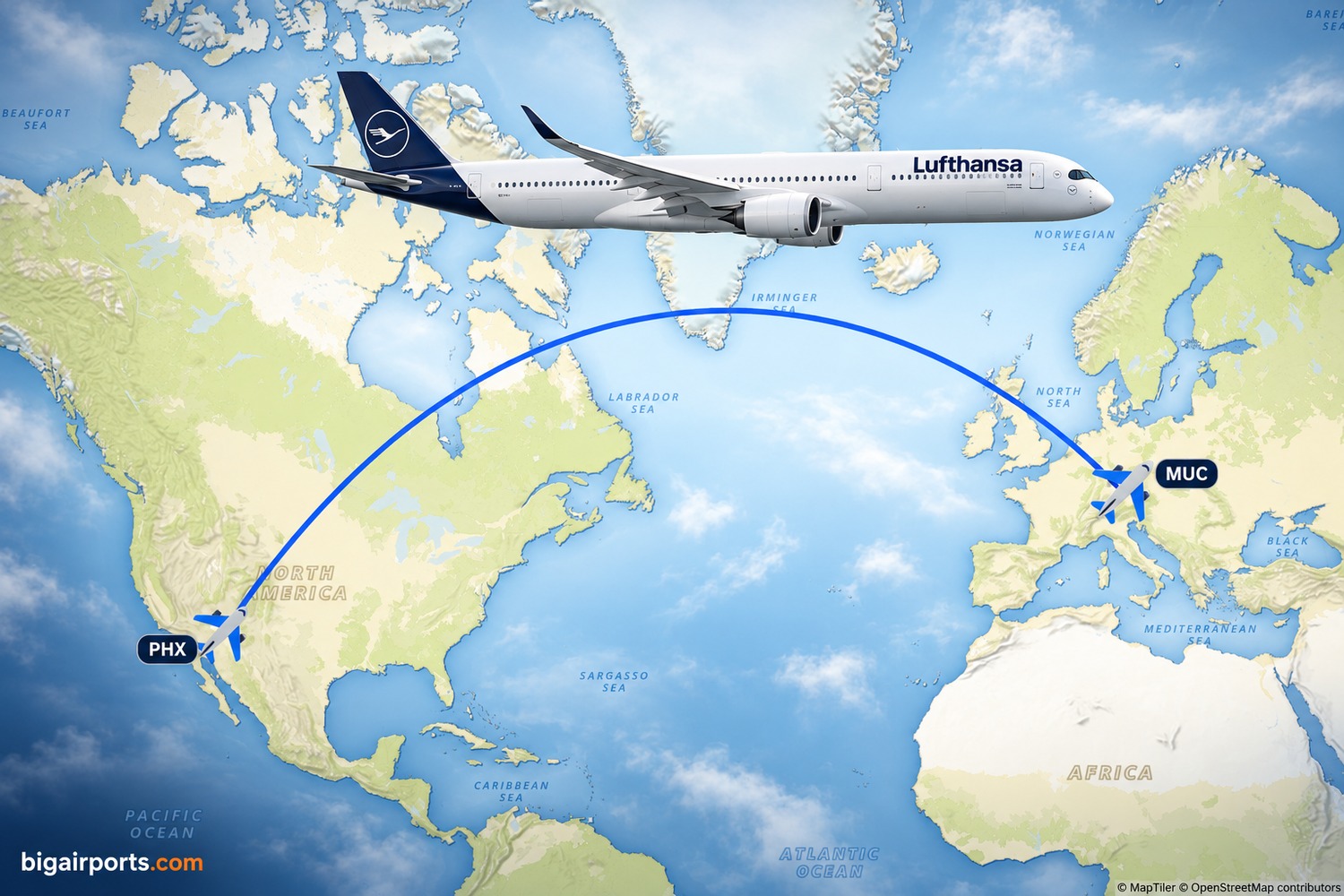
Route overview
Lufthansa will open a nonstop service between Munich and Phoenix on 3 August 2027, linking its second hub with Arizona’s largest airport for the first time. The route will operate three times weekly, on Tuesdays, Fridays and Sundays, with an Airbus A350-900, the long-haul type that forms the core of the carrier’s Munich-based widebody fleet. The great-circle sector is roughly 9,350 km, placing it among the longer transatlantic flights in the Lufthansa timetable.
- Airline
- Lufthansa
- Route
- Munich (MUC) to Phoenix (PHX)
- Aircraft
- Airbus A350-900
- Frequency
- 3x weekly (Tue, Fri, Sun)
- First flight
- 3 Aug 2027
- Distance
- approx. 9,350 km
The service was announced as part of the Lufthansa Group’s summer 2027 programme, which the group has described as its most extensive route expansion since 2020. Lufthansa has not previously served Phoenix from any of its hubs, so the addition brings a new point on the carrier’s United States map rather than a frequency or hub change on an existing link. The City of Phoenix Aviation Department confirmed the service in its own statement, citing onward connections across Lufthansa’s European and intercontinental network as the principal benefit for the Arizona market.
The first flight falls within the IATA summer 2027 season, which runs until late October 2027. Lufthansa has not indicated whether the service will continue through the following winter timetable.
Airline network context
Munich is Lufthansa’s second hub after Frankfurt and the home base for its Airbus A350 fleet. The airport already supports a broad North American long-haul schedule, with Lufthansa flights to points including Boston, Chicago, Denver, Los Angeles, New York, San Francisco, Seattle and Washington. Phoenix adds a south-western US gateway to that list. The nearest existing Lufthansa point is Denver, roughly 1,000 km to the north-east, which Lufthansa serves from both Frankfurt and Munich.
Three weekly rotations is a conservative opening frequency by the standards of Lufthansa’s North American operation from Munich, where most routes run daily in summer. The Tuesday, Friday and Sunday pattern gives a spread across the week while keeping a single aircraft rotation within the schedule.
The route also extends Star Alliance coverage. United Airlines, Lufthansa’s joint-venture partner across the Atlantic, serves Phoenix from its domestic hubs, including Denver and Chicago, which both rank among the busiest routes at Sky Harbor. That gives the new flight feed on the US side as well as the connecting bank at Munich.
About the aircraft
The Airbus A350-900 is a twin-engine widebody powered by Rolls-Royce Trent XWB-84 engines, with a carbon-fibre composite fuselage and wing. Airbus quotes a range of around 15,000 km, well beyond the Munich to Phoenix sector, leaving margin for westbound winter headwinds and summer temperature penalties on departure from Phoenix, where surface temperatures regularly exceed 40 degrees Celsius in August.
Lufthansa took delivery of its first A350-900 in December 2016 and placed the type into service from Munich in early 2017. The fleet has grown since then and remains concentrated at the Bavarian hub. Lufthansa operates the type in several cabin configurations. Its original three-class layout seats 293 passengers across Business, Premium Economy and Economy, while the newer Allegris-equipped aircraft add a First Class cabin and revised seating in all classes. Lufthansa has not published which variant will be assigned to Phoenix.
The A350-900 is well suited to a three-weekly, long-sector launch where capacity needs to be matched to a developing market rather than to an established trunk route.
About the airports
Munich Airport is Germany’s second-busiest airport and the principal gateway to Bavaria. bigairports.com data lists 240 nonstop routes from Munich. The densest link in the dataset is Amsterdam with 5,153 flights, followed by Madrid with 2,408, Barcelona with 1,869 and Palma de Mallorca with 1,558. The route to Copenhagen is the most competitive in the top tier, with nine operators, while Madrid and Paris Charles de Gaulle each attract eight. The vast majority of the busiest Munich routes are short-haul, reflecting the airport’s role as a European connecting hub for Lufthansa and its Star Alliance partners, who operate from the jointly run Terminal 2. The airport handled around 41 million passengers in 2024 and operates two parallel runways.
Phoenix Sky Harbor International Airport is the main airport for the Phoenix metropolitan area, home to roughly five million people, and handles more than 50 million passengers a year. It is a hub for American Airlines and a major base for Southwest Airlines. bigairports.com data lists 192 nonstop routes from Phoenix. The busiest by flight count is Denver with 237 flights, followed by Dallas-Fort Worth with 209, Seattle with 179, Chicago O’Hare with 165 and Los Angeles with 154. Los Angeles is the most contested route, with nine operators, and Denver, Seattle and San Diego each have eight. Nearly all the top routes are domestic, which underlines how limited Phoenix’s long-haul network remains relative to its passenger volume.
Market context and competition
There is currently no nonstop service between Munich and Phoenix, and no carrier connects Phoenix with Germany year-round. Condor operates a seasonal Frankfurt to Phoenix flight, which has been the only direct link between Arizona and Germany to date. Transatlantic capacity at Sky Harbor is otherwise concentrated on London Heathrow, served by both British Airways and American Airlines, giving the oneworld alliance effective control of the Phoenix to Europe market.
Lufthansa’s entry changes that picture. The new flight will be the first Star Alliance transatlantic service from Phoenix, offering connections at Munich to Lufthansa’s European short-haul network, which the airport data above shows to be extensive, and to the group’s Asian and Middle Eastern destinations. For the German and wider central European market, Arizona is primarily a leisure destination anchored by the Grand Canyon, Sedona and the state’s winter climate, with Phoenix serving as the principal entry point. Business demand is supported by the region’s semiconductor and technology sector, which has expanded substantially in recent years.
The main competition on the origin and destination pair will be one-stop itineraries via London on British Airways and American, via Frankfurt on Condor during its operating season, and via United’s hubs for passengers already in the Star Alliance system. Lufthansa’s own Frankfurt hub remains unserved from Phoenix, so Munich will carry the full Lufthansa product for the Arizona market from launch.
With a three-weekly A350-900 schedule, Lufthansa is testing the market at modest capacity. Whether the frequency grows or the service becomes year-round will depend on load factors through the first summer and on the carrier’s broader fleet allocation at Munich as further Allegris-equipped aircraft arrive.
Sources & references (6)
Generated with editorial oversight from AI research.