Lufthansa to Resume Frankfurt-Kuala Lumpur Flights in October 2026
The German carrier will operate five weekly Boeing 787-9 rotations between FRA and KUL from 25 October 2026, restoring a nonstop link dropped in 2016 as its third Southeast Asian route from Frankfurt.
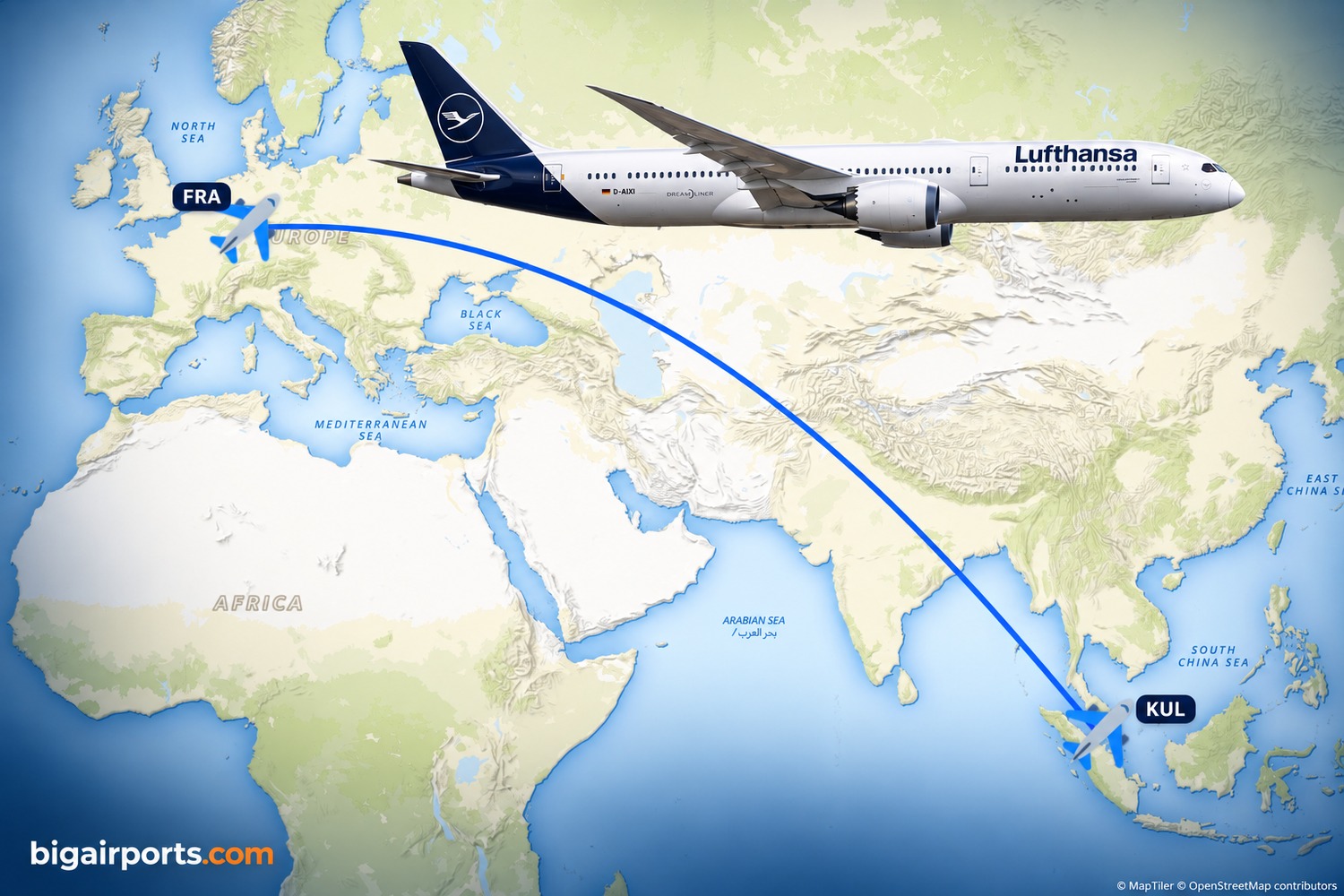
Route overview
Lufthansa will open a nonstop service between Frankfurt and Kuala Lumpur on 25 October 2026, deploying the Boeing 787-9 on five weekly rotations. The launch coincides with the start of the northern winter 2026/27 timetable and restores a city pair the German flag carrier last served in 2016.
- Airline
- Lufthansa
- Route
- Frankfurt (FRA) to Kuala Lumpur (KUL)
- Aircraft
- Boeing 787-9
- Frequency
- 5x weekly
- First flight
- 25 October 2026
The sector covers roughly 9,970 kilometres on the great-circle track, with block times of around 12 to 13 hours depending on direction, placing it among the longer segments on Lufthansa’s Asia-Pacific schedule. At launch it will be the only nonstop passenger link between Germany and Malaysia, a market that has depended entirely on one-stop routings for the past decade.
The route was announced in March 2026 through the Lufthansa Group newsroom and was picked up widely by Malaysian business media, which framed the connection as a gain for trade and tourism ties between the two countries. The 25 October start date aligns with the first day of the IATA northern winter season, the point at which carriers typically reset long-haul schedules. Five weekly frequencies put the service just below a daily pattern at launch.
Network context
Kuala Lumpur becomes Lufthansa’s third Southeast Asian destination from Frankfurt, joining Bangkok and Singapore on the intercontinental schedule. The carrier withdrew from the Malaysian capital in early 2016 during a wider consolidation of its long-haul network, a decision that left Malaysia without a nonstop link to Germany. At the time, the retreat formed part of a broader thinning of European carriers’ Southeast Asian networks under pressure from Gulf and Asian hub competitors. The return follows the steady arrival of Boeing 787-9s at the Frankfurt hub, where the type has progressively taken over mid-sized long-haul missions from older widebodies.
The addition also deepens Lufthansa’s connecting proposition over its home hub. Passengers originating across the carrier’s European short-haul network, which current schedule data shows feeding Frankfurt from points such as Berlin, Hamburg, Munich, Vienna and Zurich, gain a one-stop path to Malaysia on a single ticket and a single carrier for the first time in ten years.
The Boeing 787-9 on the route
Lufthansa took delivery of its first Boeing 787-9 in 2022, the carrier’s first all-new long-haul type since the 747-8, and has concentrated the fleet at Frankfurt. In the standard long-haul configuration the aircraft seats 294 passengers, split between 26 in business class, 21 in premium economy and 247 in economy. Lufthansa’s examples are powered by General Electric GEnx-1B engines.
At five weekly rotations the schedule adds roughly 2,940 seats per week to the city pair across both directions, capacity the market has not seen on a nonstop basis since the previous service ended. With a range of approximately 14,000 kilometres, the 787-9 handles the 13-hour sector with margin, and its per-seat economics suit long routes of moderate density, the profile Frankfurt-Kuala Lumpur presents after a decade without nonstop service.
Frankfurt and Kuala Lumpur: the airports
Frankfurt Airport is Germany’s principal international gateway and Lufthansa’s largest hub, with 294 active routes in current schedule data. Amsterdam is its single busiest link, with 4,927 tracked flights and six operators, ahead of Madrid and Palma de Mallorca, while Paris Charles de Gaulle draws the widest field of carriers at eight operators. The network blends dense intra-European trunk routes with domestic feed from Berlin, Hamburg and Munich, the traffic base that supports Frankfurt’s intercontinental departures. Among long-haul destinations, Shanghai Pudong stands out with six carriers active on the route.
Kuala Lumpur International Airport serves the Malaysian capital from Sepang and counts 163 active routes. Singapore is the busiest destination, with 2,652 tracked flights across eight operators, followed by Jakarta at 1,893 flights and nine operators. A dense domestic trunk to Kota Kinabalu, Kuching and Penang, each above 1,300 tracked flights, gives arriving long-haul passengers onward coverage across East and Peninsular Malaysia, while leisure points such as Langkawi and Bali sit high in the rankings. North Asian connectivity is also substantial, with Guangzhou at 959 tracked flights and Shanghai Pudong at 813 across seven operators. The two airports already overlap on one intercontinental market: both hold nonstop service to Shanghai Pudong.
Market context and competition
No other carrier operates nonstop between Frankfurt and Kuala Lumpur, so Lufthansa enters the O&D without direct competition. Since 2016 the traffic base has been carried on one-stop itineraries: Singapore Airlines over Singapore, Emirates over Dubai, Qatar Airways over Doha, Turkish Airlines over Istanbul and KLM over Amsterdam are among the principal routings. Malaysia Airlines does not serve Germany; its European operation is limited to London Heathrow and Paris Charles de Gaulle, leaving the Frankfurt market to be contested entirely by connecting carriers until now.
A nonstop product changes the shape of that competition. The 12 to 13 hour block time compares with typical one-stop journey times of 16 hours or more over the Gulf and Southeast Asian hubs, and the single-carrier itinerary removes a transfer for both point-to-point passengers and those connecting onwards at either end.
The five weekly 787-9 rotations begin on 25 October 2026 as part of the winter 2026/27 timetable, a decade after Lufthansa’s previous Kuala Lumpur service ended. For Frankfurt, the route restores a long-standing gap in its Southeast Asian map; for Kuala Lumpur, it returns a direct German gateway to an airport whose 163-route network has, until now, reached the country only through intermediate hubs.
Sources & references (4)
Generated with editorial oversight from AI research.