Lufthansa to Link Frankfurt and Columbus with 787-9 in May 2027
Three weekly Boeing 787-9 rotations between FRA and CMH from 5 May 2027 will give Columbus its first scheduled transatlantic service and Lufthansa an uncontested new US market.
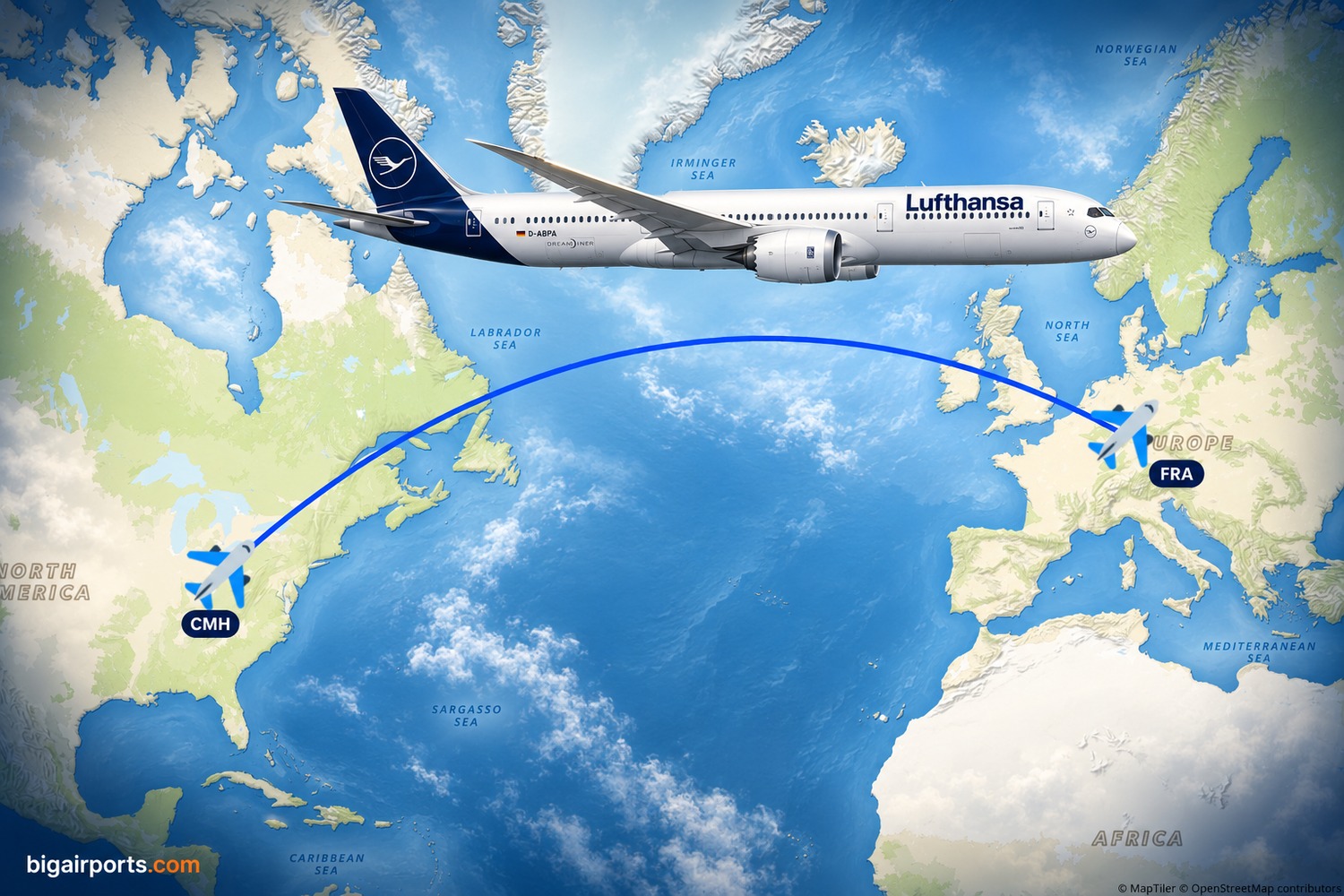
Lufthansa will launch nonstop flights between Frankfurt Airport and John Glenn Columbus International Airport on 5 May 2027, giving Ohio’s capital its first scheduled transatlantic service. The carrier will operate three weekly rotations on Wednesdays, Fridays and Sundays with the Boeing 787-9, placing Columbus on a European airline’s network for the first time in the city’s aviation history.
- Airline
- Lufthansa (LH)
- Route
- Frankfurt (FRA) to Columbus (CMH)
- Aircraft
- Boeing 787-9
- Frequency
- 3x weekly (Wed, Fri, Sun)
- First flight
- 5 May 2027
Route overview
The sector covers a great-circle distance of around 6,800 kilometres, with westbound block times expected in the region of nine hours and a shorter eastbound leg on prevailing winds. A three-weekly pattern is a conventional opening frequency for a new mid-size North American market: it tests demand across the week while keeping capacity matched to local traffic. The Wednesday, Friday and Sunday departures bracket the business week and capture weekend leisure flows in both directions. The service was announced on 19 October 2026 by the carrier and the Columbus Regional Airport Authority, which confirmed the schedule and the May 2027 start date.
For Columbus, the announcement closes a conspicuous gap. The metropolitan area is home to more than two million people and ranks among the fastest-growing in the American Midwest, yet it has never had a scheduled nonstop to Europe. Passengers bound for Frankfurt and points beyond currently connect over Chicago, Washington, Atlanta or Detroit, adding several hours to every itinerary.
Lufthansa’s network context
Frankfurt is Lufthansa’s principal hub and the centre of its intercontinental operation, and the new service plugs Columbus directly into the hub’s connecting banks across Europe, the Middle East, Africa and Asia. The addition follows a pattern the carrier has applied consistently in North America: alongside the major gateways, it adds mid-size markets with strong corporate demand where it can operate as the sole transatlantic carrier rather than one of several at a congested entry point.
The corporate case on the Columbus side is substantial. Central Ohio hosts Intel’s semiconductor campus under construction in New Albany, Honda’s long-established manufacturing operations, Ohio State University and a sizeable insurance and banking employment base. Alliance mechanics reinforce the station: Lufthansa’s transatlantic joint venture with United Airlines and Air Canada means United’s existing Columbus services to Chicago O’Hare, Washington Dulles, Denver and Newark sit within the same commercial structure, keeping Star Alliance passengers inside one network at both ends.
About the aircraft
Lufthansa introduced the Boeing 787-9 to its fleet in 2022, with the type concentrated at Frankfurt and powered by General Electric GEnx-1B engines. A range of roughly 14,000 kilometres leaves ample margin on the Columbus sector, and Boeing puts the type’s fuel burn per seat at around 20 per cent below the previous-generation widebodies it replaces, which matters on a route that must prove itself at three weekly frequencies.
As delivered, Lufthansa’s 787-9s seat 294 passengers in a two-cabin layout, and the carrier is progressively introducing its Allegris long-haul cabin product across the widebody fleet. The 787-9 has become Lufthansa’s standard tool for precisely this kind of mission: a long, thin route where a larger aircraft would be difficult to fill year-round, but where premium demand justifies a full long-haul product. The type also offers meaningful belly cargo capacity, a relevant consideration for a catchment with a heavy manufacturing and logistics base.
About the airports
Frankfurt Airport is Germany’s largest airport, handling around 60 million passengers a year across four runways. Its network spans 294 nonstop routes in bigairports data, the densest of them intra-European corridors led by Amsterdam, Madrid and Palma de Mallorca, supplemented by an intercontinental map that stretches from the Canary Islands to Shanghai. For connecting passengers originating in Columbus, that breadth is the core of the proposition: one stop in Frankfurt opens most of Lufthansa Group’s global network.
John Glenn Columbus International, named after the astronaut and senator from Ohio, is operated by the Columbus Regional Airport Authority and currently serves 72 nonstop routes in bigairports data. The network is overwhelmingly domestic, led by Chicago O’Hare, Atlanta, New York LaGuardia and Orlando, with Washington served through both Dulles and Reagan National; its longest sectors today reach only medium-haul destinations such as Denver and Dallas-Fort Worth. The airport is also midway through construction of a new terminal to replace its original facility, a project timed usefully against the arrival of widebody international service. Frankfurt will become its longest route by a wide margin.
Market context and competition
Lufthansa will face no nonstop competition on the Frankfurt to Columbus pairing, and none of the 72 routes currently served from the Ohio airport crosses an ocean. Today the market is carried entirely over intermediate hubs: United and its joint-venture partners route Columbus traffic over Chicago O’Hare, Washington Dulles and Newark, Delta and its European partners sell connections over Atlanta and Detroit, and American offers itineraries over Charlotte, Philadelphia and Dallas-Fort Worth. From May 2027, Lufthansa converts that connecting traffic into a single-carrier nonstop product it alone controls. No plans beyond the opening three-weekly schedule have been announced, and the carrier has not indicated whether the service will operate year-round or seasonally.
The commercial logic is therefore less about head-to-head competition than about stimulation and capture. Nonstop service typically grows an origin-and-destination market beyond its connecting-era size, and the combination of local corporate contracts, inbound German and wider European business traffic, and Frankfurt’s onward connectivity gives the route several demand streams rather than one. For central Ohio, the practical effect is immediate: one-stop access to Lufthansa Group destinations across Europe, Africa, the Middle East and Asia, on a route that did not exist in any form before this announcement.
Sources & references (5)
Generated with editorial oversight from AI research.