Jetstar Launches Melbourne-Colombo Boeing 787-8 Flights Three Times Weekly
The Qantas Group budget carrier began nonstop Boeing 787-8 services between Melbourne and Colombo on 25 August 2026, operating three times weekly on its first scheduled route to Sri Lanka.
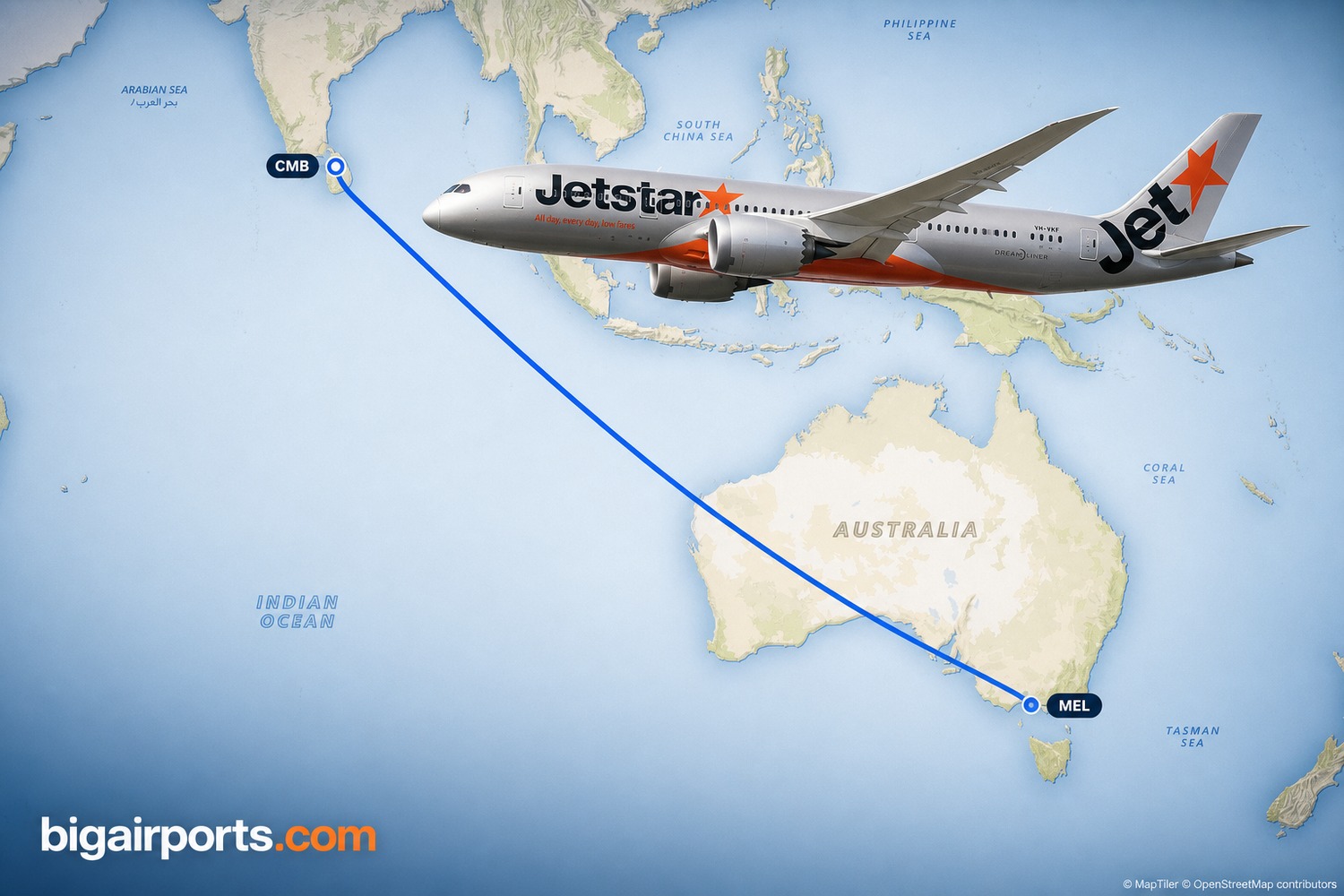
Jetstar Airways has begun nonstop services between Melbourne and Colombo, the carrier’s first scheduled route to Sri Lanka. The inaugural flight departed on 25 August 2026, and the service operates three times weekly, on Tuesdays, Thursdays and Saturdays, using Boeing 787-8 aircraft drawn from the airline’s long-haul fleet.
- Airline
- Jetstar Airways
- Route
- Melbourne (MEL) to Colombo (CMB)
- Aircraft
- Boeing 787-8
- Frequency
- 3x weekly (Tue/Thu/Sat)
- First flight
- 25 Aug 2026
Route overview
The service links Melbourne Airport with Bandaranaike International Airport in Colombo, a great-circle distance of approximately 8,200 kilometres. That makes it one of the longest sectors in Jetstar’s network, longer than the carrier’s established Melbourne services to Bali and Hong Kong and broadly comparable with its Honolulu operation.
The schedule was first filed in December 2025, as reported by AeroRoutes, and the launch pattern of three weekly rotations positions Colombo as a year-round scheduled operation rather than a seasonal programme. With 335 seats per departure in Jetstar’s 787-8 configuration, the timetable delivers just over a thousand seats per week in each direction.
The Tuesday, Thursday and Saturday pattern spreads the three rotations evenly across the week. Colombo becomes one of a small number of long-haul points on Jetstar’s Melbourne timetable, alongside established 787 markets such as Denpasar and Hong Kong, both of which the airport’s network data shows as high-frequency, multi-operator routes.
Jetstar’s network context
Colombo is Jetstar’s first destination in South Asia. The Qantas Group subsidiary has built its widebody international network around leisure markets in Southeast Asia and the Pacific, with Denpasar, Phuket, Tokyo and Honolulu among the anchors of its 787 flying. Sri Lanka takes the fleet into a market with a materially different demand profile, weighted towards visiting friends and relatives traffic alongside inbound tourism.
From its Melbourne base, Jetstar already operates a mix of domestic trunk routes and international leisure services. Network data for the airport shows Denpasar served by six operators and Singapore by five, an indication of how contested Melbourne’s established Asian leisure markets have become. Colombo, by contrast, gives the carrier a long-haul sector with no incumbent low-cost competitor.
Within the Qantas Group, the launch also fills a gap the mainline carrier does not cover. Qantas itself does not fly to Sri Lanka, so the Jetstar service becomes the group’s only nonstop link between Australia and Colombo, feeding the wider group network through Melbourne rather than relying on partner carriers over third-country hubs.
About the aircraft
Jetstar assigns the route to the Boeing 787-8, the smaller Dreamliner variant and the backbone of the airline’s long-haul operation. The carrier’s fleet of 11 aircraft is configured with 335 seats, comprising 21 Business and 314 Economy, a high-density layout consistent with its low-cost long-haul model.
The type joined Jetstar from 2013, when it progressively replaced the airline’s Airbus A330-200s on international routes. Powered by General Electric GEnx-1B engines, with a range in the region of 13,500 kilometres, the 787-8 covers the Melbourne to Colombo sector, a flight of roughly ten and a half hours, with a comfortable margin.
The cabin follows Jetstar’s standard long-haul split: a small Business cabin in a 2-3-2 layout at the front of the aircraft and Economy at nine abreast behind it, with meals, baggage and seat selection sold as add-ons in line with the carrier’s unbundled fare model. The same fleet and product operate Jetstar’s other widebody routes, so Colombo passengers see the established long-haul offering rather than a route-specific configuration.
The airports at each end
Melbourne Airport is Australia’s second-busiest airport and operates around the clock without a curfew, a point of difference from Sydney. Live network data on bigairports.com records 74 routes from the field. Sydney is the densest market, with 611 tracked flights across seven operators, followed by Brisbane on 379 and Hong Kong on 254, the airport’s strongest long-haul showing.
The Melbourne network is anchored by the domestic trunk routes to Sydney, Brisbane, Adelaide and Canberra, but the international side is broad, taking in Singapore with five operators, Auckland, Bali and Cairns. Colombo adds a new country to that map and gives the airport a direct link into South Asia.
Bandaranaike International is Sri Lanka’s principal international gateway and the hub of SriLankan Airlines. The same dataset records 54 routes from Colombo, with a network weighted towards the Gulf and the Indian subcontinent. Dubai is the densest market, with 662 tracked flights across four operators, ahead of Malé on 178, Kuala Lumpur on 116 and Chennai on 110. Singapore, served by three operators from Colombo, is the clearest overlap with Melbourne’s own route map.
Beyond the international network, the dataset also shows thin domestic links to Batticaloa, Trincomalee and Weerawila, single-operator routes that connect the capital region with the island’s east and south. For arriving Melbourne passengers, the practical draw is the airport’s position roughly 30 kilometres north of Colombo, within reach of the country’s west-coast beach resorts and the cultural sites inland.
Market context
SriLankan Airlines has been the sole nonstop operator between Melbourne and Colombo, serving the city pair with widebody Airbus A330s. Jetstar’s arrival makes it the first Australian carrier and the first low-cost carrier on the route, introducing price-led competition to a market that has otherwise depended on one-stop routings.
Those one-stop alternatives are visible in both airports’ network data. Singapore and Kuala Lumpur feature prominently at each end, and the Gulf carriers connect Colombo to Australia over Dubai, Doha and Abu Dhabi. Melbourne is home to one of Australia’s largest Sri Lankan communities, and launch coverage in the Sydney Morning Herald and the Australian travel trade press pointed to diaspora and leisure demand as the foundation of the service.
Sources & references (4)
Generated with editorial oversight from AI research.