Juneyao Airlines Launches Shanghai Pudong–Manila A320neo Service
Juneyao Airlines began twice-weekly Shanghai Pudong–Manila flights on 2 September 2026 with Airbus A320neo equipment, rising to five weekly rotations from 17 October as the carrier enters the China–Philippines market.
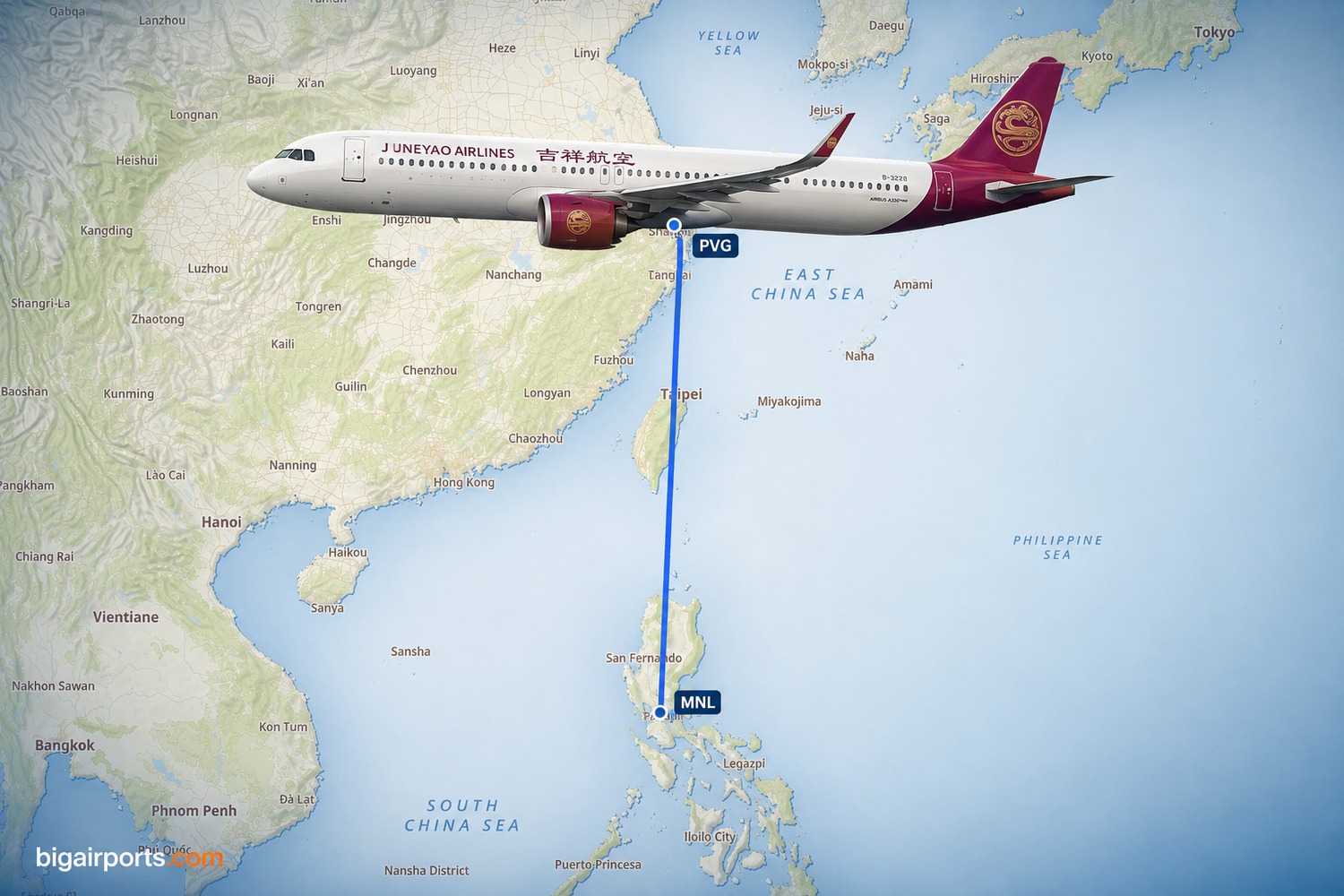
Juneyao Airlines launched scheduled services between Shanghai Pudong International Airport and Manila’s Ninoy Aquino International Airport on 2 September 2026, adding the Philippine capital to the Shanghai-based carrier’s Southeast Asian network. The route opened at twice-weekly frequency with Airbus A320neo equipment and is scheduled to step up to five weekly rotations from 17 October 2026.
- Airline
- Juneyao Airlines (HO)
- Route
- Shanghai Pudong (PVG) – Manila (MNL)
- Aircraft
- Airbus A320neo
- Frequency
- 2x weekly, rising to 5x weekly from 17 October 2026
- First flight
- 2 September 2026
Route overview
The Pudong–Manila sector covers a great-circle distance of roughly 1,850 kilometres, putting scheduled block time in the region of four hours southbound. At launch, the twice-weekly operation offers around 320 one-way seats per week, based on a typical two-class A320neo layout of about 160 seats; the move to five weekly frequencies on 17 October will lift that to roughly 800 seats each way per week.
The staggered ramp-up follows a pattern familiar from other Chinese carriers entering new international markets: open at minimum viable frequency, confirm booking behaviour, then scale into the northern winter season. The October increase positions the route for the year-end travel peak between eastern China and the Philippines, a period that combines leisure demand with substantial visiting-friends-and-relatives traffic in both directions. The route was first published in distribution systems in August 2026, giving the carrier a short selling window ahead of the inaugural flight.
Juneyao Airlines’ network context
Juneyao Airlines, a privately owned carrier founded in 2006 and part of the Shanghai-based Juneyao Group, operates from bases at both Shanghai Pudong and Shanghai Hongqiao. It has been a Star Alliance Connecting Partner since 2017, feeding traffic to and from alliance members’ networks at its Shanghai hubs while remaining outside full alliance membership.
The fleet is built around the Airbus A320 family, supplemented by Boeing 787-9s deployed on long-haul services to Europe, including Helsinki, Athens and Manchester. Within Asia, the carrier pairs a dense Chinese domestic operation with international services to Japan, South Korea, Thailand, Singapore and other regional markets. Manila slots into that structure as a natural narrowbody extension: close enough for efficient A320neo rotations, and connected at Pudong to Juneyao’s domestic feed network for passengers originating beyond Shanghai.
For the group, the Philippines also complements the operations of 9 Air, Juneyao’s low-cost subsidiary based in Guangzhou, giving the wider company exposure to the China–Philippines market from two separate mainland gateways.
About the aircraft
Juneyao is operating the route with the Airbus A320neo, the re-engined successor to the A320ceo family. New-generation engines and Sharklet wingtips deliver a fuel-burn reduction of around 15 to 20 per cent per seat against the previous generation, and the type’s range of up to 6,300 kilometres covers the Shanghai–Manila sector with full payload and comfortable reserves.
The economics of the neo suit frequency-led market entry. Rather than committing widebody capacity to an unproven sector, Juneyao can add rotations incrementally as demand firms, precisely the approach reflected in the October step-up from two to five weekly flights. The A320neo also keeps trip costs low enough to sustain the route through seasonal troughs, an advantage on a market where demand has historically been uneven across the year. Cabin configuration follows Juneyao’s standard narrowbody product, with a small business-class section ahead of economy.
About the airports
Shanghai Pudong is one of Asia’s largest international gateways, with 283 nonstop routes in current tracking data. Its densest passenger link is Hong Kong, served by nine operators with more than 1,400 tracked flights, while Anchorage, a technical stop for transpacific freighters, accounts for over 600 movements across 12 operators, underlining Pudong’s parallel role as a cargo hub. Long-haul passenger service spans Los Angeles and Amsterdam, and regional frequencies are heavy to Tokyo Narita, Seoul Incheon and Taipei. The airport continues to expand, with additional terminal capacity under construction.
Ninoy Aquino International, the primary gateway to the Philippines, shows 100 nonstop routes in the same dataset. The domestic trunk to Cebu is its single busiest market, with seven carriers and more than 560 tracked flights, while Hong Kong leads the international table at over 1,070 flights across ten carriers. Regional connectivity concentrates on Taipei and Singapore, and Dubai is the airport’s principal long-haul link at more than 330 flights. The airport has been under private management since 2024, with the new operator progressing a rehabilitation programme covering terminals, airfield capacity and passenger processing. Juneyao’s arrival adds a further mainland-Chinese operator to a route map otherwise dominated by domestic inter-island connectivity.
Market context and competition
The Shanghai–Manila city pair is already contested by Philippine Airlines and China Eastern Airlines, with Cebu Pacific representing the low-cost segment, so Juneyao enters as a challenger rather than a monopoly operator. Its competitive case rests on schedule depth at Pudong: passengers originating across Juneyao’s Chinese domestic network gain a one-stop path to Manila, while Manila-originating traffic gains access to secondary Chinese cities beyond the reach of nonstop service.
Underlying demand on the corridor is broad-based, combining trade flows, tourism and the overseas Filipino worker market, and China–Philippines air capacity has been rebuilding steadily since the pandemic-era trough. At five weekly A320neo rotations, Juneyao’s contribution remains measured at roughly 800 weekly seats each way, but it establishes scheduled service in a market where the carrier previously had no nonstop presence from Shanghai. For Ninoy Aquino, the addition also deepens mainland-Chinese connectivity, which trails the airport’s dense Hong Kong and Taipei links in current schedule data. Schedules for the route are filed and on sale through the carrier’s distribution channels, with the full five-weekly pattern effective 17 October 2026.
Sources & references (4)
Generated with editorial oversight from AI research.