Air Arabia Launches Daily Sharjah–Rome Fiumicino A320neo Service
The UAE low-cost carrier began Airbus A320neo flights between Sharjah and Rome Fiumicino on 1 July 2026, its second Italian destination and one of the longest sectors on its Sharjah network.
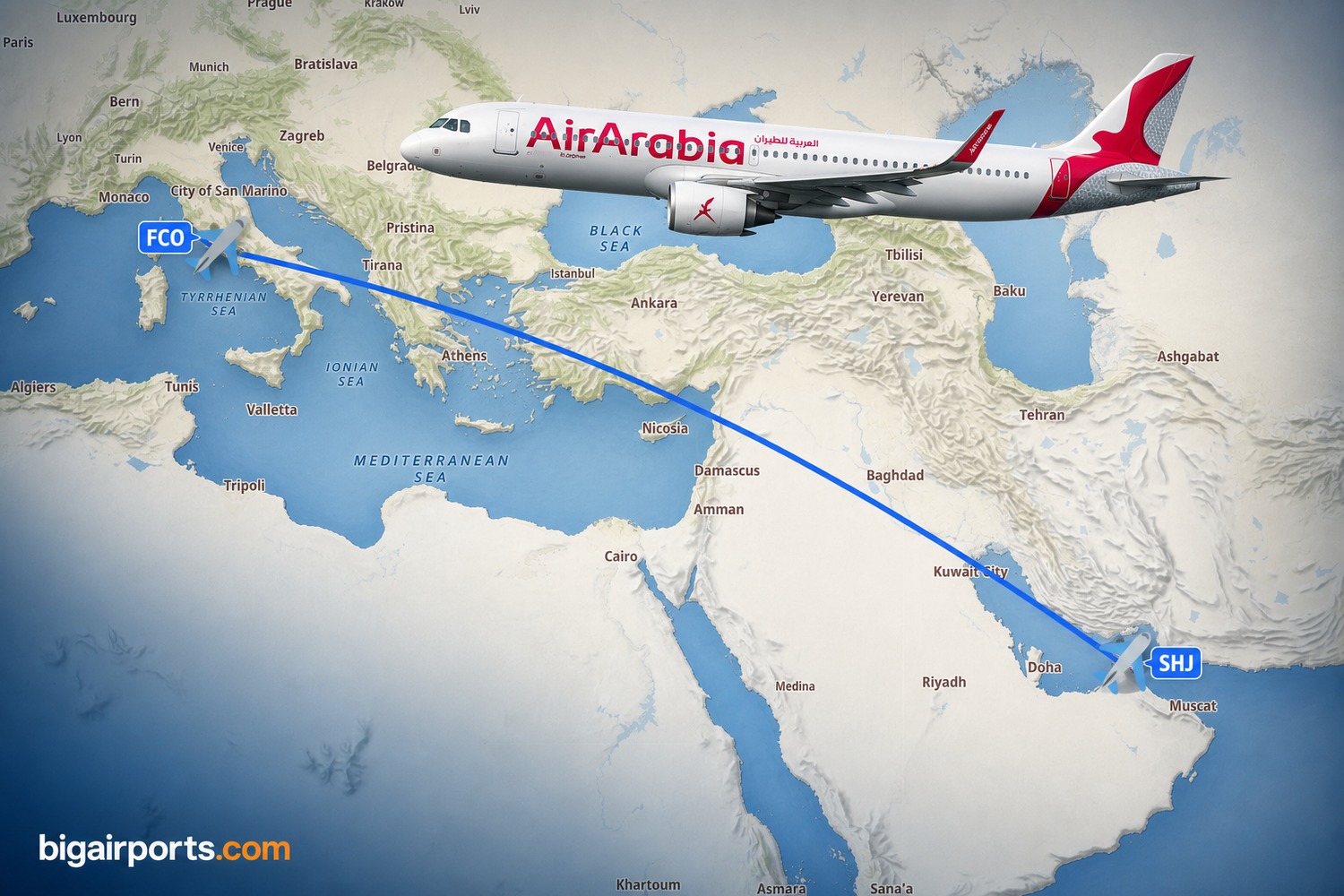
Air Arabia began scheduled flights between Sharjah and Rome Fiumicino on 1 July 2026, giving the low-cost carrier its second Italian destination and one of the longest sectors flown from its home base. The service is operated with the Airbus A320neo and was announced as a daily rotation on a sector of roughly 4,300 kilometres.
- Airline
- Air Arabia (G9)
- Route
- Sharjah (SHJ) to Rome Fiumicino (FCO)
- Aircraft
- Airbus A320neo
- Frequency
- Daily
- First flight
- 1 July 2026
Route overview
The route links Sharjah International Airport in the United Arab Emirates with Rome Fiumicino Leonardo da Vinci International Airport, Italy’s principal intercontinental gateway. Air Arabia confirmed the launch in a company announcement, and the schedule was first reported by AeroRoutes in May 2026.
The carrier positioned the service as a daily operation from 1 July 2026, although subsequent third-quarter schedule filings reported by AeroRoutes showed the frequency trimmed to five weekly rotations during parts of the season. Adjustments of this kind are routine in a launch quarter, and the airline’s published intent remains a daily service.
At approximately 4,300 kilometres, the sector sits towards the upper end of what Air Arabia schedules from Sharjah, with a westbound block time of around six and a half hours. Rome joins a small group of European points on the carrier’s Sharjah network and becomes one of its westernmost destinations.
Air Arabia’s network position
Air Arabia, founded in 2003 as the Middle East’s first low-cost carrier, operates an all-Airbus narrowbody fleet from its main base at Sharjah, with additional UAE operations at Abu Dhabi and Ras Al Khaimah and joint-venture carriers in Morocco, Egypt and Pakistan.
Rome is the group’s second Italian destination, a milestone the airline highlighted in its launch communication. Italy joins a European portfolio that the carrier has expanded gradually, using the extra range and lower trip costs of its newest narrowbodies to reach markets that were previously marginal for a Sharjah-based low-cost operation.
The addition also deepens Air Arabia’s presence in the UAE–Europe market, where the group can feed the Rome service with connecting traffic from its South Asian and Middle Eastern short- and medium-haul network over Sharjah, a pattern the carrier already applies on its other longer sectors. Gulf News noted at launch that the route forms part of a wider push to broaden the airline’s European footprint from its UAE bases.
About the aircraft: Airbus A320neo
The route is flown with the Airbus A320neo, the re-engined variant of Airbus’s narrowbody family. The type delivers a fuel-burn improvement of around 15 to 20 per cent per seat over the previous-generation A320ceo, together with a longer range of roughly 6,300 kilometres, which places the Sharjah–Rome sector comfortably within its capability.
Air Arabia placed an order for 120 A320neo-family aircraft in 2019, covering the A320neo, A321neo and long-range A321XLR, and the type is progressively taking over the carrier’s longest and thinnest routes as deliveries continue. The airline operates its narrowbodies in a single-class economy configuration, consistent with its point-to-point low-cost model, which keeps unit costs low on a sector of this length. In high-density single-class layouts the A320neo typically accommodates around 180 seats, giving the carrier meaningful weekly capacity on the pair even at five rotations.
About the airports
Sharjah International Airport has served as Air Arabia’s home base since the carrier’s first flight in 2003 and currently offers 120 nonstop destinations, according to bigairports.com network data. Its schedule is anchored in the Middle East and South Asia: the densest route is Doha, with 349 monthly flights across two operators, followed by Dhaka (176 flights), Cairo (158), Manama (134) and Mumbai (125). European coverage from Sharjah is comparatively thin, limited to points such as Moscow Domodedovo and Istanbul Sabiha Gökçen, which underlines how far outside the airport’s core geography the new Rome service reaches.
Rome Fiumicino, the home hub of ITA Airways and Italy’s busiest airport, is a substantially larger operation, with 238 nonstop destinations in the current schedule. Its busiest markets are intra-European trunk routes: Madrid leads with 1,241 monthly flights across seven operators, ahead of Amsterdam (1,138) and Barcelona (958). The airport’s densest medium-haul market is Tel Aviv, served by eight operators with 164 monthly flights. Gulf links exist at Fiumicino but form a small share of a network dominated by European traffic, leaving room for additional Middle East capacity.
Market context and competition
There was no nonstop service between Sharjah and Rome before this launch, so Air Arabia enters the city pair without direct competition. The broader UAE–Rome market, however, is well served: Emirates operates Rome from Dubai, some 15 kilometres from Sharjah, and full-service connectivity between Italy and the Gulf is also available over other regional hubs.
Air Arabia’s proposition is therefore price-led. The carrier is targeting point-to-point leisure and visiting-friends-and-relatives traffic between Italy and the northern Emirates, along with connecting passengers from its Sharjah network to a European capital that its customer base could previously reach only via other airlines or airports.
For Fiumicino, the service adds a low-cost Gulf link to a route map weighted towards Europe, and it arrives without displacing an incumbent. For Sharjah, Rome extends a network of 120 destinations further into Western Europe than most of its schedule reaches today. The early signal to watch is frequency: whether the operation settles at the announced daily pattern or holds at five weekly rotations through the winter season will indicate how quickly demand on the pair matures.
Sources & references (5)
Generated with editorial oversight from AI research.