flydubai Launches Daily Dubai-Bangkok Don Mueang 737 MAX Service
flydubai began daily Boeing 737 MAX flights from Dubai International to Bangkok's Don Mueang on 1 July 2026, giving the domestic-dominated low-cost hub a rare nonstop Gulf link.
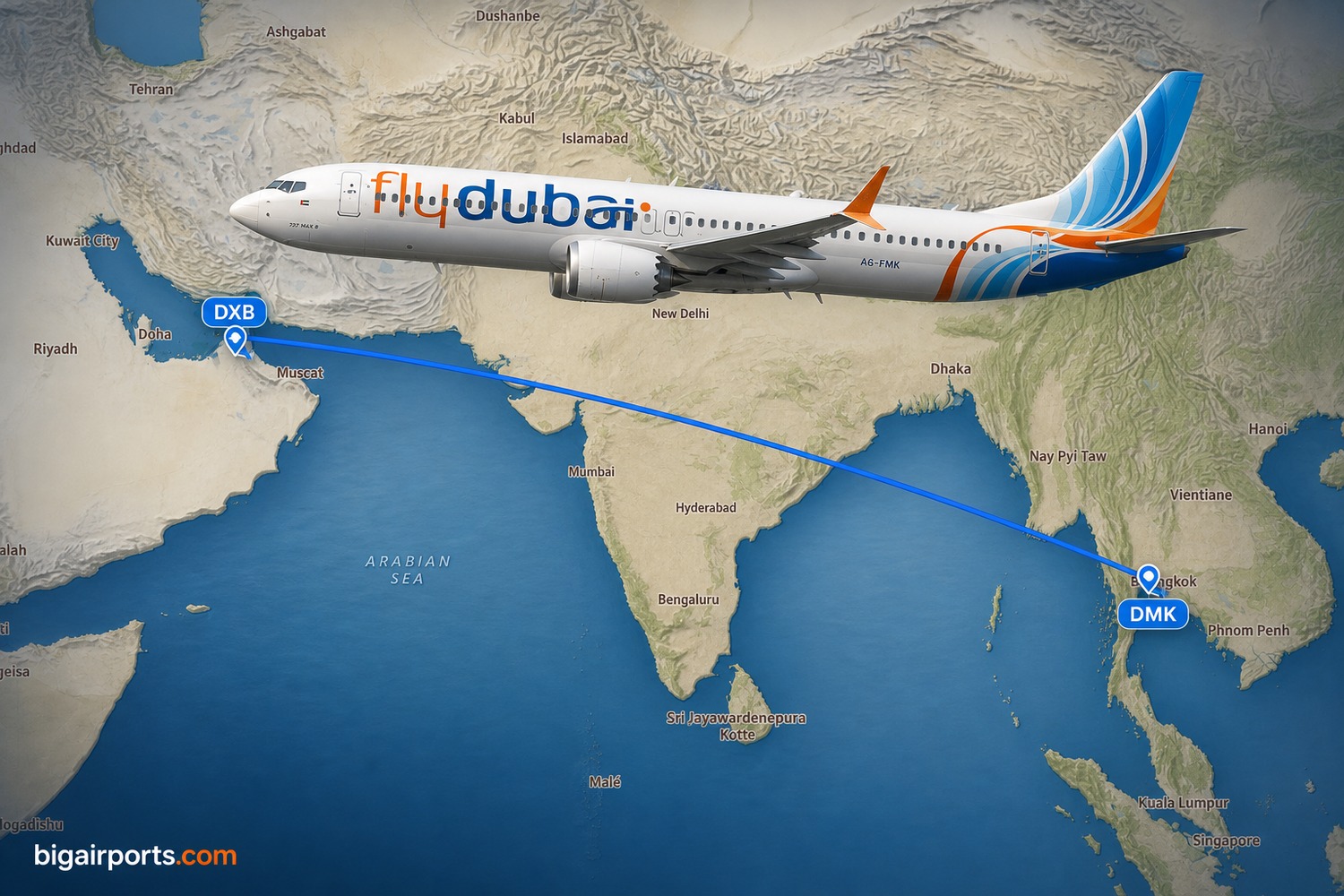
flydubai began daily flights between Dubai International Airport and Bangkok’s Don Mueang International Airport on 1 July 2026, deploying Boeing 737 MAX aircraft on the roughly 4,900-kilometre sector. The launch places the Dubai-based carrier at the Thai capital’s secondary airport, a field otherwise dominated by short-haul low-cost operators.
- Airline
- flydubai (FZ/FDB)
- Route
- Dubai (DXB) to Bangkok Don Mueang (DMK)
- Aircraft
- Boeing 737 MAX
- Frequency
- Daily
- First flight
- 1 July 2026
Route overview
The service operates once daily in each direction, year-round, according to the airline. In choosing Don Mueang over Suvarnabhumi, flydubai has positioned the route at the older of Bangkok’s two commercial airports, the base for Thailand’s largest low-cost carriers and their extensive domestic networks. The airline said Bangkok joins its network with the launch, extending its reach into Southeast Asia from its home hub in Dubai.
The sector sits towards the longer end of flydubai’s route map, which is built around the narrowbody economics of the 737 family. At around 4,900 kilometres, the flight is comfortably within the 737 MAX’s operating range, and the daily frequency supports both point-to-point traffic and connections over Dubai. Coverage of the launch in Gulf and Thai media has framed the route around trade and tourism flows between the UAE and Thailand, with Bangkok remaining one of the most visited cities in the world and Dubai serving as a major transfer point for traffic originating across Europe, Africa and the wider Middle East.
flydubai’s network position
flydubai began operations in June 2009 and is wholly owned by the Government of Dubai. The carrier has grown into one of the region’s largest narrowbody operators, with a fleet built exclusively around the Boeing 737 and a network the airline puts at more than 135 destinations. Its model concentrates on markets that are underserved from Dubai or that sit below the traffic thresholds required for widebody service, and Bangkok extends that formula into one of Southeast Asia’s largest travel markets.
Since 2017, flydubai has maintained an extensive partnership with Emirates, including codeshares and coordinated scheduling at their shared Dubai hub. That agreement gives the Bangkok service relevance beyond the local market: passengers arriving from Don Mueang can connect onto the two carriers’ combined network across Europe, Africa and the Middle East, while Emirates-marketed traffic gains access to Bangkok’s second airport for the first time.
The aircraft: Boeing 737 MAX
flydubai operates the route with the Boeing 737 MAX, the type that forms the backbone of its fleet. The carrier was among the earliest operators of the MAX, taking its first MAX 8 in 2017, and today flies both the MAX 8 and MAX 9 variants alongside previous-generation 737-800s. Powered by CFM International LEAP-1B engines, the MAX family delivers a fuel-burn improvement of around 14 per cent over the 737NG, an economy that matters on a sector of this length flown every day.
The aircraft’s range, roughly 6,500 kilometres for the MAX 8, leaves adequate margin on the Dubai to Bangkok routing. flydubai’s MAX cabins are fitted in a two-class configuration, with the airline offering lie-flat business seating on its MAX 8 fleet alongside a standard economy cabin, an unusual product for a narrowbody operator in this sector-length band.
The airports: Dubai International and Don Mueang
Dubai International serves 296 nonstop routes, according to bigairports.com network data. Its densest markets are regional: Riyadh leads with 430 tracked flights across six operators, followed by Jeddah with 314 and Mumbai with 296. Bahrain, Doha, Kuwait and Muscat all rank among the busiest short-haul links, while London Heathrow, with 155 flights across four operators, is the strongest long-haul market in the sample. The Bangkok launch adds a further medium-to-long-haul spoke to a hub whose schedule is already heavily weighted towards the Gulf and South Asia.
Don Mueang presents a very different profile. The airport serves 96 nonstop routes, and its schedule is dominated by Thai domestic trunk flying: Chiang Mai with 273 flights, Phuket with 212 and Nakhon Si Thammarat with 161 top the table, with Hat Yai, Krabi, Udon Thani and Surat Thani close behind, most contested by three operators apiece. International capacity is thin by comparison: Kuala Lumpur (69 flights) and Jakarta (60) are the only non-domestic markets among its busiest routes, and Jakarta is the sole medium-haul entry. The airport is home to Thai AirAsia, Nok Air and Thai Lion Air, whose networks account for much of that domestic density.
Market context and competition
In the wider Dubai-Bangkok market, the dominant operator is Emirates, which flies widebody services from Dubai to Suvarnabhumi, Bangkok’s principal long-haul gateway. flydubai’s decision to serve Don Mueang instead means the two Dubai-based carriers address the city through different airports, and the new flight stands as the only Gulf service within Don Mueang’s route set shown in current network data.
The choice of airport also shapes the connecting proposition at the Bangkok end. Don Mueang’s 96-route, domestic-heavy schedule offers onward access to Thai regional points such as Chiang Mai and Phuket, the two busiest routes at the airport, positioning the flydubai service for passengers heading beyond the capital. On the Dubai side, the flight feeds into a hub where the busiest fifteen markets alone account for several thousand tracked flights, spanning six operators on the densest route and reaching from Riyadh and Jeddah to Heathrow, Delhi and Dhaka.
For Don Mueang, the service is a rare long-haul international addition at an airport whose traffic is driven almost entirely by domestic low-cost flying. For flydubai, it is a further step eastwards from a 296-route home hub, executed with the narrowbody economics that have defined the carrier since 2009.
Sources & references (4)
Generated with editorial oversight from AI research.