American Airlines to Launch Daily Chicago–Tokyo Narita 787-9 Route
American Airlines will fly daily Boeing 787-9 services between Chicago O'Hare and Tokyo Narita from 27 March 2027, becoming the fourth carrier on the Chicago–Tokyo city pair and the only one serving Narita.
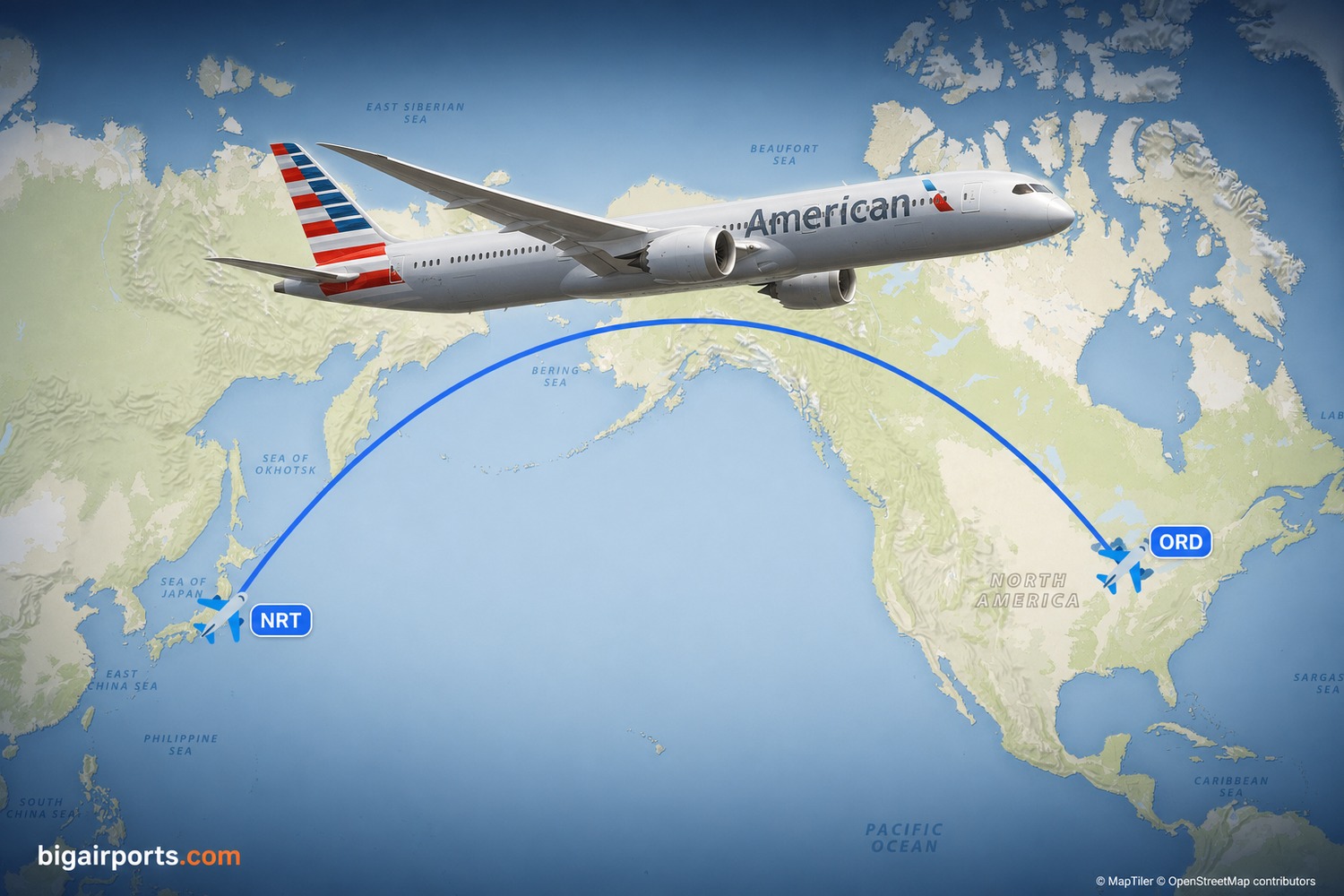
American Airlines will launch a daily nonstop service between Chicago O’Hare and Tokyo Narita on 27 March 2027, operated by the Boeing 787-9. The announcement, which the carrier framed as a new chapter for its Chicago hub, restores a transpacific link from O’Hare and returns American to a Tokyo market it has been absent from for several years.
- Airline
- American Airlines
- Route
- Chicago O'Hare (ORD) to Tokyo Narita (NRT)
- Aircraft
- Boeing 787-9
- Frequency
- Daily
- First flight
- 27 March 2027
Route overview
The sector covers a great-circle distance of roughly 6,270 miles (10,090 kilometres), with westbound block times of around 13 hours and a somewhat shorter eastbound return. American will operate the service daily, year-round, and at typical 787-9 capacity the schedule adds up to roughly 2,000 seats per week in each direction to the Chicago–Tokyo market, depending on which cabin configuration is deployed.
The Tokyo launch headlined a wider American network announcement that also included new domestic services to Charlottesville, Virginia and Ontario, California. For O’Hare, though, the Narita flight is the substantive item: a year-round widebody intercontinental addition at a hub where American’s long-haul network has been noticeably thinner than its domestic operation in recent years.
The move is a resumption rather than a first. American previously linked Chicago with Tokyo before consolidating its Japan flying elsewhere in its network, and trade coverage has consistently framed the 2027 launch as a return to a market the carrier once served with its own aircraft. The 27 March start date places the launch at the opening of the northern summer 2027 scheduling season, the traditional window for new long-haul services.
American’s network context
American’s transpacific position rests on its joint business with Japan Airlines, in place since 2011, and its membership of the oneworld alliance. In recent years the carrier’s own-metal Tokyo flying has concentrated on Haneda, the closer-in Tokyo airport where slots are tightly controlled and allocated in limited tranches. Selecting Narita for the Chicago service is therefore a deliberate network decision rather than a fallback.
Narita remains Japan Airlines’ principal international connecting hub, with banks of onward departures to Southeast Asia timed around transpacific arrivals. Routing Chicago traffic over Narita lets American sell one-stop itineraries deep into Asia under the joint business, rather than competing solely for point-to-point Tokyo demand. Aviation Week has characterised the move as part of a broader rebuilding of American’s long-haul network at O’Hare.
About the aircraft
American will fly the route with the Boeing 787-9, the backbone of its long-haul widebody fleet. The carrier’s standard 787-9 layout seats 285 passengers across Flagship Business, Premium Economy and Main Cabin, while the newer premium-configured variant, entering the fleet since 2025, seats 244 passengers including 51 Flagship Suite business class seats.
Powered by General Electric GEnx-1B engines and with a published range of around 7,500 nautical miles, the 787-9 handles the 6,270-mile sector comfortably in both directions, including against winter jet-stream headwinds on the westbound leg. At the standard 285-seat layout, a daily rotation equates to just under 2,000 seats per week each way. The type’s economics have made it American’s default choice for long, premium-weighted routes, and every one of the carrier’s recent transpacific launches has used the aircraft.
Chicago O’Hare and Tokyo Narita
Chicago O’Hare is one of the largest hubs in the United States, serving 332 routes in current bigairports.com network data. Its busiest links illustrate the airport’s dual role: dense domestic trunks such as Atlanta (201 flights), Dallas-Fort Worth (194 flights across 11 operators) and New York LaGuardia (168 flights), alongside heavyweight long-haul corridors led by Shanghai Pudong, with 323 flights across six operators, and Anchorage, whose 357 tracked flights across ten operators point to substantial freighter activity.
Tokyo Narita serves 124 routes in the same dataset. Its densest corridors are regional: Hong Kong leads with 548 flights across 11 operators, followed by Seoul Incheon with 361 flights across 19 operators and Taipei with 241 flights. Domestically, trunk routes to Chitose (385 flights) and Fukuoka (324 flights) keep Narita tied into Japan’s secondary cities even as Haneda has absorbed much of Tokyo’s premium short-haul traffic. Narita’s tracked long-haul links include Los Angeles, Singapore and Bangkok, underlining its continued role as Japan’s intercontinental gateway.
Market context and competition
Nonstop passenger capacity between Chicago and Tokyo is currently concentrated at Haneda, where United Airlines, All Nippon Airways and Japan Airlines each operate on the O’Hare pairing. No carrier currently offers scheduled nonstop passenger service between O’Hare and Narita itself; bigairports.com data tracks two operators and 53 flights on the airport pair, activity dominated by cargo. American’s entry will make it the fourth carrier on the Chicago to Tokyo city pair and the only one serving Narita with passengers.
The competitive contest is therefore less about the nonstop market and more about connecting flows beyond Tokyo. United and All Nippon Airways channel Chicago traffic over Haneda within their own transpacific joint venture, while one-stop routings over Seoul Incheon remain a price-competitive alternative for Midwest passengers heading to Southeast Asia. American and Japan Airlines will counter with the Narita connecting bank, which offers onward departures across Asia timed against morning transpacific arrivals, with reciprocal codesharing and frequent-flyer earning across both carriers under the joint business.
For O’Hare, the addition returns a Narita link to an airport that historically hosted several. For American, it extends a measured long-haul rebuild at its Chicago hub and deepens a joint business that remains central to its Pacific strategy. The first departure is scheduled for 27 March 2027, operating daily with the 787-9.
Sources & references (5)
Generated with editorial oversight from AI research.