American Airlines Adds Miami–Barcelona, Venezuela E175 Service
American Airlines will link Miami with Barcelona, Venezuela three times weekly from 15 January 2027, deploying a 76-seat Embraer E175 on its first-ever scheduled service to the eastern Venezuelan city.
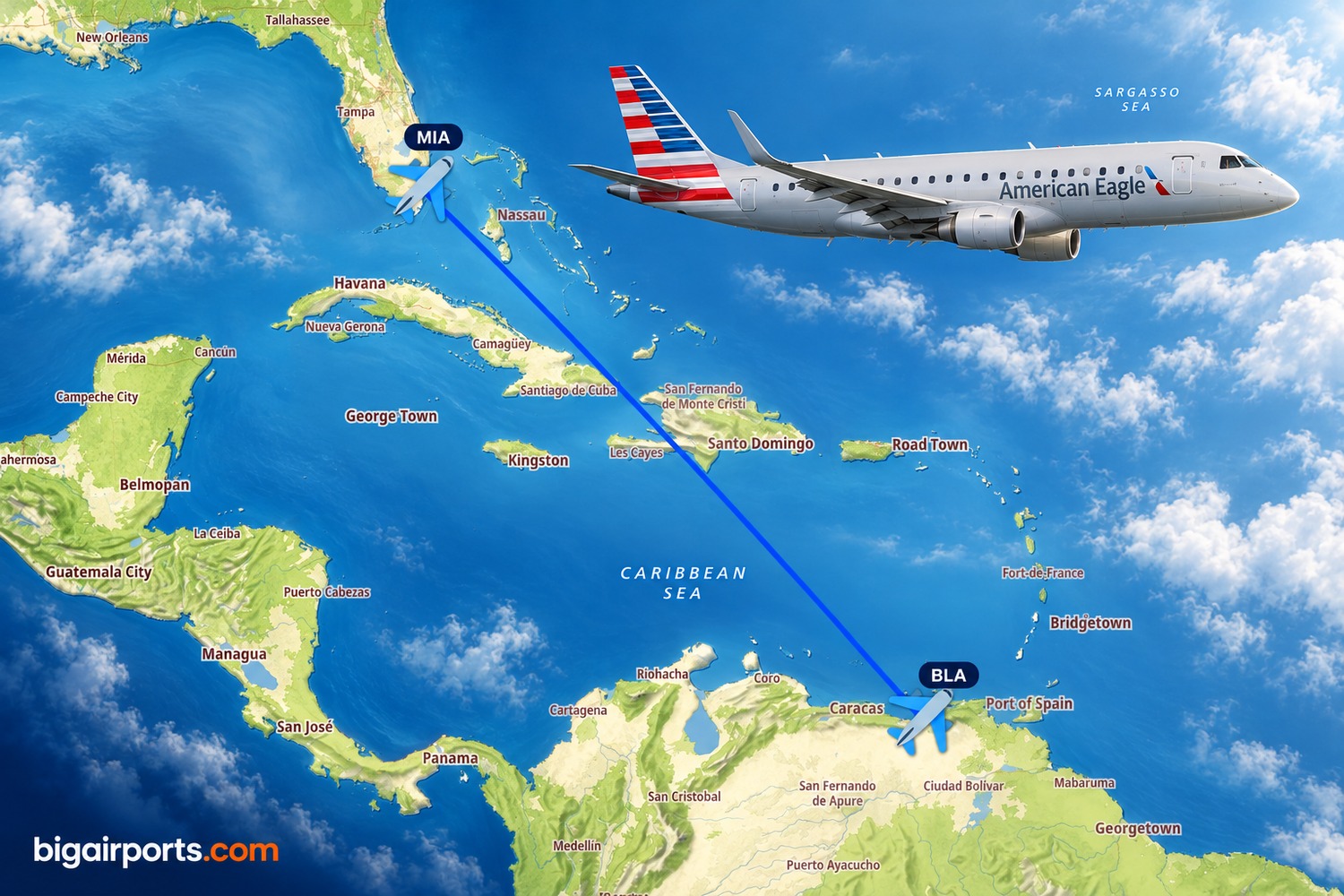
American Airlines will launch a three-times-weekly service between Miami International Airport and General José Antonio Anzoátegui International Airport in Barcelona, Venezuela, on 15 January 2027. The route will be flown by a 76-seat Embraer E175 and marks the carrier’s first-ever scheduled service to the eastern Venezuelan city, according to the airline’s announcement of 16 October 2026.
- Airline
- American Airlines
- Route
- Miami (MIA) to Barcelona, Venezuela (BLA)
- Aircraft
- Embraer E175
- Frequency
- 3x weekly (Mon/Wed/Fri)
- First flight
- 15 January 2027
Route overview
Flights will operate on Mondays, Wednesdays and Fridays, adding 228 one-way seats per week in each direction between South Florida and Venezuela’s north-eastern coast. The sector spans roughly 2,400 kilometres, or about 1,300 nautical miles, a distance well suited to the E175 and broadly comparable to American’s existing regional-jet flying from Miami into the deeper Caribbean. The Monday, Wednesday and Friday pattern concentrates capacity on peak travel days while leaving the airframe free for other Miami flying across the remainder of the week.
The new service gives Barcelona its only scheduled link to the United States. Network data from bigairports.com records just a single flight between the two airports in the current reporting period, indicating no established scheduled operation on the pair today. For American, the route grows its Venezuela network, which the carrier has been rebuilding after suspending all flying to the country in March 2019.
American’s network context
Miami is American’s principal gateway to Latin America and the Caribbean, and the carrier is the airport’s dominant operator. Barcelona slots into a Miami operation that already reaches an unusually broad set of regional points, from high-frequency trunk routes such as Bogotá to thinner markets served with narrowbodies and regional jets.
American’s history in Venezuela is long but interrupted. The airline was for decades the largest US carrier serving the country, with services concentrated on Caracas, before suspending all Venezuelan flying in March 2019 amid the country’s political and economic crisis. The Barcelona launch is the latest step in the carrier’s measured return to the market, and the first time American has placed its code on a scheduled service to the city. The airline’s own announcement frames the route as growing its Venezuela network rather than re-entering it, underlining that the rebuild is already under way.
About the aircraft
The Embraer E175 assigned to the route is the smallest aircraft in American’s network to operate international flying of this length. In American’s configuration the type seats 76 passengers, with 12 in first class, 20 in Main Cabin Extra and 44 in the main cabin, in a two-by-two layout with no middle seats. American’s E175 fleet is flown by regional affiliates, including wholly owned subsidiary Envoy Air, under the American Eagle brand; Envoy operates the bulk of the regional schedule at Miami.
With a range of around 2,200 nautical miles, the E175 comfortably covers the Miami to Barcelona sector with full payload. The type has become American’s standard tool for opening thin international markets from Miami, where a mainline narrowbody would add more seats than early demand can absorb. Deploying it here signals that American sees Barcelona as a market to be developed gradually rather than one with proven high-volume demand.
The airports: Miami and Barcelona
Miami International is one of the western hemisphere’s most connected hubs. bigairports.com network data shows the airport serving 262 nonstop destinations in the current period. Its densest international links underline the Latin orientation of the hub: Bogotá leads with 552 flights across 22 operators, while Madrid is the single busiest route by flight volume, with 1,403 flights recorded in the period. Amsterdam, Santo Domingo and Quito round out the busiest international pairs. Domestic trunk routes to Atlanta, New York, Dallas-Fort Worth and Orlando sit alongside that international base.
Barcelona’s General José Antonio Anzoátegui International, by contrast, is a modest regional airport serving the Barcelona and Puerto La Cruz conurbation in Anzoátegui state, a centre for Venezuela’s oil and gas industry and the gateway to the Mochima coastline. Current data shows just 12 nonstop routes, dominated by domestic flying: Caracas is the busiest link with 193 flights across three operators, followed by Porlamar and Valencia. International service is limited to a single-operator Madrid link with 57 flights in the period, plus minimal activity to Bogotá and Panama City. American’s arrival therefore represents a material step-change in the airport’s international connectivity.
Market context and competition
American will face no scheduled nonstop competition on the Miami to Barcelona pairing at launch. Passengers travelling between the two cities today rely on connections over Caracas, Bogotá or Panama City, or on the limited long-haul option via Madrid. Each of those routings adds hours to a journey the E175 will complete nonstop in an afternoon, and none offers meaningful frequency: the Panama City and Bogotá links from Barcelona each show only token activity in the current data.
The wider US to Venezuela market remains constrained by years of suspended services, regulatory friction and reduced capacity, and traffic is expected to be led by family visits among South Florida’s large Venezuelan community alongside energy-sector business demand into Anzoátegui. That profile fits a 76-seat aircraft on three weekly rotations far better than daily narrowbody service would.
The launch also deepens the imbalance between the two ends of the route. Miami’s 262-destination network dwarfs Barcelona’s 12 routes, meaning the new service functions primarily as a feeder into American’s Miami hub, connecting eastern Venezuela onward to the United States, Europe and the Caribbean. If demand matures, the obvious levers are additional weekly frequencies or an upgauge to mainline narrowbody equipment, though American has announced only the three-weekly E175 operation for now. Forward schedules beyond the launch period have not been published, and the carrier has given no indication of seasonal adjustments to the service.
Sources & references (4)
Generated with editorial oversight from AI research.