flyadeal Launches Riyadh–Mumbai A320neo Service Five Times Weekly
The Saudia Group low-cost subsidiary began five-weekly Airbus A320neo flights between King Khalid International and Chhatrapati Shivaji on 3 October 2026, opening its second Indian gateway.
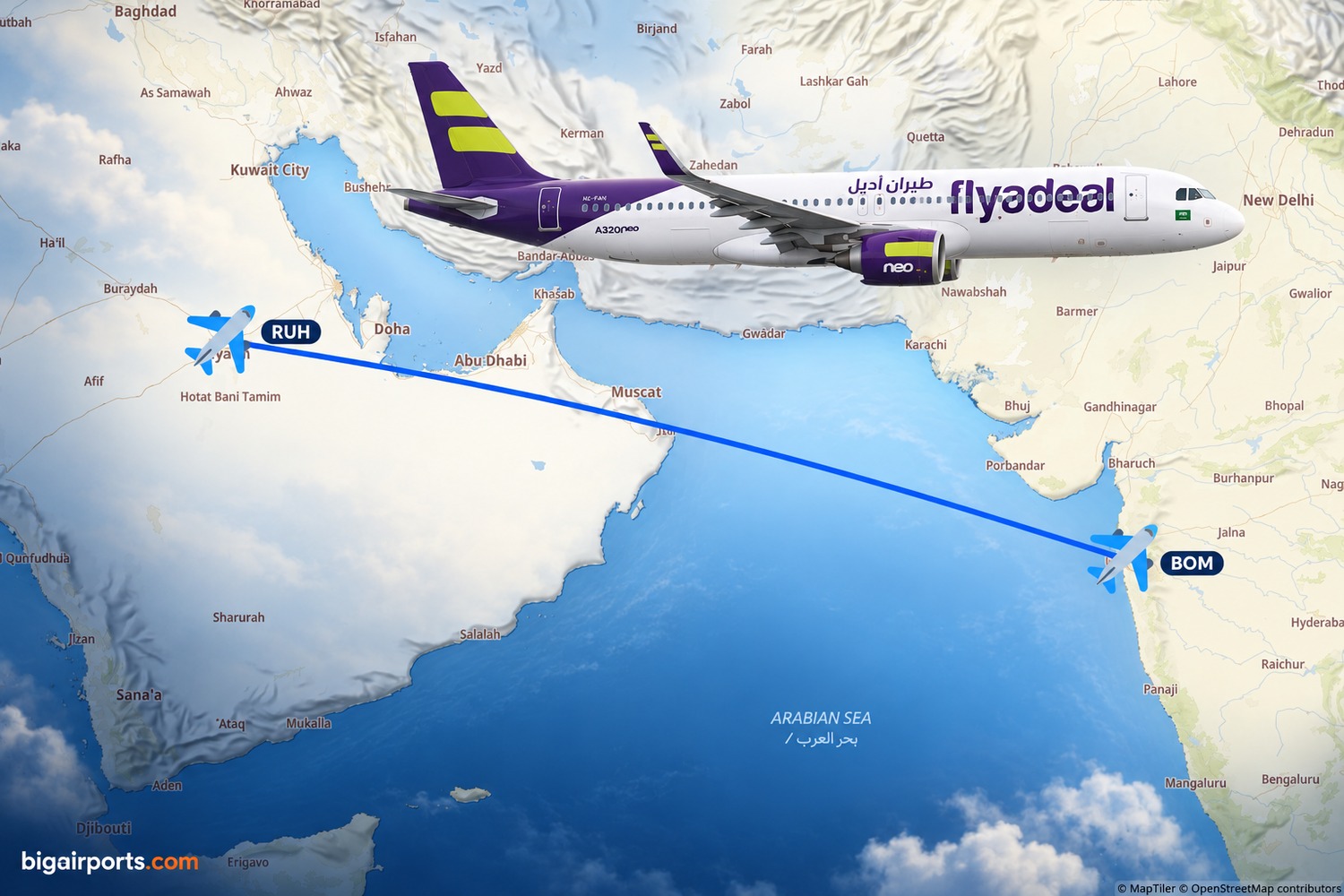
Saudi low-cost carrier flyadeal commenced scheduled services between Riyadh and Mumbai on 3 October 2026, operating the city pair five times weekly with an Airbus A320neo. The route gives the Saudia Group’s budget subsidiary its second gateway in India and adds a nonstop option on a corridor where much of the traffic has historically connected over the Gulf hubs.
- Airline
- flyadeal (F3)
- Route
- Riyadh (RUH) to Mumbai (BOM)
- Aircraft
- Airbus A320neo
- Frequency
- Five weekly
- First flight
- 3 October 2026
- Sector length
- c. 2,780 km
Route overview
The service links King Khalid International Airport (RUH) with Chhatrapati Shivaji International Airport (BOM), a sector of roughly 2,780 kilometres, or about 1,500 nautical miles, with a block time of around four hours. flyadeal operates the aircraft in a single-class configuration, and at five rotations per week the schedule places roughly 930 one-way seats into the market in each direction, close to 1,860 round-trip seats weekly. The deployment is consistent with the rest of the carrier’s international operation, which is flown entirely with Airbus narrowbody equipment, and flyadeal becomes the newest entrant on the pair.
Coverage of the launch indicates the airline is targeting price-sensitive point-to-point traffic: workers, visiting friends and relatives, and religious travellers moving between western India and Saudi Arabia. Trade reporting describes Mumbai as flyadeal’s second Indian gateway, consolidating an India entry that forms part of the carrier’s wider international build-up.
flyadeal’s network context
Founded in 2017 as the low-cost arm of Saudia Group, flyadeal operates an all-Airbus A320-family fleet from bases in Jeddah, Riyadh and Dammam. The carrier built its position on high-frequency Saudi domestic trunk routes before layering on regional international services, adding points across Egypt, Jordan and the wider Gulf before pushing east into the subcontinent.
Mumbai extends that second phase. India is a strategically important market for Saudi aviation, and coverage of the launch framed it as part of a broader push in which Saudi carriers are betting heavily on India, with flyadeal positioned at the budget end of the spectrum alongside its full-service parent, Saudia. The group has also ordered Airbus A330neo widebodies for flyadeal, due later this decade, which will add capacity for religious-traffic peaks and denser medium-haul routes. For now, the A320neo defines the outer edge of the airline’s network range, and Mumbai sits comfortably within it.
About the aircraft
flyadeal operates the Airbus A320neo in a 186-seat single-class layout, powered by CFM International LEAP-1A engines. The type delivers 15 to 20 per cent lower fuel burn per seat than the previous-generation A320ceo and offers a range of approximately 6,300 kilometres, leaving a comfortable margin on the four-hour Riyadh–Mumbai sector in both directions, including against seasonal headwinds on the westbound leg.
For a low-cost operator, the neo’s economics matter most on precisely this kind of mission: a medium-haul international sector flown with dense single-class seating and high daily aircraft utilisation across a mixed domestic and international flying programme. The type has become the workhorse of budget operations across the Gulf, where its combination of range and seat costs has opened India and other medium-haul markets to narrowbody economics.
About the airports
King Khalid International is Riyadh’s primary airport and currently offers nonstop service on 135 routes. Its densest domestic links are Jeddah, with 908 tracked flights across four operators, and Dammam; Abha, with 259 tracked flights, and Medina, with 222, round out the domestic trunks. Internationally, Dubai is the standout city pair, with 2,097 tracked flights spread across six operators, while Cairo is the most contested route by carrier count, with nine operators. South Asia is already a competitive segment from Riyadh: Islamabad is served by nine operators, and long-haul coverage includes London with five. The airport remains the centre of Riyadh’s aviation growth ahead of the planned King Salman International development.
Chhatrapati Shivaji International is India’s second-busiest airport and lists 152 nonstop routes on current data. Delhi is its densest domestic pairing, with 580 tracked flights across seven operators, followed by Bangalore with 366 across six. Dubai leads its international table with 1,131 tracked flights across five operators, while Amsterdam, with 419, anchors the long-haul schedule; among Gulf pairings, Abu Dhabi logs 85 tracked flights across five operators. Mumbai also operates under well-documented slot constraints on its intersecting runways, which makes any new foreign-carrier entry on a trunk international route notable in its own right.
Market context and competition
The Riyadh–Mumbai city pair already carries nonstop capacity at both ends of the market. Saudia and Air India operate the route at the full-service end, while Indian low-cost carriers IndiGo and Akasa Air have added Mumbai–Riyadh services as part of their wider Gulf expansion. flyadeal’s entry adds a Saudi low-cost product to a field that already spans both countries’ flag carriers and India’s budget operators.
Indirect competition is arguably the larger target. Network data at both ends underlines how heavily Gulf-hub connectivity shapes this corridor: Dubai is the single densest international pairing from both Riyadh and Mumbai, and a substantial share of India–Saudi traffic has historically moved one stop over the UAE and Qatari hubs. A nonstop low-cost product at five weekly frequencies is aimed squarely at recapturing that connecting traffic on price and total journey time.
Launch coverage quoted the airline’s focus on price-sensitive flyers, and the economics of a 186-seat A320neo on a four-hour sector give flyadeal room to price below the full-service incumbents. Reporting also placed the launch within a wider wave of Saudi capacity into India, spanning new routes and frequency additions by the kingdom’s carriers. As launched, the service adds roughly 1,860 weekly seats to the Saudi Arabia–India market, with any further frequency growth dependent on slot availability at the Mumbai end.
Sources & references (4)
Generated with editorial oversight from AI research.