flyadeal Launches Twice-Weekly Medina–Karachi A320neo Service
The Saudi low-cost carrier began two weekly Airbus A320neo rotations between Prince Mohammad Bin Abdulaziz Airport and Jinnah International on 6 September 2026, Medina's first substantial Pakistani link.
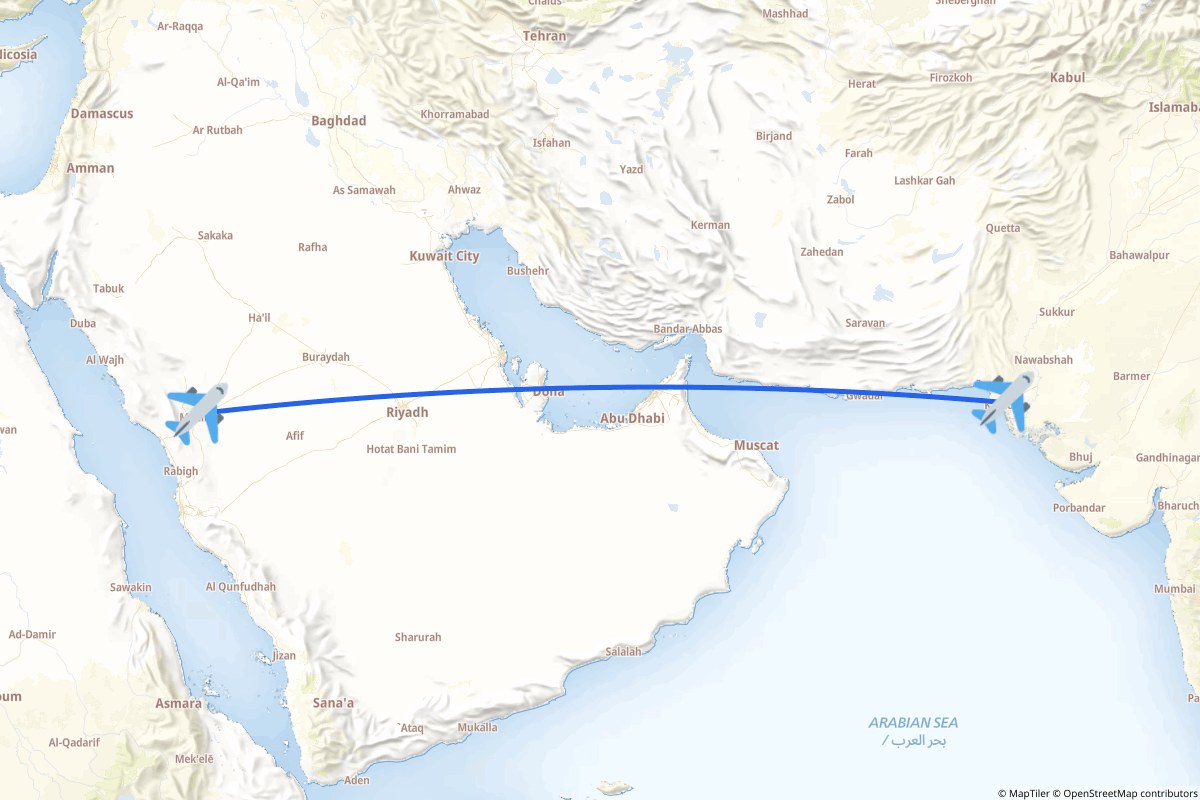
flyadeal launched twice-weekly flights between Medina and Karachi on 6 September 2026, opening a nonstop link on a corridor that has long depended on full-service carriers and one-stop connections over the Gulf. The Saudi low-cost carrier operates the sector with the Airbus A320neo, its standard narrow-body type.
- Airline
- flyadeal (F3)
- Route
- Medina (MED) – Karachi (KHI)
- Aircraft
- Airbus A320neo
- Frequency
- Twice weekly
- First flight
- 6 September 2026
Route overview
The service connects Prince Mohammad Bin Abdulaziz Airport in Medina, Saudi Arabia, with Jinnah International Airport in Karachi, Pakistan — a great-circle distance of roughly 2,770 kilometres, or about 1,495 nautical miles. For an A320-family aircraft, that translates into a scheduled block time in the region of three and a half to four hours, placing the sector firmly in the medium-haul bracket.
At two rotations per week, flyadeal’s single-class layout puts 372 seats each way per week into the market — just under 19,350 seats each way over a full year if the schedule holds. It is a measured capacity entry by narrow-body standards, and consistent with how the carrier has opened other medium-haul international markets: a limited schedule on a city pair where nonstop capacity has been scarce.
Airline network context
flyadeal is the low-cost subsidiary of Saudia Group, headquartered in Jeddah and flying commercially since September 2017. The carrier operates an all-Airbus A320-family fleet in a single-class configuration. Its network was initially built around the Saudi domestic trunk routes and has been extended progressively to international points across the Middle East, North Africa and South Asia. Within Saudia Group, the division of labour is conventional: the full-service parent concentrates long-haul and premium traffic, while flyadeal develops price-sensitive point-to-point markets where a single-cabin narrow-body can be filled on fare stimulation alone.
Karachi deepens the carrier’s presence in Pakistan, one of the largest source markets for Umrah and Hajj pilgrims travelling to Saudi Arabia. Medina — home to the Prophet’s Mosque and the second-holiest city in Islam — is one of the kingdom’s two principal pilgrimage gateways alongside Jeddah, and religious traffic underpins much of the airport’s international demand. Serving that flow with a low-cost product from the pilgrimage gateway itself, rather than via a domestic connection, is the commercial logic of the route.
About the aircraft
The Airbus A320neo is the re-engined successor to the A320ceo, delivering around 20 per cent lower fuel burn per seat than the previous generation thanks to new-technology engines and aerodynamic refinements. In flyadeal’s configuration the type carries 186 passengers in a single economy cabin, the standard high-density layout for the model.
The 2,770-kilometre Medina–Karachi sector sits comfortably within the A320neo’s range, leaving margin for payload and seasonal winds. Operating the route with the carrier’s sole fleet family also preserves crewing and maintenance commonality, keeping unit costs consistent with the rest of the network — a structural advantage for a low-cost operator adding thinner international sectors. On board, flyadeal applies its standard unbundled product, with seat selection, checked baggage and catering sold as paid extras rather than included in the base fare.
About the airports
According to bigairports.com network data, Prince Mohammad Bin Abdulaziz Airport serves 124 routes. Its densest markets are domestic: Riyadh leads with 504 tracked flights across three operators, followed by Cairo with 355 flights and five operators, Jeddah with 246 and Dammam with 193. On the international board, Istanbul (165 flights, four operators) and Kuwait City (133 flights, two operators) head the field. Notably, Sialkot was the airport’s only tracked Pakistani point before this launch — a single operator with two flights — meaning Karachi becomes Medina’s first Pakistani link of any real scale. As the gateway to Islam’s second-holiest city, the airport also sees pronounced seasonal peaks around Ramadan and the Hajj period, when international frequencies swell across its network.
Jinnah International Airport shows 38 routes in the same dataset. Karachi’s single busiest market is Dubai, at 629 tracked flights, ahead of the domestic trunks to Islamabad (316 flights) and Lahore (288 flights), each served by five operators. The Saudi market is already well established at the Pakistani end: Jeddah draws eight operators and 235 flights — more carriers than any other Karachi route — while Riyadh is served by four operators with 44 flights. Medina, by contrast, does not appear among the airport’s densest markets, underlining how thin nonstop capacity on this pair has been. As Pakistan’s principal commercial centre and most populous city, Karachi functions as the main international gateway for the country’s south, with a catchment extending across Sindh and Balochistan.
Market context and competition
Saudi Arabia hosts one of the world’s largest Pakistani expatriate communities, generating steady labour, family-visit and pilgrimage traffic in both directions throughout the year. Much of the Karachi–Medina flow has historically routed over the Gulf hubs: Karachi’s 629 tracked Dubai flights, together with services to Sharjah, Abu Dhabi and Doha, illustrate the volume of connecting capacity sitting between southern Pakistan and western Saudi Arabia.
Within the Saudi–Karachi market itself, competition is concentrated on the Jeddah pair, where eight operators compete, while Medina has drawn comparatively little nonstop attention. flyadeal’s entry therefore gives the origin-and-destination market something it has lacked: a dedicated low-cost nonstop option priced on an unbundled-fare model, positioned against full-service carriers and one-stop itineraries rather than against another budget operator on the same pair.
The operation itself is straightforward: two weekly Airbus A320neo rotations, 186 seats per departure, linking a 124-route pilgrimage gateway with Pakistan’s largest city. The first flight operated on 6 September 2026, and the route now sits alongside Sialkot as one of two Pakistani markets in Medina’s tracked network — by some distance the larger of the two.
Sources & references (4)
Generated with editorial oversight from AI research.