Etihad Airways to Launch Abu Dhabi-Calgary Boeing 787-9 Service
The Gulf carrier begins four-times-weekly Boeing 787-9 flights between AUH and YYC on 25 October 2026, the first nonstop service ever to link the Middle East and Western Canada.
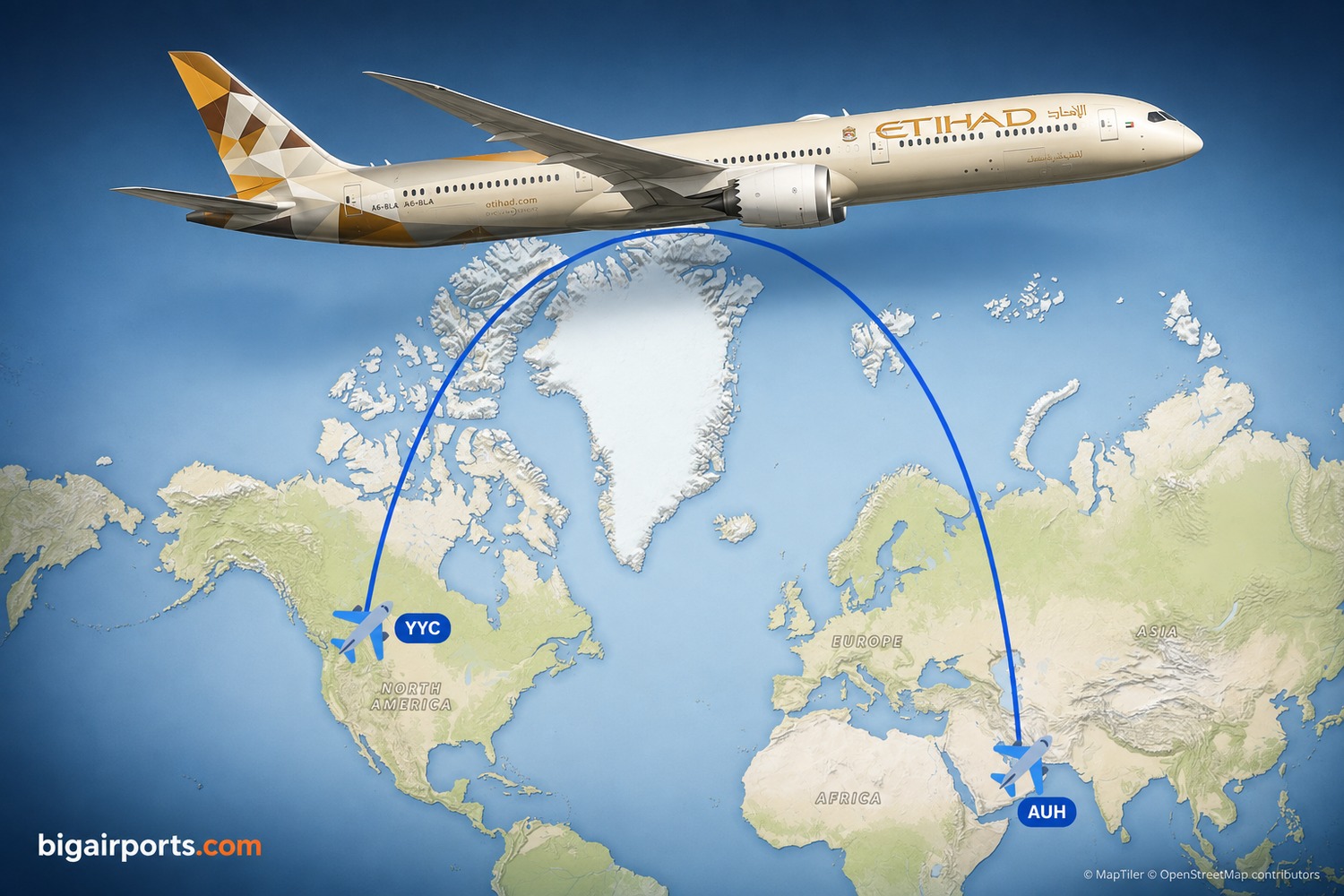
Etihad Airways will launch a four-times-weekly service between Abu Dhabi and Calgary on 25 October 2026, establishing the first nonstop link between the Middle East and Western Canada. The route connects the carrier’s hub at Zayed International Airport with Calgary International Airport and will be flown with Boeing 787-9 equipment, making Calgary the airline’s second Canadian destination after Toronto.
- Airline
- Etihad Airways (EY)
- Route
- Abu Dhabi (AUH) to Calgary (YYC)
- Aircraft
- Boeing 787-9
- Frequency
- 4x weekly (Tue, Thu, Fri, Sun)
- First flight
- 25 Oct 2026
Route overview
Flight EY29 is scheduled to depart Abu Dhabi at 02:25 and arrive in Calgary at 07:00 the same day, a westbound block time of 14 hours 35 minutes. The return service, EY30, leaves Calgary at 13:00 and lands in Abu Dhabi at 12:55 the following day after 13 hours 55 minutes in the air. Etihad will operate the rotation on Tuesdays, Thursdays, Fridays and Sundays.
At roughly 11,540 kilometres (6,230 nautical miles) on the great circle, the sector ranks among the longest in Etihad’s network. The airline had originally targeted a 3 November 2026 start when it announced the route in January; schedule filings reported by aviation analytics provider Cirium have since brought the launch forward by nine days to 25 October.
The overnight westbound timing delivers an early-morning arrival into Calgary, while the midday departure returns the aircraft to Abu Dhabi around lunchtime the next day, keeping the rotation within a two-day cycle despite the sector length.
Network context
Calgary extends a North American operation that Etihad says complements its existing services to Toronto, New York and Chicago, alongside a planned Charlotte launch. The addition follows a run of long-haul route announcements from the Abu Dhabi carrier, including Luxembourg and Palma, as it continues a broad expansion of its international network.
Chief executive Antonoaldo Neves called the route “both a significant and historic step in Etihad’s global expansion”, adding: “By creating the only nonstop link between the Middle East and Western Canada, we are opening new opportunities for trade, tourism and investment, while giving travellers direct access to two distinctive and globally important destinations.”
The airline is framing the pairing around the two cities’ shared industrial profile, describing Abu Dhabi and Calgary as centres of energy, innovation and culture, and pointing to corporate travel, trade engagement and two-way tourism as the route’s core demand drivers. For leisure traffic, Etihad is selling Calgary as the gateway to the Canadian Rockies, while Canadian travellers gain one-stop access to the carrier’s network across Africa, Asia and the Middle East over Abu Dhabi.
About the aircraft
Etihad will deploy the Boeing 787-9 Dreamliner on the route in a two-class configuration. Published schedule data indicates the Calgary flights are planned with the carrier’s 303-seat 2024-era layout, offering Business and Economy cabins. The airline says the aircraft will feature its latest widebody cabin products, with its signature long-haul service and onboard hospitality carried across to the new route. Etihad’s 787-9 fleet has carried several configurations over the years, beginning with a 226-seat, three-class arrangement that included First class; the airline has since standardised on denser two-cabin layouts for its long-haul flying.
Four weekly rotations of the 303-seat aircraft equate to 1,212 seats per week in each direction, a measured opening commitment for a long and unproven sector, and a deliberate step short of the daily operation Etihad typically runs on its established North American trunk routes.
About the airports
Zayed International Airport, Etihad’s home base in Abu Dhabi, currently serves 163 routes, according to bigairports.com network data. Its densest corridors sit within the Gulf and the Indian subcontinent: Doha leads on tracked frequency with 258 flights across three operators, ahead of Cairo on 230, Mumbai on 205 and Riyadh on 191. Long-haul spokes such as Amsterdam and Bangkok sit alongside that short- and medium-haul core, and the Calgary service adds a rare westbound ultra-long-haul spoke to the mix.
Calgary International Airport serves 144 routes and is the principal air gateway to Alberta and the Canadian Rockies. Its network is dominated by domestic trunks: Vancouver is its largest market with 769 tracked flights across 13 operators, followed by Toronto on 635 and Edmonton on 372. Until now the airport has had no Middle East service of any kind; Etihad’s arrival gives it its first.
Chris Dinsdale, president and chief executive of Calgary Airports, said the operator was “proud to partner with Etihad Airways to link two great cities”, calling the route “key to connecting our region’s leisure and business travellers to important locations in the Middle East, as well as a wealth of linked destinations in Africa, Asia and around the world.”
Market context
No carrier currently operates nonstop between Calgary and any Middle Eastern point, leaving Etihad without direct competition on the origin and destination market. The closest historical attempt came from WestJet, the Calgary-based carrier, which secured slots for a Calgary to Dubai service in 2022, also earmarked for Boeing 787-9 operation; those flights never materialised.
Traffic between Alberta and the Gulf today moves over intermediate hubs, typically via Toronto, Calgary’s second-largest route, or via European transfer points. The new service removes a connection in each direction and puts Etihad in sole control of the nonstop market from day one.
The four-weekly pattern gives the airline room to test demand across the winter season, with the corporate energy segment, inbound Rockies tourism and connecting flows over Abu Dhabi all expected by the carrier to contribute. The first flight departs Abu Dhabi in the early hours of 25 October 2026.
Sources & references (4)
Generated with editorial oversight from AI research.