Etihad Airways to Launch Daily Abu Dhabi to Tashkent Flights
Etihad Airways begins a daily Abu Dhabi to Tashkent service on 9 August 2026, backed by a new codeshare with Uzbekistan Airways, which is adding Abu Dhabi to its own network in parallel.
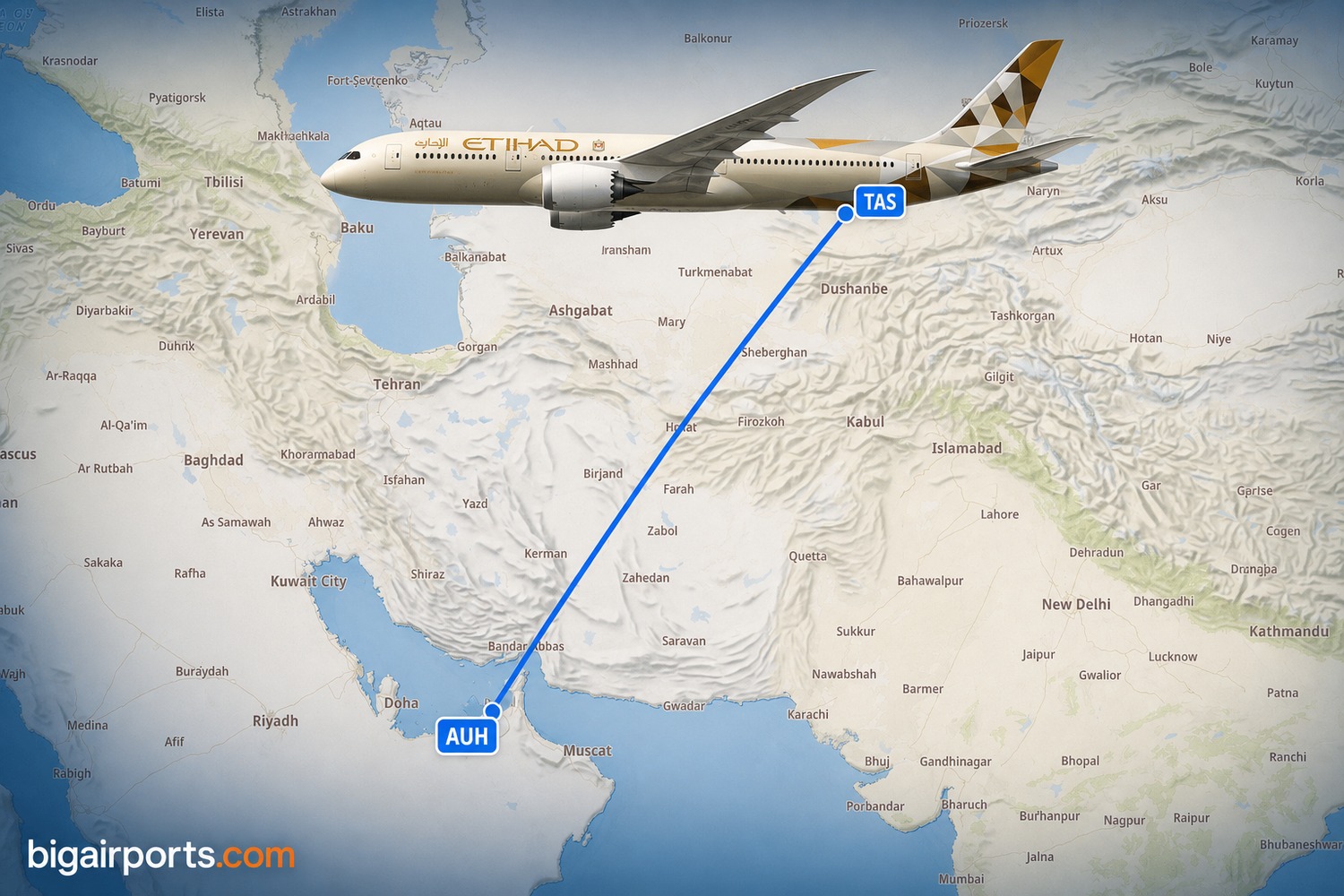
Route overview
Etihad Airways will launch a daily service between Abu Dhabi and Tashkent on 9 August 2026, linking its home base at Zayed International Airport with Tashkent International Airport, the principal international gateway to Uzbekistan. The sector covers a great-circle distance of roughly 2,300 kilometres, placing it in the medium-haul bracket of the Gulf carrier’s network, comparable in stage length to Abu Dhabi’s existing links into southern India. Etihad has not yet confirmed which aircraft type will operate the service, and seat capacity on the route therefore remains open until the schedule is filed.
- Airline
- Etihad Airways
- Route
- Abu Dhabi (AUH) to Tashkent (TAS)
- Frequency
- Daily
- First flight
- 9 Aug 2026
- Aircraft
- Not disclosed
The launch does not arrive in isolation. Etihad has concluded a codeshare agreement with Uzbekistan Airways, presented by the Abu Dhabi carrier as opening “the Silk Road”, and the Uzbek flag carrier has in parallel announced Abu Dhabi as a new destination in its own network. The city pair will therefore carry metal from both countries’ flag carriers, with the codeshare knitting the two schedules together for connecting traffic. Local press in Tashkent reported the launch in July 2026, and the route also features among the industry’s tracked new-route launches for August 2026, one of the busier months in the year for network additions.
Etihad’s network context
For Etihad, Tashkent extends the map into Central Asia, a region where Gulf carriers have expanded steadily in recent years. A daily frequency from launch is a statement of intent: it supports same-day connections in both directions over Abu Dhabi rather than the two- or three-weekly pattern often used to test a new market.
The commercial logic rests heavily on flows beyond the two capitals. Abu Dhabi’s schedule is dense across the Indian subcontinent, with Mumbai, Delhi, Chennai, Kochi, Kozhikode and Thiruvananthapuram all among the airport’s busiest links, and it reaches into Europe and Southeast Asia with services such as Amsterdam and Bangkok. Tashkent, for its part, offers onward reach into East Asia and the Uzbek domestic network. The codeshare with Uzbekistan Airways gives Etihad a mechanism to sell beyond the trunk route in a market where it has had no presence of its own, while Uzbekistan Airways gains access to Gulf connectivity over Abu Dhabi. For a carrier rebuilding its long-haul relevance around a single hub, that kind of partner feed matters: it converts a thin bilateral market into one supported by traffic streams from several regions at once.
The airports: Zayed International and Tashkent International
Zayed International Airport, Abu Dhabi’s primary gateway and Etihad’s hub, currently serves 158 nonstop routes, according to bigairports.com network data. Its densest links are regional and subcontinental: Doha leads with 258 tracked flights across three operators, followed by Cairo (230), Amsterdam (213), Mumbai (205) and Riyadh (191). Competitive depth is notable on Indian trunk routes, with five operators apiece on Mumbai and Kochi, and the short-haul Gulf grid is thick, with 178 tracked flights to Bahrain and 146 to Kuwait City. Jeddah (144), Thiruvananthapuram (117), New Delhi (96) and Kozhikode (91) round out a schedule weighted towards the Gulf and South Asia, while Tel Aviv and Bangkok illustrate the spread of the airport’s medium- and long-haul reach.
Tashkent International Airport is Central Asia’s busiest hub by route count in the bigairports.com dataset, with 116 nonstop routes. Its standout international link is Dubai, at 95 tracked flights across two operators, an order of magnitude ahead of most other city pairs in the sample. East Asian coverage is broad, with four operators each to Seoul Incheon and Urumqi and three apiece to Beijing Daxing and Guangzhou, alongside three operators to Istanbul and services to Moscow Domodedovo and Kazan. A domestic spoke system links the capital to Bukhara, Fergana, Namangan, Nukus, Termez and Urgench, the feed network that a codeshare partner can, in principle, place traffic onto. Those domestic links are thin individually, at three to nine tracked flights each, but collectively they distribute traffic across every major Uzbek region from the capital.
Market context and competition on the corridor
The UAE to Uzbekistan market today is, in practice, a Dubai story. The 95 tracked flights between Tashkent and Dubai dwarf every other Gulf link in the Tashkent data, and no Abu Dhabi service appears among the airport’s leading routes. Etihad’s entry therefore opens a second UAE gateway on the corridor rather than adding frequency to an existing one, and it does so with two carriers committed from day one, since Uzbekistan Airways is mounting its own Abu Dhabi service alongside the codeshare.
For point-to-point traffic, the route serves trade, labour and a growing Uzbek tourism market from the UAE capital. The larger prize is connectivity: over Abu Dhabi, Tashkent gains one-stop access to the Indian subcontinent, the wider Gulf and Etihad’s European network; over Tashkent, Abu Dhabi gains a routing towards secondary Uzbek cities and, via the airport’s existing links, towards East Asian points such as Seoul and Guangzhou. How the two flag carriers divide local and flow traffic will only become visible once both operations settle in.
There is also a competitive dimension within the UAE itself. Dubai’s carriers have had the Uzbek market largely to themselves, and a daily Abu Dhabi option gives passengers in the Emirates a genuine alternative gateway for the first time in the current schedule era. Pricing behaviour on the established Dubai services in the weeks after 9 August will be an early indicator of how seriously the incumbents take the new entrant.
The first Etihad flight is scheduled for 9 August 2026. bigairports.com route data for both airports will reflect the new service once operations begin.
Sources & references (5)
Generated with editorial oversight from AI research.