Eurowings to launch Stuttgart–Damascus flights in January 2027
Eurowings will fly Stuttgart to Damascus once weekly from 13 January 2027, part of a four-city German launch targeting VFR demand on a route with no existing nonstop service.
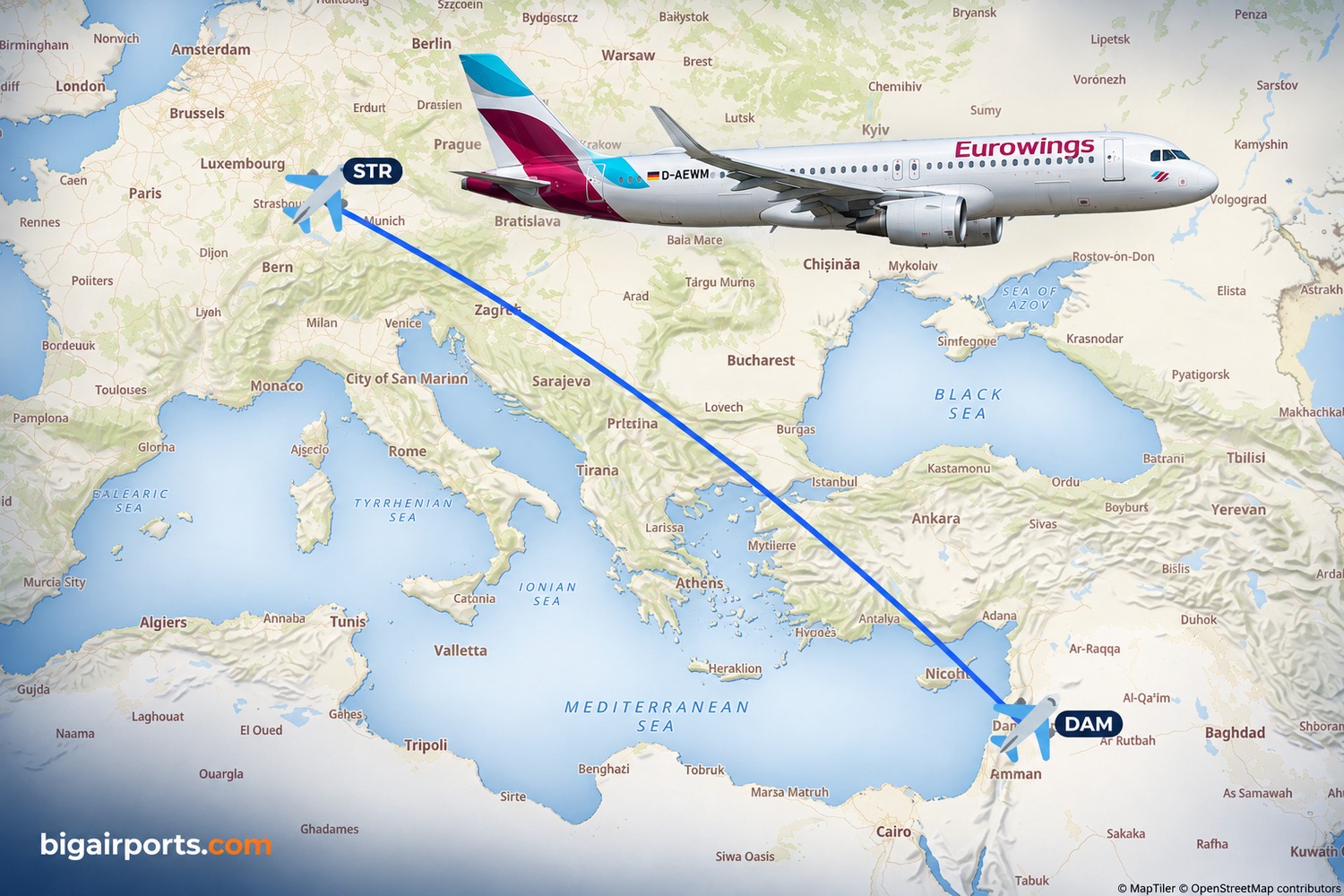
Eurowings will open a Stuttgart–Damascus service on 13 January 2027, operating once weekly on Wednesdays. The route links Stuttgart Airport with Damascus International Airport and is one of four German routes to the Syrian capital that the Lufthansa Group value carrier announced on 24 November 2026. Flights are on sale now through the airline’s own booking channels.
- Airline
- Eurowings
- Route
- STR to DAM
- Aircraft
- Not specified
- Frequency
- 1x weekly (Wednesdays)
- Schedule
- Dep 09:10, arr 15:10 local
- First flight
- 13 Jan 2027
Route overview
The Stuttgart flight is scheduled to depart at 09:10 and arrive in Damascus at 15:10 local time. The great-circle distance between the two airports is approximately 2,825 km (1,525 nm). Eurowings gives an average flight time of around 4.5 hours across its Damascus programme.
According to OAG data cited by Aviation Week, Stuttgart currently has no scheduled nonstop service to Syria. The new flight will therefore be the only direct link between Baden-Württemberg and Damascus when it starts. Eurowings has said the Damascus routes are aimed primarily at passengers visiting friends and relatives (VFR) and at travellers returning to their country of origin.
Airline network context
The Stuttgart route is part of a four-origin Damascus launch that adds up to five weekly frequencies. Hamburg opens first on 11 January 2027 with a Monday service. Düsseldorf follows on 12 January with flights on Tuesdays and Thursdays, the only origin to receive two weekly rotations. Berlin and Stuttgart both start on Wednesday 13 January, each with one weekly flight.
Damascus is a new destination for Eurowings. Aviation Week reports that the airline will be the first wholly owned Lufthansa Group carrier to serve Syria since Lufthansa and Austrian Airlines withdrew in 2011, as security deteriorated in the early stages of the civil war. The group already has an indirect presence through SunExpress, its joint venture with Turkish Airlines, which flies to Damascus and Aleppo from Antalya and Izmir.
The Syria launch extends what Eurowings describes as a leading position in the VFR segment. The airline says it operates more than 60 routes to over 20 destinations in this market, including Pristina, Erbil, Amman, Beirut, Cairo, Tirana and Belgrade. Baghdad joins the network in December 2026, with two weekly flights each from Berlin and Düsseldorf. Eurowings operates around 100 aircraft from 10 international bases and employs approximately 5,500 staff.
About the aircraft
Eurowings has not specified the aircraft type for the Damascus flights. The carrier’s fleet is made up of Airbus A320-family narrowbodies, and the stated average block time of around 4.5 hours sits comfortably within the range of that fleet. Seat capacity on the route will depend on the type assigned, which the airline has yet to confirm.
About each airport
Stuttgart is the larger and far more connected of the two airports. Live bigairports.com network data lists 143 routes from Stuttgart. Its busiest links by flight count are Amsterdam (2,420 flights), Barcelona (1,697) and Palma de Mallorca (1,482), followed by Gran Canaria (311). Domestic and Alpine connections to Frankfurt, Munich, Hamburg, Berlin, Vienna and Zurich remain central to the network. The airport’s eastern and VFR-oriented flying is already visible: Istanbul Sabiha Gökçen (171 flights), Istanbul Airport (181), Antalya (108) and Pristina (105) all appear among its top routes. Aviation.Direct notes that Stuttgart’s winter schedule also includes Cairo twice weekly, Amman and Erbil.
Damascus operates a much smaller and heavily Gulf-weighted network. Bigairports.com data shows 24 routes from the airport. Dubai is the busiest link with 973 flights, ahead of Kuwait City (509) and Sharjah (413). Amman (192), Riyadh (139), Doha (127), Istanbul Airport (121), Jeddah (91) and Abu Dhabi (79) complete the core of the network. European connections are thin: the dataset lists Amsterdam (29 flights), Stockholm (34) and Bucharest (38), alongside the two Istanbul airports. The Bucharest service, operated by Dan Air, is currently grounded following the airline’s insolvency proceedings in November.
Market context
The launch follows a sharp recovery in Syrian air capacity after the fall of the Assad government in December 2024. Aviation Week reports that Syrian airports had about 1.8 million scheduled departing seats between January and November 2026, up 68.5% on roughly 1.07 million in the same period of 2025. The number of nonstop airport pairs rose from 31 to 55.
Germany is a significant source market. Sabre Market Intelligence estimates that about 113,500 passengers travelled between Germany and Syria in the 12 months to June 2026, making Germany Syria’s second-largest European country market after Turkey. Düsseldorf was the largest German city market at about 29,400 passengers, followed by Berlin at about 22,900. Germany’s 2025 microcensus recorded roughly 732,000 residents who had migrated from Syria.
That population may not convert directly into short-trip demand. Aviation Week notes that the German government has decided against allowing brief visits to Syria without possible consequences for a traveller’s protection status; without a compelling reason, such trips can prompt authorities to review that status.
Competition on the Germany–Syria market is concentrated at Eurowings’ other origins. In Berlin, Syrian Airlines and leisure carrier Sundair already serve Damascus. Sundair began in August and Syrian Airlines added a twice-weekly route on 10 November. In Düsseldorf, LEAV Aviation and Syrian carrier Fly Cham operate to Damascus, with LEAV expanding to Cologne/Bonn and Munich. Elsewhere in the EU, Aegean Airlines starts Athens–Damascus on 2 December with up to four weekly flights. On the Stuttgart–Damascus pair itself, Eurowings will face no direct competition at launch; the main alternatives for passengers in the region remain one-stop connections via Istanbul and the Gulf hubs.
Aviation.Direct notes that operating to Syria remains subject to regulatory approvals, security requirements, insurance conditions and the reconstruction of local infrastructure for European carriers.
Sources & references (4)
Generated with editorial oversight from AI research.