Gulf Air to Launch Bahrain–Kuala Lumpur Boeing 787-9 Flights
Gulf Air will begin nonstop Boeing 787-9 flights between Bahrain International and Kuala Lumpur International on 29 September 2026, moving to a daily service via Singapore from 25 October.
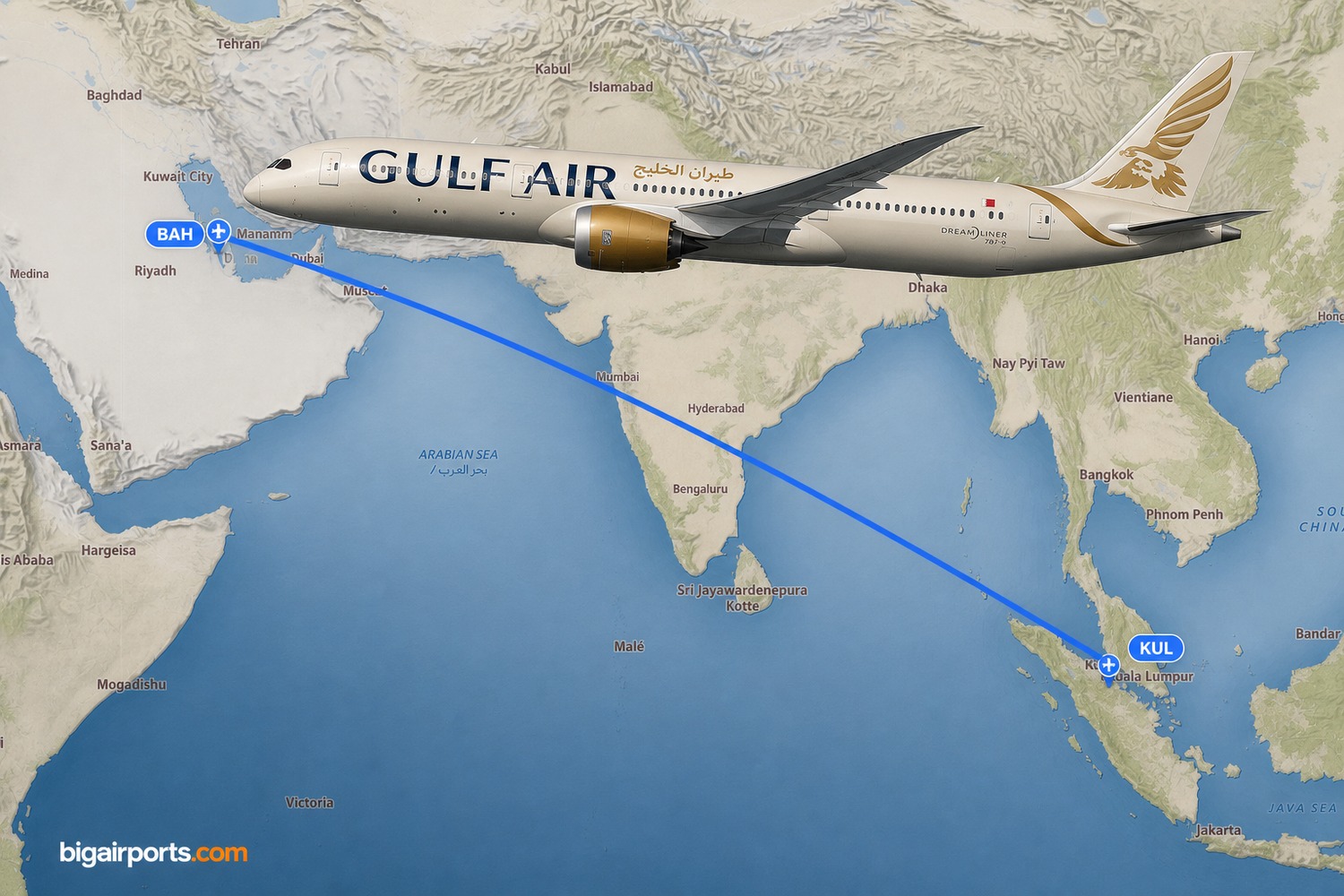
Gulf Air will launch scheduled flights between Bahrain International Airport and Kuala Lumpur International Airport on 29 September 2026, establishing a nonstop air link between Bahrain and Malaysia. The Bahraini flag carrier will deploy the Boeing 787-9 on the sector, and bookings have already opened across the airline’s sales channels.
- Airline
- Gulf Air
- Route
- Bahrain (BAH) – Kuala Lumpur (KUL)
- Aircraft
- Boeing 787-9
- First flight
- 29 September 2026
- Frequency
- Up to 5x weekly nonstop; daily via Singapore from 25 October 2026
Route overview
The service will be introduced in three phases. From 29 September to 7 October 2026, Gulf Air will operate up to five weekly nonstop rotations between Bahrain and Kuala Lumpur. Frequency then reduces to three weekly nonstop flights between 8 and 24 October, before the schedule settles into its permanent pattern on 25 October, when the route becomes a daily service routed via Singapore.
The nonstop sector covers approximately 6,000 kilometres, which places it firmly in the long-haul segment of Gulf Air’s network alongside its London Heathrow operation. At the initial five-weekly frequency, the 787-9 deployment equates to roughly 1,400 seats per week in each direction, rising to just under 2,000 weekly seats each way once the daily via-Singapore pattern takes effect. Tickets went on sale through the carrier’s website, mobile application, sales offices and travel-agency partners when the route was announced, giving the airline a selling window of well over a year ahead of the first departure.
Airline network context
For Gulf Air, Kuala Lumpur represents a further step in the rebuilding of its long-haul network around the 787-9. The carrier’s schedule from its Bahrain base is dominated by short-haul Gulf flying, supplemented by medium-haul services to the Indian subcontinent, the Levant and Turkey, and long-haul flying to London. Southeast Asia is the region where the airline has been adding depth, and the decision to pair Kuala Lumpur with Singapore in a daily one-stop pattern from late October follows a model widely used by Gulf carriers to serve two regional markets with one aircraft rotation.
The phased schedule also gives the airline flexibility. The standalone nonstop period through October allows Gulf Air to capture the initial wave of point-to-point demand, while the permanent via-Singapore routing spreads capacity across two markets once the launch period ends. As a hub, Bahrain sits between far larger neighbours in Dubai, Doha and Abu Dhabi, and Gulf Air has increasingly competed on network breadth relative to its size rather than on volume, a strategy the Kuala Lumpur addition fits squarely within.
About the aircraft
Gulf Air will operate the route with the Boeing 787-9, the backbone of its long-haul fleet. The airline configures the type with 282 seats, comprising 26 flat-bed Falcon Gold seats in business class and 256 seats in economy. The -9 variant’s range of around 14,000 kilometres leaves substantial margin on a sector of this length, and its per-seat economics on long, thinner routes are the reason the type has become the standard choice for secondary Gulf hubs opening new long-haul markets. A 282-seat widebody is small enough to sustain frequency on an untested sector, yet offers a premium cabin sized for the corporate and government traffic that typically anchors yields on Gulf long-haul routes.
About the airports
Bahrain International Airport currently hosts 64 routes, according to bigairports.com schedule data. Its network is heavily weighted towards the Gulf: Dubai is the busiest destination with 552 flights across three operators, followed by Kuwait City with 108, Doha and Jeddah with 88 each, and Riyadh with 86. Medium-haul services connect the island to Cairo, Mumbai, Istanbul, Lahore and Amman, while London Heathrow, with 37 flights across two operators, is the only long-haul destination among the airport’s busiest routes. Kuala Lumpur therefore adds a rare second long-haul spoke to the Bahrain schedule and will lift the airport’s route count to 65 when the service begins.
Kuala Lumpur International Airport operates on a different scale, with 157 routes making it one of Southeast Asia’s largest hubs. Singapore is its densest market, with 1,573 flights across eight operators, ahead of Jakarta on 1,121. Domestic trunk routes to Kota Kinabalu (1,011 flights), Kuching (893) and Penang (839) anchor the schedule, while Chinese services to Guangzhou (611), Shanghai Pudong (505) and Shenzhen (483) reflect the airport’s role as a gateway between China and Southeast Asia. Notably, no Gulf destination features among the airport’s busiest routes, underlining how much of the traffic between the two regions currently flows over other hubs.
Market context and competition
There is at present no nonstop service between Bahrain and Malaysia, and passengers on the country pair connect over the major Gulf hubs, principally Dubai, Doha and Abu Dhabi. Gulf Air’s launch gives it the only one-carrier, one-stop-free product on the origin-and-destination market, a schedule advantage that typically matters most to premium and time-sensitive traffic.
The route’s commercial case extends beyond the point-to-point market. Behind Bahrain, Gulf Air’s short-haul network across Saudi Arabia, the wider GCC and the Levant can feed the Kuala Lumpur service, while at the Malaysian end the airport’s 157-destination network offers onward connectivity across Malaysia, wider Southeast Asia and China. Malaysia is also an established leisure and halal-tourism destination for Gulf travellers, a segment the region’s hub carriers have served over their own hubs to date.
Competition on the wider Gulf–Kuala Lumpur market remains intense, with the large Gulf network carriers offering high frequencies over Dubai, Doha and Abu Dhabi. Gulf Air’s counter is specificity: a nonstop product in the launch period, a daily frequency thereafter, and the only direct link on the Bahrain–Malaysia pair. The first flight is scheduled for 29 September 2026, with the full daily via-Singapore pattern in place from 25 October 2026.
Sources & references (3)
Generated with editorial oversight from AI research.