Delta to Launch Daily Seattle–Tokyo Narita Service in March 2027
Delta Air Lines returns to Tokyo Narita after seven years with a daily A330-900neo service from its Seattle hub, adding a second Tokyo airport from SEA and a head-to-head with Alaska Airlines.
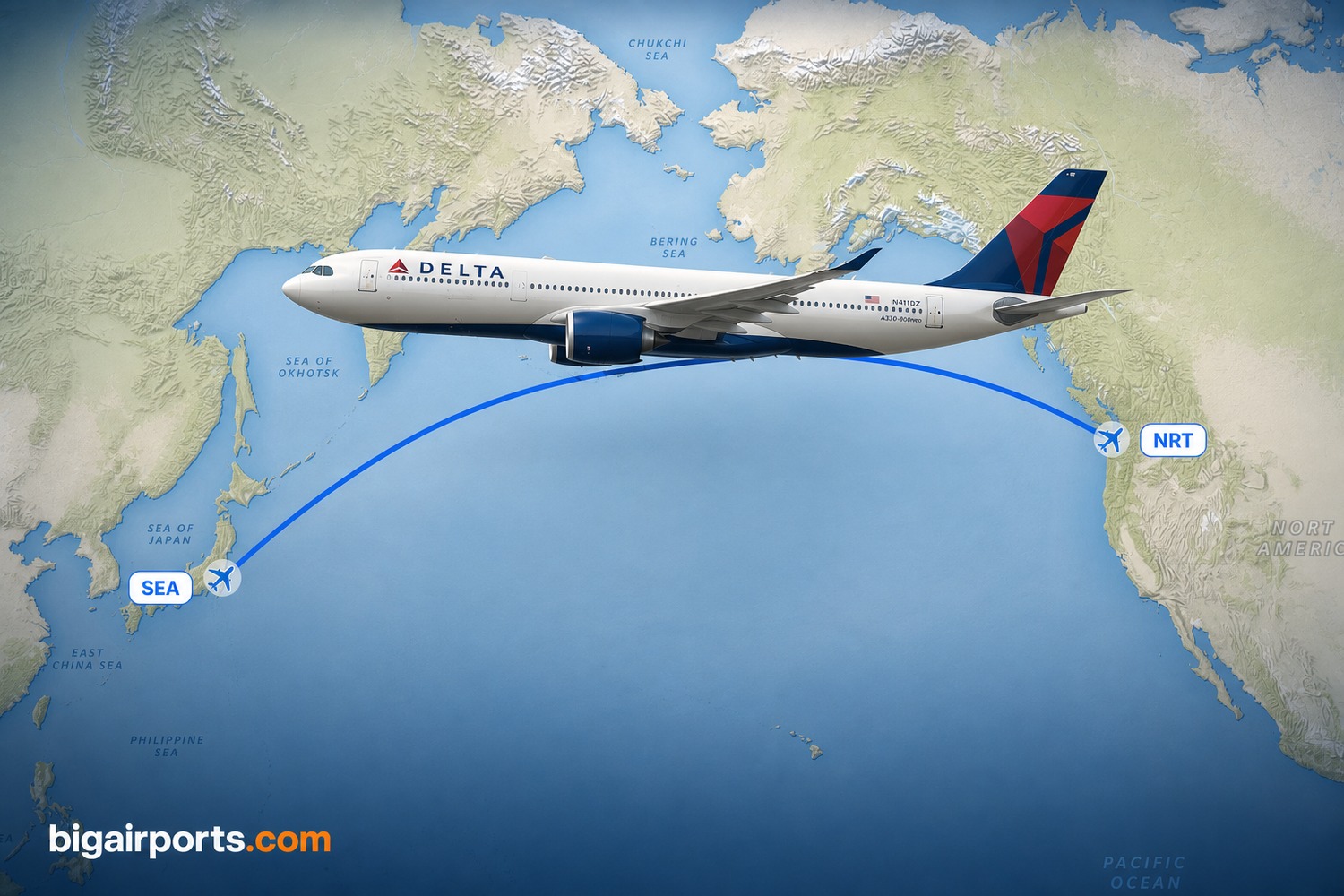
Delta Air Lines will launch a daily nonstop between Seattle–Tacoma International Airport and Tokyo’s Narita International Airport on 27 March 2027, operated with the Airbus A330-900neo. The service returns the SkyTeam carrier to Narita for the first time since March 2020, when it consolidated its Tokyo operations at the more centrally located Haneda, and it adds a second competitor on an airport pair that Alaska Airlines began serving in 2025.
- Airline
- Delta Air Lines
- Route
- Seattle (SEA) to Tokyo Narita (NRT)
- Aircraft
- Airbus A330-900neo
- Frequency
- Daily
- First flight
- 27 March 2027
Route overview
The nonstop covers a great-circle distance of roughly 7,680 kilometres (4,770 miles), a sector length well within the range of the A330-900neo. The launch date of 27 March 2027 falls at the start of the northern summer scheduling season, the traditional window for new trans-Pacific services. The Port of Seattle, which operates the airport, welcomed the announcement as a further step in the airport’s international build-out.
The route also carries historical weight. Delta inherited a substantial Narita operation through its 2008 merger with Northwest Airlines, which had used the airport as an intra-Asian hub for decades under fifth-freedom rights. As US carrier access to Haneda expanded through successive slot allocations, Delta progressively shifted its Tokyo flying across the city, and in March 2020 it moved its remaining services to Haneda and ended its Narita presence entirely. The Seattle flight will be the carrier’s first scheduled Narita operation in seven years.
Delta’s network context
Seattle has been Delta’s principal trans-Pacific gateway on the US West Coast since the carrier began building the hub in 2014. Its long-haul network from the airport currently spans Amsterdam, London and Paris in Europe, and Seoul Incheon, Shanghai, Taipei and Tokyo Haneda across the Pacific. Narita will give Delta a two-airport Tokyo presence from Seattle, with the Haneda service continuing alongside the new flight. Behind the gateway sits a dense domestic operation: Delta feed from spokes such as Salt Lake City, Los Angeles, Sacramento, Boise and San Jose connects over Seattle onto the carrier’s trans-Pacific bank, and the Tokyo flights draw on that same connecting traffic.
The carrier’s position in Japan differs from that of its US rivals. Delta is the only US major without a Japanese joint-venture partner: United coordinates with All Nippon Airways and American with Japan Airlines, both through antitrust-immunised agreements. Delta therefore relies on its own aircraft for US–Japan flying, a factor that shaped its 2020 consolidation at Haneda and that makes the decision to reopen Narita a notable reversal.
About the aircraft
Delta configures the Airbus A330-900neo with 281 seats in four cabins: 29 Delta One suites with sliding doors, 28 Premium Select seats, 56 Comfort+ seats and 168 in the Main Cabin. The layout gives the aircraft one of the highest premium-seat ratios in Delta’s widebody fleet, a fit for a business-heavy Seattle market anchored by the region’s technology and aerospace employers. The type is powered by Rolls-Royce Trent 7000 engines and, according to Airbus, burns around 25 per cent less fuel per seat than the previous-generation A330 it replaces.
Delta is the only US operator of the A330-900 and already deploys the type on trans-Pacific sectors, making the aircraft a natural fit for the new service. At daily frequency, the rotation adds 1,967 one-way seats per week in each direction between the two cities.
About the airports
Seattle–Tacoma is the busiest airport in the US Pacific Northwest, with 156 nonstop routes in the current schedule according to bigairports.com network data. Its densest links are domestic and regional: Anchorage, Portland, Denver and Phoenix all carry heavy frequencies, and trunk routes such as Los Angeles and Vancouver are contested by as many as nine operators. The airport is a dual hub, hosting Alaska Airlines’ largest base alongside Delta’s intercontinental operation, and its long-haul route map already includes Amsterdam among the leading links in the network data. The airport has spent the past decade converting that domestic density into intercontinental growth, and the Delta announcement continues that pattern.
Narita, some 60 kilometres east of central Tokyo, is one of Japan’s two main international gateways alongside slot-constrained Haneda, and offers 125 nonstop routes. The data underlines its role as a North-East Asian transfer point: 19 airlines fly to Seoul Incheon, 13 to Taipei, 12 to Shanghai and 11 to Hong Kong. Trans-Pacific links include Los Angeles, Chicago and Anchorage, while South-East Asian coverage extends to Bangkok, Singapore and Manila. Domestically, the airport retains high-frequency service to Chitose, Fukuoka and Osaka Kansai. For passengers arriving from Seattle, those onward links matter: Narita’s schedule offers one-stop access to secondary Japanese and Asian cities that Haneda’s slot-restricted timetable cannot always match.
Market context
Delta will not have the airport pair to itself. Alaska Airlines opened its own daily Seattle–Narita service in May 2025, flown with Airbus A330 aircraft from the Hawaiian Airlines fleet it acquired in 2024, and has said it aims to serve at least 12 intercontinental destinations from Seattle by 2030. Delta’s arrival therefore creates a two-carrier contest on the Seattle–Narita pair, layered on top of Delta’s existing Seattle–Haneda flight in the wider Seattle–Tokyo market.
For Seattle, the launch reinforces its standing as the primary trans-Pacific gateway between San Francisco and Vancouver. For Narita, the route restores a US hub carrier that once ranked among its largest tenants and adds western US feed to its extensive Asian connecting network. Delta has not yet published full schedule details for the service; the launch date, daily frequency and aircraft assignment stand as announced.
Sources & references (5)
Generated with editorial oversight from AI research.