Delta Adds Daily LAX-PHL Airbus A321neo Service From June 2027
Delta Air Lines will link Los Angeles and Philadelphia daily from 7 June 2027 with the Airbus A321neo, entering a transcontinental city pair anchored by American's Philadelphia hub as part of its largest-ever LAX schedule.
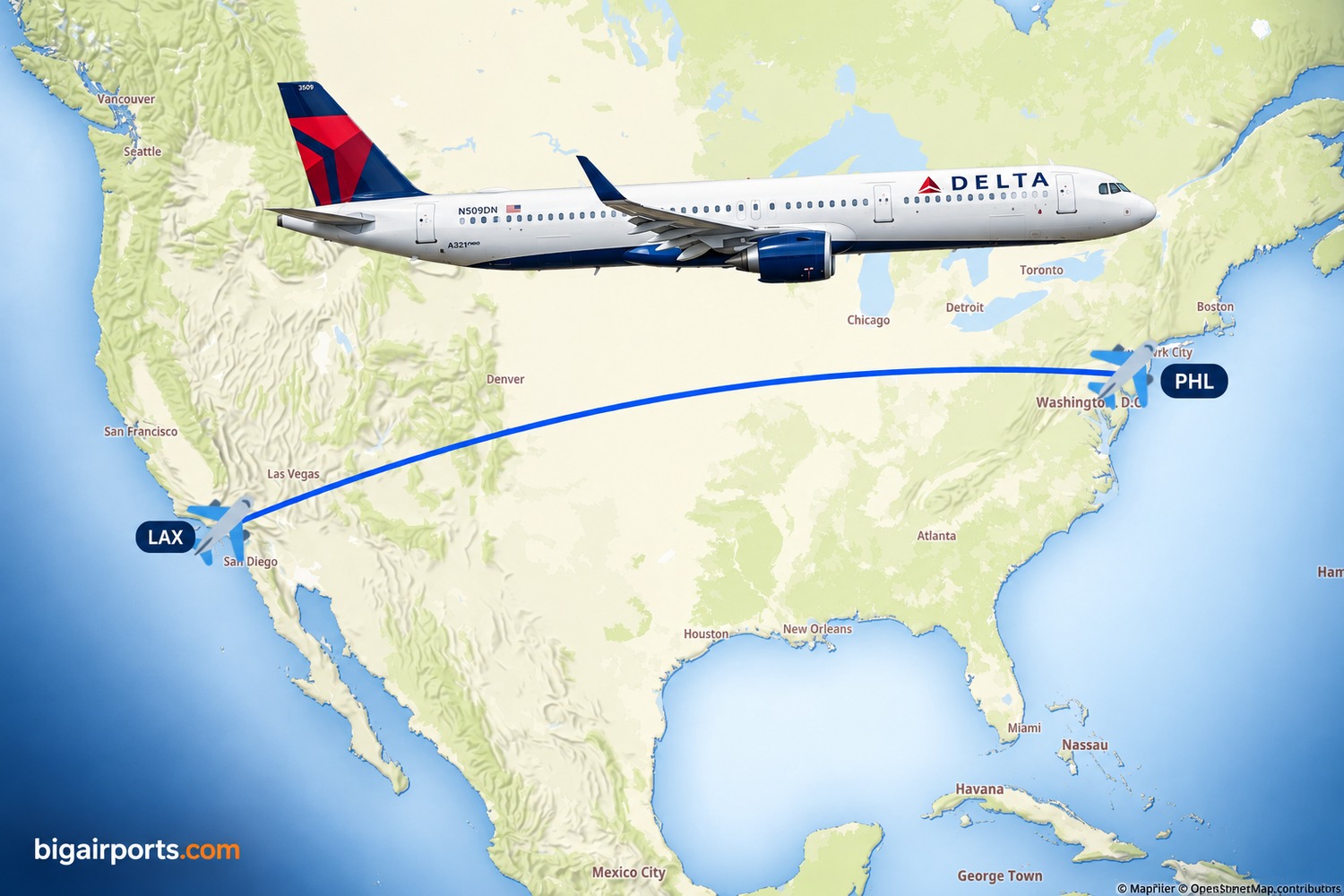
Delta Air Lines will open a new daily transcontinental route between Los Angeles International Airport and Philadelphia International Airport on 7 June 2027, with the Airbus A321neo assigned to the service. The route links the largest international gateway on the US West Coast with Pennsylvania’s busiest airport, and was announced as part of what the carrier calls its largest-ever Los Angeles schedule.
- Airline
- Delta Air Lines
- Route
- Los Angeles (LAX) to Philadelphia (PHL)
- Aircraft
- Airbus A321neo
- Frequency
- Daily
- First flight
- 7 Jun 2027
Route overview
Delta does not currently fly between Los Angeles and Philadelphia, so the launch creates a new city pair for the airline rather than a frequency addition on an existing service. The sector runs to roughly 2,400 statute miles (about 3,860 kilometres), placing it firmly in transcontinental narrowbody territory alongside Delta’s established Los Angeles services to New York JFK and Boston.
At one daily rotation in Delta’s standard A321neo layout, the schedule adds roughly 1,360 seats per week in each direction between the two airports. The route was unveiled within a wider Los Angeles announcement that also covered new destinations, frequency increases and premium product investment at the airport, rather than as a standalone Philadelphia initiative.
The timing places the start of service at the opening of the summer 2027 peak, the point in the calendar when transcontinental demand between the East Coast and Southern California is at its strongest and when new US domestic routes are most commonly introduced.
Delta’s position in Los Angeles
Los Angeles is one of Delta’s core hubs, and the airline has spent much of the past decade rebuilding its position there. The Delta Sky Way project, a USD 2.3 billion reconstruction completed in 2023, consolidated the carrier’s operation into Terminals 2 and 3 and gave it airside connectivity to the Tom Bradley International Terminal.
In the announcement covering the Philadelphia launch, Delta described itself as the number one airline in Los Angeles and said the coming season would be its largest schedule ever operated at the airport. The carrier paired the network growth with commitments on premium cabins and lounge capacity, positioning Los Angeles as a showcase station rather than simply a point of sale.
About the Airbus A321neo
Delta configures its A321neo fleet with 194 seats, split between 20 in First Class, 42 in Comfort+ and 132 in the Main Cabin. Every seat carries seatback entertainment, and the type is fitted with the airline’s fast Wi-Fi, making it Delta’s standard equipment for premium-weighted domestic trunk flying.
Powered by Pratt & Whitney GTF engines, the A321neo offers around 20 per cent lower fuel burn per seat than the previous-generation A321, according to Airbus figures. Its range covers the Los Angeles to Philadelphia sector comfortably, and Delta holds one of the largest A321neo order books of any US carrier, so aircraft availability for new transcontinental markets is not a constraint.
The choice of type is consistent with how Delta has deployed the A321neo elsewhere in its system: long domestic trunk sectors where a substantial First Class cabin and full connectivity matter, but where demand does not justify a widebody. On a roughly five-and-a-half-hour eastbound sector, the aircraft sits squarely inside its design envelope.
Los Angeles and Philadelphia by the numbers
In the bigairports.com network dataset, Los Angeles International shows 260 nonstop routes, the deepest network of any airport on the US West Coast. Its busiest corridors are dominated by short-haul shuttle markets: San Francisco leads with 378 tracked flights across 15 operators, followed by New York JFK on 327 and Las Vegas on 272. The long-haul side is equally visible, with Shanghai Pudong at 288 tracked flights across nine operators and Honolulu at 182 across eleven.
Philadelphia International lists 207 nonstop routes in the same dataset. Its densest markets sit almost entirely on the eastern seaboard and in Florida: Atlanta tops the table with 317 tracked flights across eight operators, ahead of Orlando on 291, Boston on 284 and Chicago O’Hare on 234. Los Angeles does not currently feature among Philadelphia’s fifteen highest-volume markets at all, and the airport’s longer corridors are notably thin; Phoenix, the only long-haul entry in that top fifteen, shows a single operator and 91 tracked flights.
The contrast frames what the new service is built to do. Philadelphia’s network is broad but short, while Los Angeles offers onward connectivity across the Pacific, to Latin America and throughout the western United States, so a daily nonstop bridges two networks with very little overlap.
Market context and competition
Philadelphia is a hub for American Airlines, which operates the airport’s existing nonstop service to Los Angeles and uses the field as its primary transatlantic gateway. Delta’s arrival therefore puts a second network carrier onto a city pair where American has long been the dominant nonstop operator, and it does so with a premium-configured aircraft rather than a token schedule.
For Delta, the move extends the Los Angeles build-up beyond its own hubs and focus cities into a competitor’s stronghold. Its existing Philadelphia flying is concentrated on links to Delta hubs, so a West Coast nonstop is a structural addition to the carrier’s presence at the airport rather than an incremental one. For Philadelphia, the service deepens westbound choice at an airport whose live network data skews heavily towards short and medium-haul flying.
The competitive picture at launch is straightforward: daily frequency, 194 seats per departure, and a single incumbent on the nonstop market. Delta has not published detailed timings for the route, and the schedule filed closer to the start date will show how directly the new service lines up against American’s existing rotations. The first departure is set for 7 June 2027.
Sources & references (4)
Generated with editorial oversight from AI research.