Delta to Launch Atlanta-Riyadh A350-900 Service in October 2026
Delta Air Lines will link ATL and RUH from 23 October 2026, flying daily for the first week before settling at three weekly Airbus A350-900 rotations, its first scheduled service to Saudi Arabia.
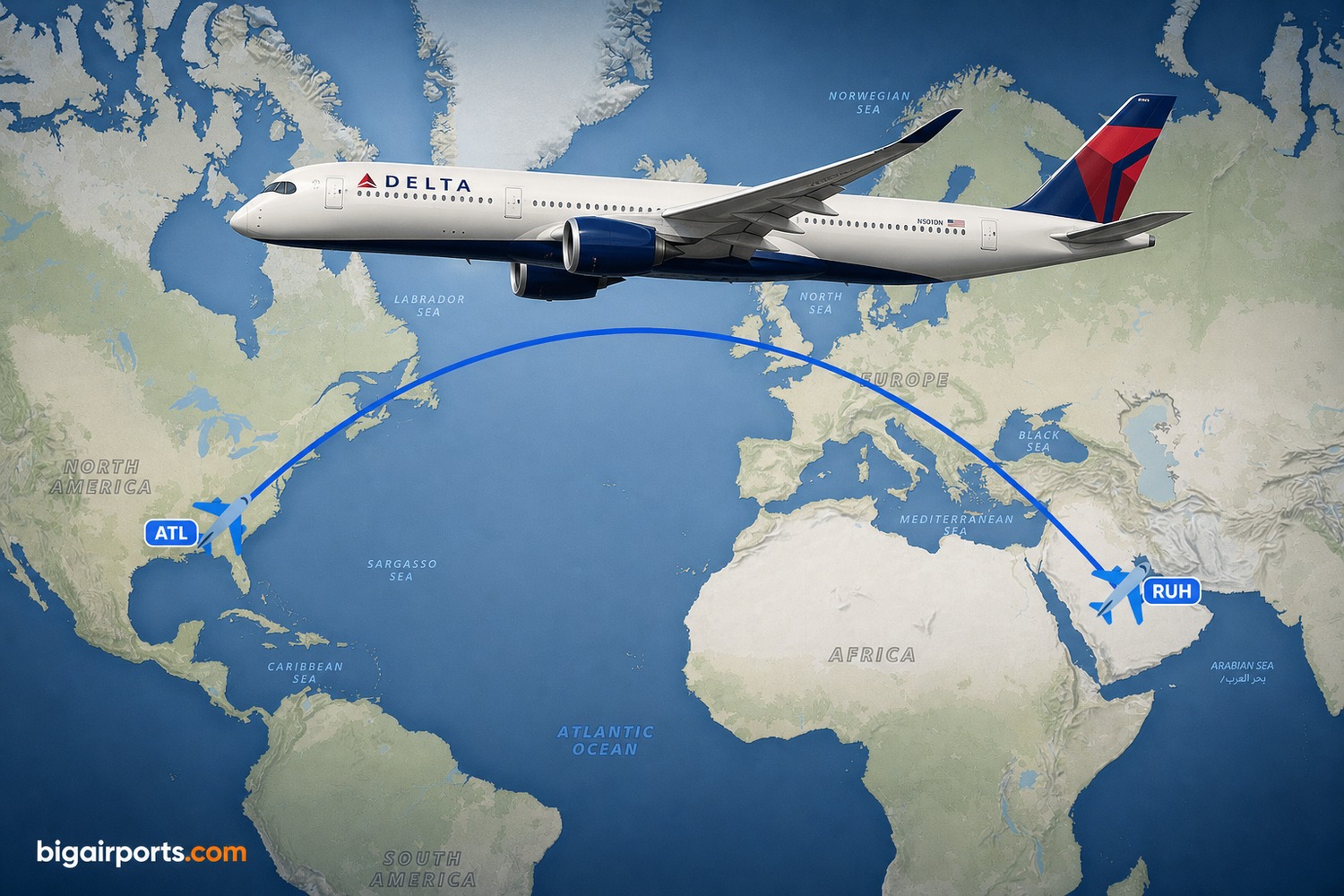
Delta Air Lines will begin nonstop flights between Atlanta and Riyadh on 23 October 2026, the carrier’s first scheduled service to Saudi Arabia and, according to the airline, the first nonstop link between the United States and the Saudi capital. The route opens daily for its first week before settling into a three-times-weekly pattern flown by the Airbus A350-900.
- Airline
- Delta Air Lines
- Route
- Atlanta (ATL) to Riyadh (RUH)
- Aircraft
- Airbus A350-900
- First flight
- 23 October 2026
- Frequency
- Daily to 30 October, then 3x weekly (Tue, Thu, Sat)
Route overview
The launch pattern is front-loaded. Delta will fly the sector daily from 23 to 30 October, concentrating capacity around the inaugural period, before moving to Tuesday, Thursday and Saturday rotations for the remainder of the winter season. Three weekly frequencies is a conservative base for a market the airline has not previously served, and a common template for US carriers testing new long-haul geographies. The winter pattern gives Delta a full season of booking data before any decision on summer capacity.
The great-circle distance between the two airports is roughly 11,700 kilometres, which will place the service among the longest sectors in Delta’s network, in the same bracket as its Atlanta services to Johannesburg and Seoul. At three weekly A350-900 rotations, the schedule offers 918 seats per direction per week once the daily launch period ends.
Delta’s network context
The route is Delta’s return to the Middle East after a ten-year absence. The carrier withdrew its Atlanta to Dubai service in February 2016, citing weak yields and subsidised Gulf competition, and has since relied on partners to cover the region. Riyadh reverses that position with Delta metal, and it does so at the airline’s largest hub rather than at a coastal gateway such as New York or Boston. Atlanta gives the route the deepest possible domestic feed base of any point in the Delta system.
The commercial logic rests on the strategic partnership with Riyadh Air that Delta announced in 2025. The two carriers have outlined plans for codesharing, interline connectivity and reciprocal loyalty benefits, which would give Delta access to onward Saudi and regional connections over Riyadh once those agreements are implemented. For Riyadh Air, still building out its own network after launching commercial operations in late 2025, the arrangement brings US feed it cannot yet generate itself. The new service was announced alongside five other new Delta international routes, and bookings opened immediately, supported by an introductory SkyMiles fare promotion.
About the aircraft
Delta will operate the route with the Airbus A350-900, the flagship of its long-haul fleet. In the airline’s standard long-haul configuration the type seats 306 passengers in four cabins: 32 Delta One suites, 48 Premium Select seats, 36 Comfort+ seats and 190 in the Main Cabin. That is a substantially more premium-weighted cabin than the widebodies Delta previously deployed to the Gulf, where its Dubai operation relied on the Boeing 777.
The A350-900 is powered by Rolls-Royce Trent XWB engines and holds the range for the Riyadh sector with margin, which matters on a routing that can face long stretches of headwind on the westbound leg. The premium-heavy layout is consistent with the traffic Delta will be targeting: corporate, government and energy-sector demand tied to US-Saudi commercial activity, rather than price-led leisure flows.
About the airports
Hartsfield-Jackson Atlanta International Airport anchors the route at the US end. The airport currently offers 274 nonstop routes, according to bigairports.com network data, and is the world’s busiest airport by passenger traffic as well as Delta’s largest hub. Its schedule is dominated by dense domestic trunks such as New York LaGuardia, Washington National and Dallas-Fort Worth, while Amsterdam is its heaviest long-haul market, a legacy of the Delta and KLM joint venture. That domestic density is the point: Riyadh-bound passengers can connect from across the eastern United States over a single hub, with dozens of same-day connections feeding each departure.
At the other end, King Khalid International Airport serves 134 nonstop routes. Its network is built on a Saudi domestic backbone, with Jeddah, Dammam, Abha and Medina among the densest markets, while Dubai is its busiest international route. Long-haul flying remains comparatively thin, with London Heathrow one of only a handful of long-haul markets, which is precisely the gap Saudi planners want filled. The airport is the designated home base of Riyadh Air and the interim centrepiece of the kingdom’s Vision 2030 aviation programme, ahead of the planned King Salman International Airport.
Market context
No airline currently operates nonstop between Atlanta and Riyadh, so Delta will have the origin-and-destination market to itself at launch. The nearest competition is one-stop: Qatar Airways carries Atlanta traffic over Doha, and the transatlantic joint-venture carriers route passengers over Amsterdam, Paris and London. Saudia, the Saudi flag carrier, serves New York, Washington and Los Angeles but does not fly to Atlanta, leaving the southeastern United States unserved by nonstop Saudi capacity.
Demand on the corridor is being shaped by Vision 2030 investment programmes, which have expanded US corporate, financial and construction activity in Riyadh, alongside government and defence traffic between the two capitals’ wider orbits. The partnership dimension matters here too: feed from Riyadh Air’s growing network would improve the economics of a three-times-weekly operation that cannot rely on local traffic alone.
For the Saudi side, a US-carrier nonstop into King Khalid supports Riyadh’s push to grow long-haul connectivity at the capital, which has historically trailed Jeddah as the kingdom’s international gateway. The first eastbound departure is scheduled for 23 October 2026, with the reduced winter pattern in place from the start of November, and tickets are on sale now across Delta’s distribution channels.
Sources & references (4)
Generated with editorial oversight from AI research.