Condor Launches Daily Frankfurt-Cairo Embraer E190 Service
The German leisure carrier began daily Frankfurt to Cairo flights on 26 June 2026, putting a 100-seat Embraer E190 on a four-hour intercontinental sector and adding a third operator to the city pair.
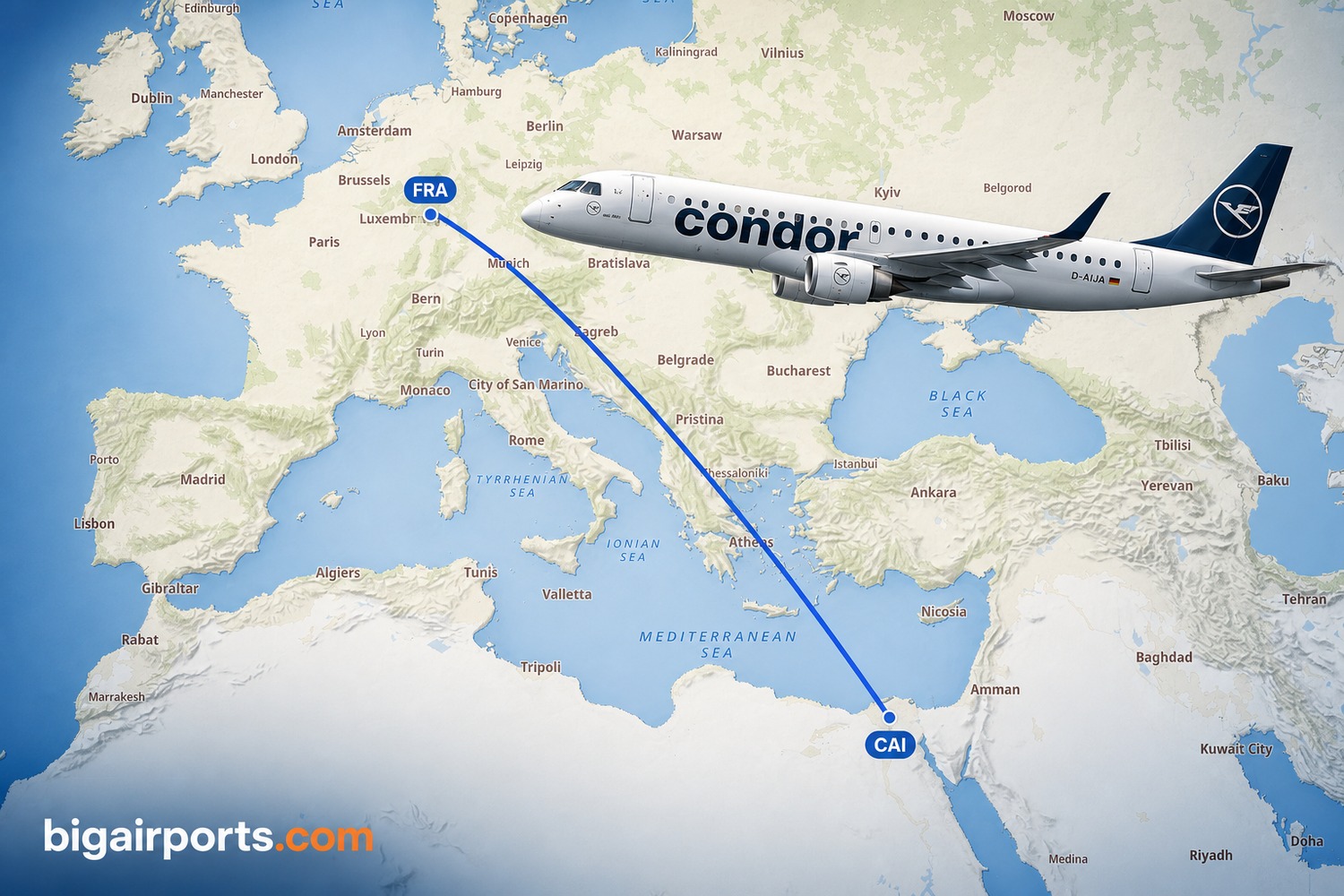
Condor has launched daily scheduled services between Frankfurt Airport and Cairo International Airport, with the first flight operating on 26 June 2026. The German leisure carrier has deployed an Embraer E190 on the roughly 2,900-kilometre sector, giving it a first scheduled presence in the Egyptian capital and adding a year-round city destination to a network traditionally weighted towards holiday markets.
- Airline
- Condor (DE)
- Route
- Frankfurt (FRA) to Cairo (CAI)
- Aircraft
- Embraer E190
- Frequency
- Daily
- First flight
- 26 June 2026
Route overview
The service operates once daily in each direction, with a block time of around four hours southbound, which is long by the standards of the E190, and the pairing is notable as a Europe to Africa intercontinental sector flown with a regional jet of roughly 100 seats. Condor marked the inaugural departure from Frankfurt on 26 June and presented the route as part of a wider expansion of its international scheduled network beyond the carrier’s core beach portfolio.
Plans for the connection had surfaced earlier in 2026, when the airline announced daily scheduled Frankfurt to Cairo flights for the summer season. The route is sold as a year-round scheduled service rather than a seasonal charter programme, a distinction that matters in a market where German traffic to Egypt has historically been dominated by leisure charters to the Red Sea coast. Trade coverage of the launch has singled out the pairing as one of the longest scheduled deployments of the E190 from Germany, with the type spending some four hours airborne on each rotation.
Condor’s network context
Condor, based at Frankfurt, has spent recent years converting itself from a charter operator into a scheduled leisure airline, renewing its long-haul fleet with the Airbus A330neo and building a broader mix of city and holiday destinations from its Frankfurt base. Cairo extends an Egypt operation that has long centred on the Red Sea resorts, which Condor serves from several German airports and where its traffic is overwhelmingly package-holiday driven. The new service, by contrast, is anchored solely at the carrier’s Frankfurt home base.
The Egyptian capital is a different kind of market. Alongside tourism anchored by Giza and the country’s museum and Nile itineraries, Cairo generates visiting-friends-and-relatives and business demand in both directions, supported by a large Egyptian community in Germany. For Condor, the route therefore diversifies the profile of its Egypt flying rather than simply adding another leisure destination, and it does so on a sector where demand is spread across the full year rather than concentrated in the winter sun season.
The aircraft: Embraer E190
The Embraer E190 is a twin-engine regional jet typically configured with around 100 seats, powered by General Electric CF34-10E engines and offering a maximum range in the region of 4,500 kilometres. Frankfurt to Cairo, at roughly 2,900 kilometres, sits comfortably within the type’s capability but towards the upper end of how E-Jets are normally scheduled in Europe, where sectors of one to two hours are the norm.
The economics of the choice are straightforward. At daily frequency, a 100-seat aircraft offers around 700 seats per week in each direction, roughly half of what a standard narrowbody would commit to the market. That allows the carrier to establish a daily schedule, which matters for point-of-sale credibility on a city route, while keeping the seat inventory it must fill to a minimum during the route’s establishment phase.
The airports at each end
At the western end, Frankfurt Airport is Germany’s largest hub, with 295 routes in current bigairports.com network data. Its densest links are intra-European: Amsterdam leads with 1,489 tracked flights across six operators, ahead of Madrid on 640 and Palma de Mallorca on 602. The airport’s reach extends across all haul lengths, from long-haul markets such as Shanghai Pudong, served by six operators, to medium-haul leisure and city links including Tenerife South and Tel Aviv, alongside dense domestic connections to Berlin, Hamburg and Munich.
Cairo International Airport, the destination, shows 131 routes in the same dataset, and its network profile skews firmly towards the Middle East. Jeddah is the single densest link, with 698 tracked flights across nine operators, while Dammam is served by ten operators, the highest operator count among the airport’s densest links, and Riyadh, Kuwait City and Medina all feature among the airport’s top markets. Regional links to Amman and Beirut add further short-haul depth. Domestic trunk routes to Luxor, Aswan, Hurghada and Sharm El Sheikh round out the picture. Measured by route count, Cairo’s network is less than half the size of Frankfurt’s, and its direct European links are comparatively thin: Madrid shows 141 tracked flights, Istanbul 116 and Barcelona 80. Against that backdrop, a new daily German service is a material addition to the airport’s European connectivity.
Market context and competition
Frankfurt to Cairo is an established origin-and-destination market already served by network carriers, with Lufthansa operating from its Frankfurt hub and EgyptAir flying the pair from the Cairo side. Condor’s arrival adds a third scheduled operator with a leisure-carrier cost base and a distribution footprint built on the German package-holiday and seat-only markets.
The competitive dynamics differ from Condor’s usual Egypt flying. On the Red Sea routes, the carrier competes chiefly with other leisure operators; on Cairo, it faces two full-service airlines carrying connecting traffic over their respective hubs, while Condor’s E190 operation is aimed squarely at point-to-point demand. The capacity gap between a 100-seat regional jet and the competitors’ larger equipment also means Condor’s entry expands the market’s seat count only modestly, limiting the risk of oversupply on the pair.
The airline has not announced further Cairo frequencies or additional Egyptian city destinations. For now, the daily E190 rotation stands as a measured commitment: a new intercontinental city pair for the carrier, flown with the smallest aircraft in its scheduled operation, on a market where year-round demand is already proven by the incumbents’ schedules.
Sources & references (5)
Generated with editorial oversight from AI research.