Air China Launches Beijing–Zagreb A330 Route from 4 September 2026
Air China begins three-times-weekly Airbus A330-200 flights between Beijing Capital and Zagreb on 4 September 2026, giving Croatia its only scheduled air link with China and Zagreb its longest route.
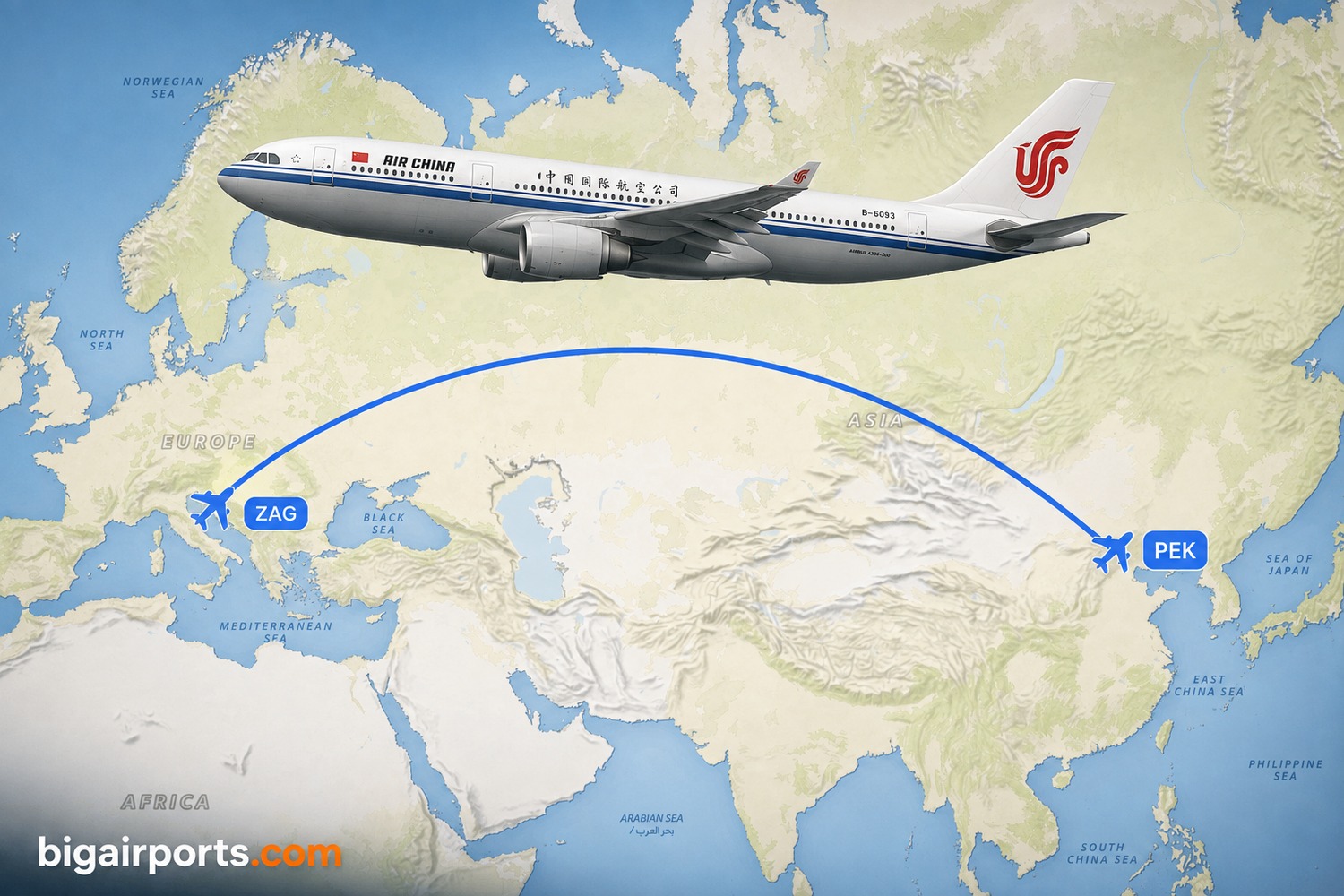
Air China will begin a three-times-weekly service between Beijing Capital International Airport and Zagreb Franjo Tuđman International Airport on 4 September 2026, deploying the Airbus A330-200 on the route. The launch gives Croatia its only scheduled air link with China and introduces regular widebody flying to a Zagreb timetable otherwise built almost entirely on short-haul European services.
- Airline
- Air China (CA)
- Route
- Beijing Capital (PEK) to Zagreb (ZAG)
- Aircraft
- Airbus A330-200
- Frequency
- Three times weekly
- First flight
- 4 September 2026
Route overview
The service links the Chinese and Croatian capitals over a great-circle distance of roughly 7,700 kilometres, comfortably within the A330-200’s range but far beyond anything in Zagreb’s current timetable. According to bigairports.com network data, the longest sectors flown from the Croatian airport today are medium-haul services to Madrid and Málaga; every other route in its 75-strong network is short-haul. Beijing to Zagreb therefore becomes the airport’s longest route by a clear margin and its first scheduled service to East Asia.
Regional trade coverage, including EX-YU Aviation News and Croatia Week, describes the operation as the first scheduled connection between China and Croatia. At three rotations per week, the schedule is sized conservatively, in line with the pattern Chinese carriers have followed when opening secondary European capitals with widebody equipment.
For Beijing Capital, by contrast, Zagreb is a modest addition to a network already spanning 229 routes. The imbalance is typical of long-haul launches into smaller European capitals, where the bulk of demand originates at the hub end of the route.
Air China’s network context
Air China is the flag carrier of China and a founding member of Star Alliance, with its principal international hub at Beijing Capital. Its European portfolio has long been anchored by trunk routes to points such as Frankfurt, Paris Charles de Gaulle, London and Madrid, complemented by Central and South-East European destinations including Budapest and Athens. Zagreb extends that second group and continues a wider trend of Chinese carriers adding thinner European capitals at low frequency with A330-class aircraft.
The route also reinforces the carrier’s position at its home base. Air China concentrates its long-haul international operation at Beijing Capital, while a substantial share of the city’s domestic and low-cost capacity has shifted to Beijing Daxing since that airport opened in 2019.
Zagreb is additionally the home base of Croatia Airlines, a fellow Star Alliance member that has been standardising its fleet on the Airbus A220. Its regional network across Croatia and the wider Adriatic gives the new service natural interline potential where through-ticketing arrangements apply.
The aircraft: Airbus A330-200
The Airbus A330-200 is the shorter-fuselage, longer-range member of the A330ceo family, with a maximum range of around 13,450 kilometres. That leaves a generous performance margin on the 7,700-kilometre sector, including winter rotations flown against strong westbound headwinds. Air China’s examples are powered by Rolls-Royce Trent 700 engines.
The carrier operates the type in two-class configurations seating up to 283 passengers, with 30 in business class and 253 in economy in the densest layout. On that basis, the three-weekly rotation would place roughly 850 one-way seats per week into the market, a cautious volume for a route with no direct competition. The type’s lower-deck hold also offers meaningful cargo capacity, a relevant consideration on a country pair previously served only via transfer hubs.
The choice of equipment follows Air China’s practice on other secondary European points, where the smaller widebody matches thinner long-haul demand better than the carrier’s Boeing 777s and 787s.
The airports: Beijing Capital and Zagreb
Beijing Capital is one of the world’s largest hubs, with 229 routes tracked in bigairports.com data. The densest markets illustrate the scale of the operation: Hong Kong alone accounts for 963 tracked flights across four operators, while domestic trunk routes to Hangzhou, Shanghai Pudong, Dalian and Shenzhen each register in the hundreds. For Zagreb-originating passengers, that breadth is the practical value of the new service: one-stop access to mainland China and, through Air China’s hub, much of Asia.
Zagreb Franjo Tuđman, located in Velika Gorica just south of the Croatian capital, is the country’s principal international gateway. bigairports.com counts 75 routes, with the network centred on Western European hubs. Amsterdam is the busiest market with 790 tracked flights, ahead of Frankfurt, with 139 flights across three operators, and Munich. Domestic services to Dubrovnik and Split link the capital with the Adriatic coast, while Madrid and Málaga are the only medium-haul entries in the schedule. Nothing currently on the books approaches the length of the Beijing sector.
Market context and competition
No other carrier operates scheduled services between Croatia and China, so Air China enters the origin-and-destination market without direct competition. Traffic between the two countries currently moves over one-stop connections, with Istanbul, Frankfurt, Munich and Vienna the principal transfer points; all four are served from Zagreb today. Turkish Airlines’ Istanbul hub in particular offers broad coverage of Chinese destinations, making it the strongest competitor on connecting itineraries.
Croatia joined the European Union in 2013 and entered both the Schengen Area and the eurozone in January 2023. For passengers arriving from Beijing, that means onward travel across most of the EU without further border checks, a detail that widens the route’s effective catchment beyond Croatia itself.
Launch reporting cites growing Chinese tourism to Croatia as the principal demand driver, with Zagreb acting as the entry point for itineraries continuing to the Adriatic coast. Point-of-sale demand from Croatia towards China is thinner, which is consistent with the conservative three-weekly frequency at launch. The first flight is scheduled for 4 September 2026, and the route will appear in bigairports.com live network data for both airports once operations begin.
Sources & references (5)
Generated with editorial oversight from AI research.