Air China Launches Three-Weekly Beijing to Bucharest A330 Service
The Star Alliance carrier began Airbus A330-200 flights between Beijing Capital and Bucharest Otopeni on 4 September 2026, establishing the only nonstop passenger link between mainland China and Romania.
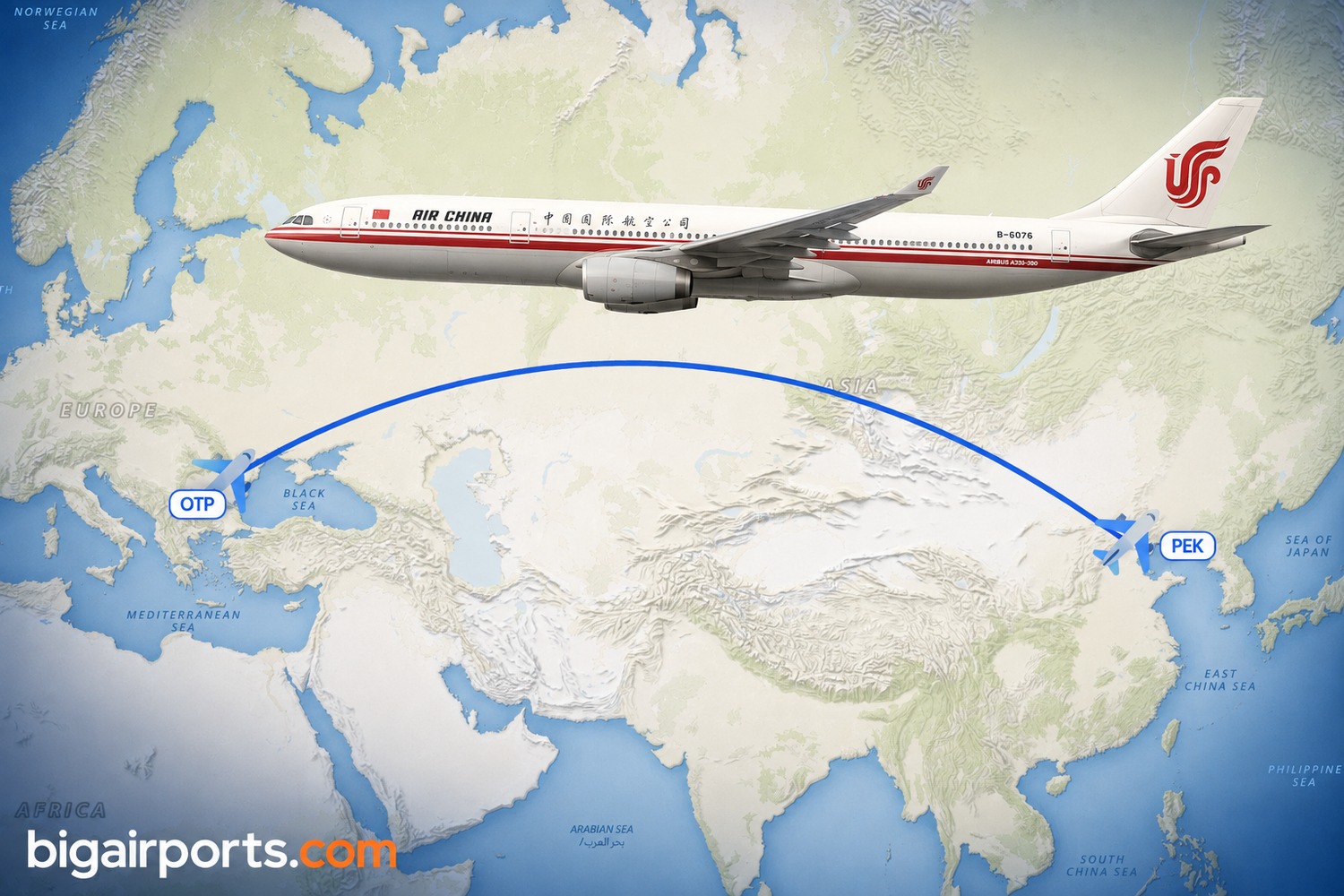
Air China has launched scheduled passenger services between Beijing Capital International Airport and Bucharest Henri Coandă International Airport, with the inaugural flight operating on 4 September 2026. The Star Alliance carrier is flying the sector three times weekly with Airbus A330-200 equipment, establishing the only nonstop passenger link between mainland China and Romania.
- Airline
- Air China
- Route
- Beijing Capital (PEK) to Bucharest Otopeni (OTP)
- Aircraft
- Airbus A330-200
- Frequency
- Three weekly
- First flight
- 4 September 2026
Route overview
The nonstop sector covers a great-circle distance of roughly 7,100 kilometres, putting scheduled block times in the region of ten hours on the westbound leg and somewhat less on the return with prevailing winds. Air China’s two-class A330-200s typically seat 237 passengers, with 30 in business class and 207 in economy, giving the route roughly 711 seats per week in each direction at the launch frequency.
Bucharest is not the aircraft’s final stop. Launch coverage confirms the operation as a linked Beijing to Zagreb via Bucharest routing, with the widebody continuing to the Croatian capital after its Otopeni call. For the Romanian market the schedule nonetheless functions as a straightforward nonstop to Beijing, and it is the only scheduled passenger service between Romania and mainland China currently on sale.
At three rotations per week the schedule sits below the daily frequency that corporate traffic tends to demand, but it is a conventional entry point for a new long-haul market: Chinese carriers have generally opened secondary European destinations at two or three weekly frequencies and adjusted capacity as demand has firmed.
Air China’s network context
Air China, a member of Star Alliance since 2007, operates its principal hub at Beijing Capital and maintains one of the largest European networks of any Chinese carrier, with established services to points including Frankfurt, Munich, Paris, London, Madrid, Barcelona, Rome, Milan, Geneva, Zurich, Vienna, Warsaw, Budapest and Athens. Bucharest extends that portfolio deeper into central and eastern Europe, a region where Chinese airlines have steadily rebuilt and expanded capacity since long-haul flying resumed at scale in 2023.
The carrier has remained concentrated at Beijing Capital rather than the newer Beijing Daxing, keeping its domestic feed and long-haul bank at the same airport. That matters for a route of this type: a three-weekly service to a secondary European capital depends less on point-to-point demand than on connectivity at both ends, and the Beijing hub supplies onward links across China and north-east Asia behind the nonstop. The Zagreb continuation also gives the carrier two south-east European points from a single aircraft rotation, spreading the cost of the operation across two markets rather than one.
About the aircraft
The Airbus A330-200 is a long-range twin-engine widebody that entered service in 1998. Air China’s examples are powered by Rolls-Royce Trent 700 engines and, in the carrier’s standard two-class layout, seat 237 passengers. With a maximum range of around 13,400 kilometres, the type covers the Beijing to Bucharest sector with ample reserves, and the onward continuation to Zagreb sits comfortably within its capability.
The -200 has become Air China’s tool for long, thin sectors: it offers full long-haul range with fewer seats to fill than a Boeing 777 or Airbus A350, which suits markets that cannot yet support a daily widebody. Its belly holds also add scheduled cargo capacity on a country pair otherwise served only over third-country hubs.
About the airports
Beijing Capital (PEK)
Beijing Capital is Air China’s home base and one of the busiest airports in Asia, with 231 routes tracked in current bigairports.com network data. Its densest link is Hong Kong, with 978 tracked flights shared between four operators, followed by high-frequency trunk routes to Hangzhou, Shanghai (both Hongqiao and Pudong), Shenzhen and Dalian. Trunk domestic routes such as Chongqing and Urumqi each carry five competing operators, and the profile overall is heavily domestic and regional. That breadth underlines the depth of connecting feed available behind Air China’s long-haul departures, which is the commercial logic of routing a service such as Bucharest over the carrier’s main hub.
Bucharest Henri Coandă (OTP)
Bucharest Henri Coandă, in Otopeni just north of the capital, is Romania’s principal international gateway, with 146 routes in current tracking. Its busiest link is Amsterdam, at 1,293 tracked flights across four operators, ahead of Madrid, Barcelona and Paris. Tel Aviv stands out with eight operators on the route, while London is served from both Stansted and Luton. Domestic services to Timişoara, Cluj-Napoca, Oradea and Iaşi, plus the short hop to Chişinău, give the airport a national feed role of its own. The network is overwhelmingly short and medium haul, which makes a scheduled widebody service to east Asia a structural addition rather than an incremental one.
Market context
There is no nonstop competition on the Beijing to Bucharest city pair. Traffic between Romania and China has to date moved over intermediate hubs, and the strongest of those connecting paths are all well represented at Otopeni: Istanbul with three operators, Vienna and Munich with four each, Paris with five and Amsterdam with four. Turkish Airlines, Austrian Airlines, Lufthansa, Air France and KLM will continue to carry one-stop traffic between Bucharest and a broader range of Chinese cities than a three-weekly nonstop can address.
Air China’s advantage is journey time on the core Beijing traffic and one-stop access over its hub to the Chinese domestic network. In the opposite direction, Otopeni’s domestic spokes to Timişoara, Cluj-Napoca, Iaşi and Oradea offer feed from the Romanian regions, subject to schedule alignment. As of the 4 September 2026 launch, Air China holds the only nonstop product in the market.
Sources & references (4)
Generated with editorial oversight from AI research.