British Airways Returns to Melbourne from London Heathrow in 2027
British Airways will fly daily from Heathrow to Melbourne via Kuala Lumpur from 9 January 2027, its first Melbourne service since 2006 and its second Australian destination alongside Sydney.
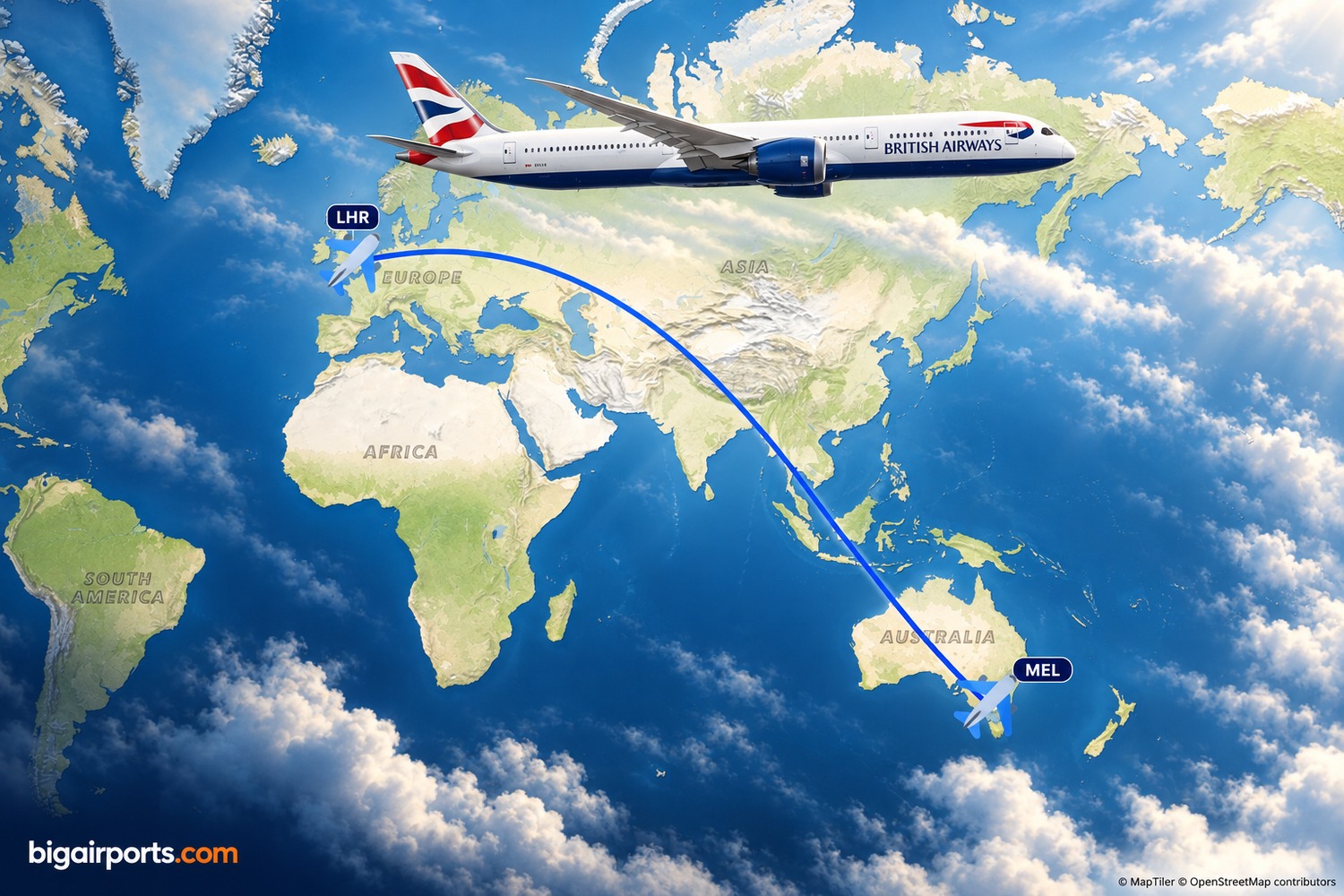
British Airways will return to Melbourne on 9 January 2027, launching a daily service from London Heathrow via Kuala Lumpur. The route restores a city the carrier last served in 2006, when its Australian network still ran through Singapore. Heathrow lists the service among its new winter 2026/27 long-haul launches, operating from Terminal 5.
- Airline
- British Airways
- Route
- London Heathrow to Melbourne via Kuala Lumpur
- Aircraft
- Boeing 787-9 (per published schedules)
- Frequency
- Daily
- First flight
- 9 Jan 2027
Route overview
The service carries flight numbers BA33 outbound and BA34 inbound. According to the published January 2027 schedule, BA33 departs Heathrow at 21:10, arrives in Kuala Lumpur at 18:05 the next day, departs again at 19:45 and reaches Melbourne at 06:40 on the second morning. The return BA34 leaves Melbourne at 16:35, stops in Kuala Lumpur between 21:35 and 23:15, and lands at Heathrow at 05:20 the following day.
The Melbourne to London block time is scheduled at 23 hours 45 minutes, a figure shaped by headwinds and by routings that avoid Iranian and Russian airspace. That makes it British Airways’ second-longest service, behind Sydney to Heathrow at up to 24 hours 25 minutes. Both sectors operate under a single flight number, giving passengers a same-plane connection rather than an interline change. Simple Flying reports that the carrier holds fifth-freedom rights on the Kuala Lumpur to Melbourne sector. The airline has published return fares from £1,110 including taxes, fees and carrier charges, across World Traveller, World Traveller Plus, Club World and First.
Airline network context
Melbourne becomes the airline’s second Australian destination, alongside the long-standing daily Sydney service via Singapore. These two cities are the carrier’s only points in Oceania. The 05:20 Heathrow arrival sits close to the 05:45 arrival of the Sydney flight, placing both Australian services into the same early-morning connecting bank at Terminal 5.
The launch is timed to coincide with the Australian Open and the Melbourne Grand Prix, both staged in the city in the first quarter. It forms part of a broader winter programme: a Colombo service, up to five weekly flights to San José in Costa Rica from 25 October on the Boeing 787-8, twice-weekly Fuerteventura from 13 December, and the St Louis route that began in April with four weekly 787-8 rotations. The carrier has also stated increased capacity to Cape Town, Tokyo, Bridgetown, Kingston and San José for the season.
About the aircraft
British Airways has not named an aircraft type in its own announcement. Schedule data analysed by Simple Flying shows the route filed for the Boeing 787-9, which the carrier operates in two configurations of 215 and 216 seats.
The 215-seat layout carries the newer product: 8 First seats in a 1-2-1 arrangement, 38 Club Suites at 1-2-1, 39 World Traveller Plus seats at 2-3-2 with 38-inch pitch, and 130 World Traveller seats at 3-3-3 with 31-inch pitch. First and business together account for just over 21 per cent of capacity, down from 23 per cent on the 216-seat version, which retains the older business cabin. Between the launch and the end of July 2027 the newer configuration is scheduled on 115 of 204 departures.
About the airports
London Heathrow serves 221 routes in bigairports.com data and ranks as Europe’s busiest airport for international departures, ahead of Paris Charles de Gaulle, Frankfurt and Istanbul, according to Cirium. Heathrow describes itself as the world’s busiest two-runway airport. Its densest corridors are short and medium haul: Madrid logs 5,493 flights in the dataset, Barcelona 5,037 and Amsterdam 4,948. On long haul, Dubai records 773 flights across four operators, and New York JFK draws five operators, the widest competitive field on any single Heathrow route in the sample. Melbourne will join a long-haul portfolio that already spans the Gulf, North America and Asia.
Melbourne Airport handles 72 routes. Its network is dominated by domestic trunk flying: Sydney accounts for 611 flights across seven operators, Brisbane 379 flights across six, and Adelaide 170 across four. The airport’s principal long-haul links run to Hong Kong, with 556 flights across four operators, and Singapore, served by five operators. Denpasar draws six carriers. Europe does not appear among Melbourne’s top routes, reflecting a market that has long been served almost entirely through Asian and Gulf intermediate hubs rather than by European carriers operating their own aircraft into Victoria.
Market context and competition
Demand on the corridor is substantial. Roughly 1.3 million round-trip passengers travelled between Europe and Melbourne in the 12 months to June 2026, more than 3,500 per day before seasonality. Heathrow was the largest single airport market, with about 264,000 passengers, or over 700 a day. Nearly all of them connected, with Dubai, Doha, Abu Dhabi and Singapore the dominant transfer points. Ten airports, including Bangkok, Guangzhou, Hong Kong, Istanbul, Kuala Lumpur and Shanghai Pudong, handled 90 per cent of sixth-freedom traffic.
British Airways enters as the only European carrier offering a single-flight-number itinerary from London. The one-stop competition is nonetheless faster on paper. January 2027 journey times from Melbourne to London stand at 23 hours via Colombo on SriLankan, 23 hours 5 minutes via Dubai on Emirates, 23 hours 10 minutes via Changi on Singapore Airlines, 23 hours 20 minutes via Abu Dhabi on Etihad and 23 hours 35 minutes via Doha on Qatar Airways.
Same-aircraft one-stop products are also multiplying. Turkish Airlines has operated Istanbul to Melbourne via Singapore since 2024, Finnair begins a daily Helsinki to Melbourne service via Bangkok on 25 October, and oneworld partner Qantas reintroduces Perth to London via Singapore on 1 February 2027, while its nonstop Heathrow to Perth flight continues with same-plane onward travel to Melbourne in the westbound direction from late October. Against that field, British Airways is relying on Terminal 5 connectivity, a four-cabin product and its own point-of-sale strength in the UK to recapture a share of a market it left two decades ago.
Sources & references (5)
Generated with editorial oversight from AI research.